Why Does Home EV Charging Speed Vary?
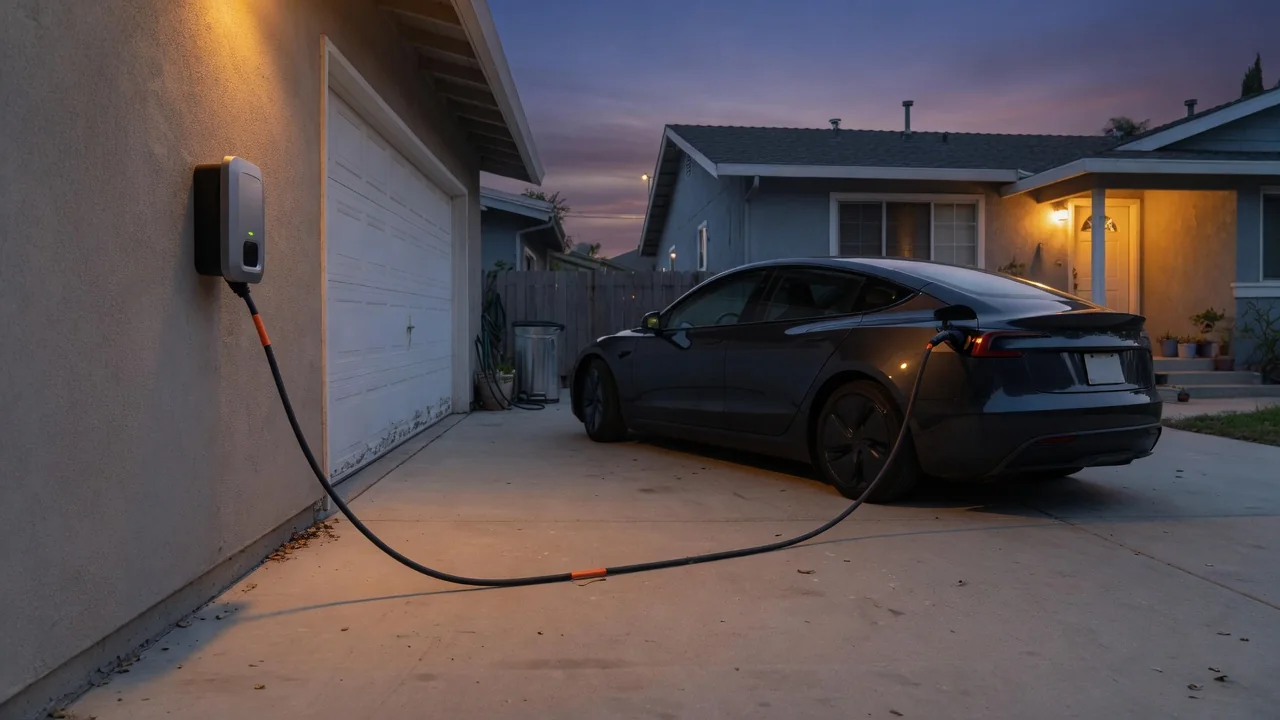
Plug the same electric car into the same wall on two different nights and the hours to full can differ noticeably. Anyone asking why does home EV charging speed vary is really asking about three limits working together: the circuit feeding the charging equipment, the hardware inside the car, and the battery's temperature and state of charge. The slowest of those sets the pace.
Electrical supply
Home charging starts with alternating current from the panel, and power is simply voltage multiplied by current. A standard 120-volt household outlet, often called Level 1, delivers a small fraction of what a dedicated 240-volt Level 2 circuit can supply, so the same car may gain only a few miles of range per hour on one and many times that on the other. The breaker rating matters too, because charging is a continuous load and equipment is set to draw less than the circuit's full rating.
Supply conditions also shift from day to day. Voltage at the outlet can sag when a long wiring run, an air conditioner, or a clothes dryer loads the same service, and lower voltage means fewer kilowatts at the same amperage. Some wall units share a circuit or use load management that trims current when the house is busy. Drivers may see this as a lower kilowatt figure on the charger display or app during the evening than they see late at night.
Onboard charger
The box on the wall is not actually the charger. It is supply equipment that tells the car how much current is available and then closes a relay. The real conversion from AC to the DC the battery stores happens in the onboard charger, a power electronics module inside the vehicle. That module has its own maximum rate, so a car with a modest onboard charger will not charge faster just because it is connected to a higher-amperage wall unit.
Onboard charger capacity differs by make, model, trim, and sometimes model year, and plug-in hybrids often carry smaller units than long-range battery electric cars. The owner's manual or vehicle specification sheet is the place to confirm the figure for a particular car. A useful observation is the charging screen: if the displayed power sits flat at the same value regardless of which Level 2 station is used, the onboard charger is likely the limiting factor rather than the home wiring.
Battery needs
The battery management system has the final say over how much current the pack accepts. Lithium-ion cells take charge poorly when cold, so on a winter night the car may limit power or divert part of the incoming energy to a battery heater before meaningful charging begins. In very hot weather the system may run cooling pumps or a compressor and trim the rate to protect the cells. Either way, less of the power drawn from the wall ends up as stored range.
State of charge shapes the session as well. Many cars hold steady power through the middle of the pack and then taper as the cells approach full, because the final portion requires gentler current and cell balancing. Topping from a high starting level to one hundred percent can therefore feel slow compared with filling from a low level to a daily limit. How early the taper starts and how pronounced it is depends on the battery chemistry and the manufacturer's calibration.
Everyday Use and Observations
In daily use these limits show up as small inconsistencies. The estimated finish time may run longer after a cold commute than after a mild one, and a car parked in an attached garage often charges more consistently than one left on an exposed driveway. Preconditioning the cabin while plugged in, or running seat heaters and defrost, takes a share of the incoming power. Scheduled charging can also make sessions look different when the start is delayed for off-peak electricity rates.
Displayed units can add confusion. Some vehicles report miles of range added per hour, which depends on recent driving efficiency, while others show kilowatts or amps. A week of highway driving in the cold can lower the miles-per-hour figure even though the electrical power is unchanged. Comparing kilowatts from one session to the next gives a clearer picture, and noting the outdoor temperature, starting charge level, and whether other large appliances were running helps explain most of the variation.
Limits and Next Steps
Some variation is normal and needs no action, but certain patterns deserve attention. A sudden, lasting drop in power at the same outlet, repeated session interruptions, a breaker that trips, or a plug, cord, or receptacle that feels hot or shows discoloration all point to a supply problem rather than ordinary battery behavior. Stop using that outlet and have a licensed electrician inspect the circuit. Household wiring faults are not something to diagnose by touch or trial and error.
If the car displays a charging warning or stores a fault code, treat it as a clue rather than a verdict; the message narrows the search, but it does not prove that a specific component has failed, and its meaning can differ between manufacturers. A dealer or qualified EV technician can read the vehicle data and confirm the cause. For anyone simply wanting faster charging, the sensible first step is comparing the car's onboard charger rating with what the home circuit can safely supply.