Why Does Corrosion Increase Electrical Resistance?
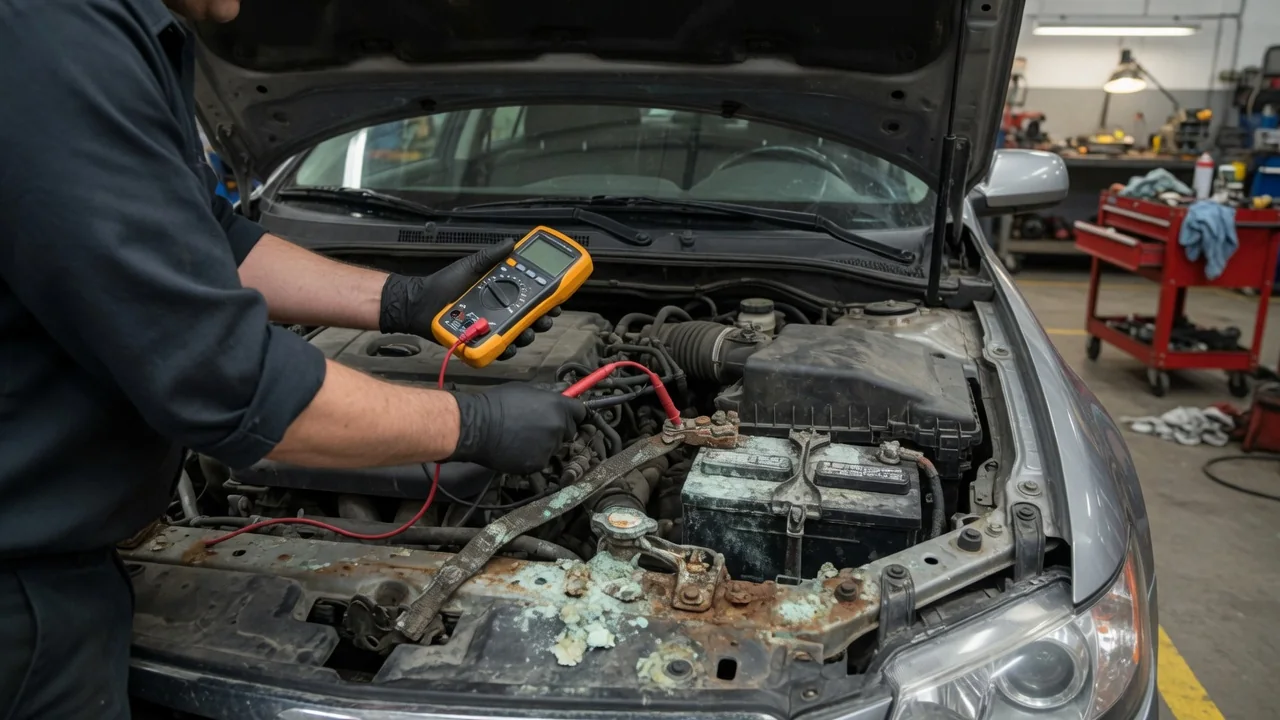
Corrosion increases electrical resistance in two ways. It replaces clean, conductive metal with compounds that carry current poorly, and it shrinks the area where two metal parts actually touch. In a car, battery cables, grounds, fuses, and connector pins all depend on metal-to-metal contact, so even a thin layer of corrosion can change how a circuit behaves. Knowing what happens at the contact surface, how heat develops, and what a sound repair involves helps explain many puzzling car electrical faults.
Contact Surface: Where Corrosion Blocks the Current Path
Two metal surfaces that look flat are rough at a microscopic level. When a terminal is clamped onto a battery post or a connector pin slides into its socket, current flows only through the small high points that truly touch, often called contact spots. The rest of the apparent contact area carries little or no current. A good connection relies on enough clamping force and clean metal to create many of these conductive spots. With enough of them, current can pass without being squeezed through narrow paths.
Corrosion attacks exactly this zone. Copper, brass, tin, aluminum, and steel react with oxygen, moisture, road salt, and battery acid vapors. These reactions form oxides, sulfates, chlorides, and similar compounds. These products conduct far less well than the base metal, and some behave almost like insulators. As they build up, they separate the surfaces, reduce the number of metal-to-metal spots, and force current through the few that remain. Resistance rises for two reasons: the film itself conducts poorly, and current crowds into smaller paths.
Moisture makes the process worse. Water with dissolved salts acts as an electrolyte. Where two different metals meet, galvanic corrosion can develop. Examples include a copper lug on a steel body ground or an aluminum part bolted to steel. Corrosion can also wick along stranded wire under the insulation. The individual strands turn dark or green, and the conductor's effective cross-section shrinks well away from the visible terminal. Vibration can also cause small movements between mating surfaces, known as fretting. Fretting repeatedly exposes fresh metal that then oxidizes, so debris gradually builds up at connector pins.
Heat: How Added Resistance Turns Into a Hot Spot
Any resistance in a circuit converts part of the electrical energy into heat. The heat produced at a connection rises with the square of the current multiplied by the resistance. That makes corrosion most dangerous in high-current paths, such as a starter cable, alternator output, cooling fan feed, or main ground. A corroded joint in one of these circuits can become warm or hot while the rest of the wire stays cool. Because the extra resistance is concentrated in a tiny area, the temperature at that point can climb faster than in the surrounding wiring.
Heat then feeds the original problem. Higher temperature speeds up oxidation of exposed metal. Repeated heating and cooling makes metals and plastics expand and contract, and that cycling can relax terminal spring tension, loosen bolted lugs, and soften or deform connector housings. A looser contact has fewer touching spots and lets more moisture in. Resistance rises further, and more heat is produced. Left unchecked, this loop can discolor insulation, melt a connector body, or burn a fuse box terminal.
In low-current circuits, such as sensor signal lines or switch inputs, the same corrosion may produce little detectable heat. There the main effect is an unwanted voltage drop or an unstable signal rather than a hot spot. This is why corrosion can cause either overheating faults or electronic glitches, depending on where it occurs.
Repair: Restoring Clean Metal Contact
An effective repair restores clean metal contact and the original clamping or spring force. It also protects the joint from the conditions that caused the corrosion. Before working on battery terminals or major connections, disconnect the battery in the order specified in the vehicle's service information. Follow any precautions for airbags and electronic module resets. High-voltage components on hybrid and electric vehicles should be left to properly trained technicians.
Light surface corrosion on battery posts, clamps, and ground lugs can often be removed with a terminal brush or a suitable abrasive. Battery acid residue can be neutralized with a baking soda and water solution, then rinsed and dried. Body ground contact surfaces should be cleaned to bright metal, and the fastener tightened to the specified torque. Small connector pins are more delicate. Aggressive scraping can remove protective plating and weaken spring tension, so a contact cleaner made for electrical connectors is generally a safer choice.
Cleaning is usually not enough if corrosion has reached inside the insulation, eaten into a crimp, or deformed a terminal. In those cases, replace the terminal, the affected wire section, or the connector pigtail with correct parts. A properly crimped and sealed joint restores the conductor's full cross-section. After the repair, check that connector seals are intact. Use protective coatings or dielectric grease only where the manufacturer allows them. Finally, correct the source of the moisture or acid, such as a leaking battery vent or a damaged seal.
Practical Implications and Limits
In everyday use, rising resistance usually shows up as reduced performance rather than a clean failure. Common symptoms include slow cranking, dim or flickering lights, a charging system that seems weak, fans or motors running slower than normal, and intermittent warning lights or sensor codes. Corrosion often worsens with humidity, temperature, or vibration, so the fault may come and go. That makes it easy to blame an expensive component when the real cause is a connection.
Measurement has limits too. A simple ohmmeter check passes only a small test current. A corroded joint may read acceptably at that current, yet drop significant voltage when real load current flows. A voltage drop test across the connection while the circuit is operating gives a more realistic picture. Acceptable drop values differ by circuit and manufacturer, so compare readings against the vehicle's service information rather than a universal number.
Finally, not every corrosion problem is visible from the outside. Wiring inside harness wraps, under seals, or beneath plastic covers can corrode with no external sign. Exposure also depends heavily on location, climate, road salt use, and how the vehicle is stored. The general mechanisms described here apply across vehicles, but connector design, materials, and approved repair methods vary. Model-specific procedures should come from the manufacturer's documentation.