Why Does Coolant Need Corrosion Inhibitors?
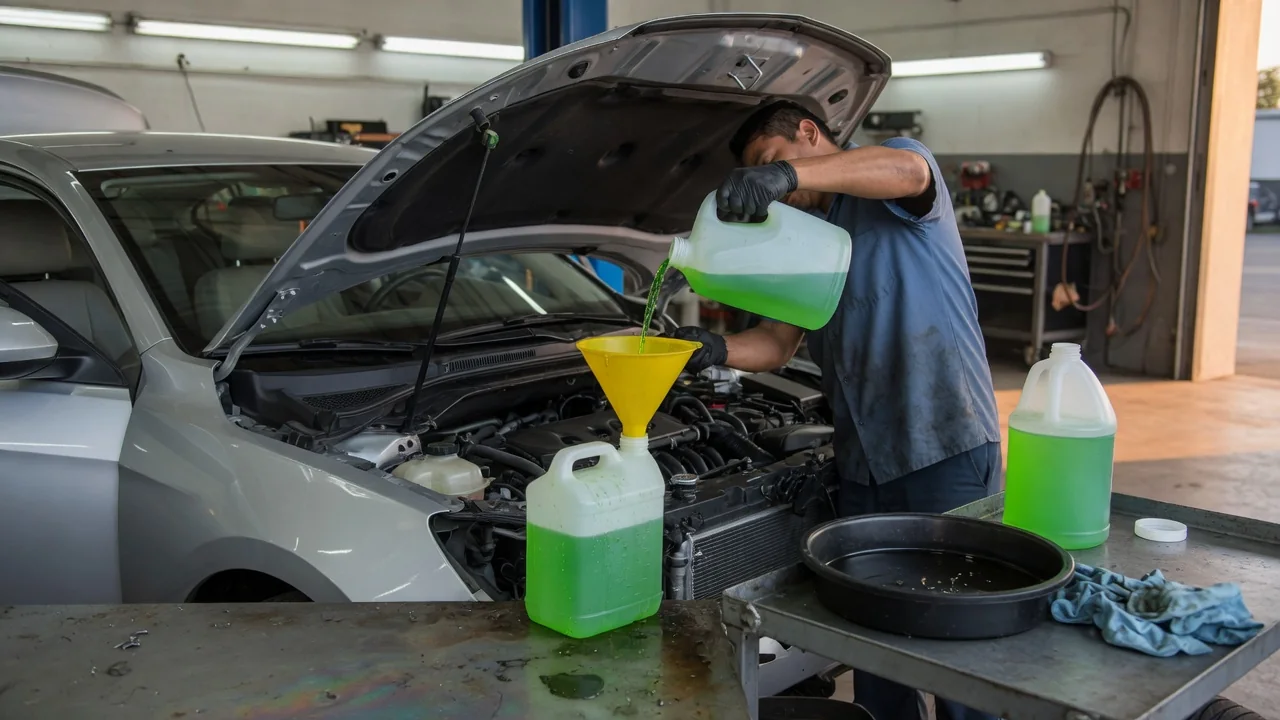
Engine coolant does more than resist freezing and boiling. The glycol and water mixture that carries heat away from the engine would, on its own, slowly attack the metals it touches. That is why coolant needs corrosion inhibitors: a package of additives that protects internal surfaces, keeps passages clear, and helps the cooling system last. Understanding how coolant corrosion inhibitors work explains why fluid type and service timing matter.
Mixed metals and why they corrode
A typical cooling system is not built from a single material. Depending on the design, the engine block may be cast iron or aluminum, the cylinder heads are often aluminum, and the radiator and heater core may be aluminum, copper, or brass. Steel appears in fittings and some pump components, and older systems may contain solder joints. Each of these metals reacts differently to hot water, dissolved oxygen, and the acidic byproducts that form as glycol ages under heat. Plain water alone would cause rust and scale within this mix, and glycol without additives does not prevent that.
Mixed metals add another problem: galvanic corrosion. When two dissimilar metals are connected and immersed in a conductive liquid, they behave like a weak battery. The more chemically active metal gives up material while the less active one is spared. Coolant is conductive enough to support this reaction, and aluminum is among the more active metals in the system, so unprotected aluminum surfaces can pit or thin over time. Because the radiator, heads, and water pump may all be made of different alloys, a cooling system offers many such pairings.
Corrosion inhibitors interrupt these reactions in several ways. Some form a thin protective layer on metal surfaces, others bond selectively to areas where corrosion is starting, and buffering agents keep the coolant from becoming acidic. Certain additives target specific metals, which is one reason formulations differ by system design. Inhibitors also help limit cavitation erosion, the pitting caused by collapsing vapor bubbles near water pump impellers and, in some heavy-duty diesel engines, on the outside of cylinder liners.
Service life of the inhibitor package
Corrosion inhibitors are not permanent. They are consumed as they build and repair protective films, neutralize acids, and react with contaminants. Heat cycling, exposure to air, and the gradual breakdown of glycol all draw on the additive reserve. The important point for owners is that the glycol's freeze and boil protection can remain adequate long after the inhibitors are depleted. A refractometer or hydrometer reading that shows good freeze protection says nothing about how much corrosion protection remains.
Once the inhibitor package is exhausted, the coolant can begin attacking the system it was meant to protect. Typical results include pitting on aluminum surfaces, rust and scale deposits, partially blocked radiator and heater core passages, and abrasive deposits that wear water pump seals. Restricted passages reduce heat transfer, which can lead to higher operating temperatures or weak heater output. Contamination speeds the process: combustion gases from a leaking head gasket, oil intrusion, or hard tap water added during top-offs can use up inhibitors faster or introduce minerals that form scale.
Different inhibitor chemistries are designed for different service lives. Traditional formulations based on inorganic inhibitors such as silicates and phosphates act quickly but deplete relatively fast, so they are typically associated with shorter replacement intervals. Organic acid formulations deplete more slowly and are generally designed for extended intervals. The actual interval for a given vehicle is set by its manufacturer, usually expressed in both time and mileage, and the owner's manual or maintenance schedule is the reliable reference.
Correct fluid for the cooling system
Coolants are commonly grouped by their inhibitor technology. Inorganic additive technology (IAT) relies mainly on silicates and phosphates. Organic acid technology (OAT) uses carboxylate-based inhibitors. Hybrid organic acid technology (HOAT) combines organic acids with a measured amount of inorganic inhibitors, and further variants are phosphate-free, silicate-free, or otherwise adjusted for particular manufacturer requirements. These differences exist because manufacturers tune the protection package to the metals, gasket materials, and operating conditions of their systems.
Color is not a dependable guide. Dyes are chosen by the coolant maker, and the same color can appear on fluids with different chemistries, while the same chemistry can be sold in different colors. The dependable approach is to match the specification listed in the owner's manual, often given as a manufacturer standard or industry specification code, and to confirm that code on the product label. Products marketed as universal may list compatible specifications; checking that list against the manual is more reliable than relying on the general claim.
Mixing incompatible coolants can upset the intended inhibitor balance, shorten the effective service life, and in some combinations contribute to deposits or sludge. When switching from one type to another, a thorough flush is generally recommended rather than a simple top-off. Water quality matters as well: concentrated coolant should be mixed with distilled or deionized water at the ratio the manufacturer specifies, since minerals in tap water can form scale and consume inhibitors. Premixed coolant removes that variable.
Practical implications and limits
For most owners, the practical takeaway is that coolant condition cannot be judged reliably by looks. Rusty color, floating debris, or an oily film indicate a problem that is already underway, while clear, bright coolant may still have a depleted additive package. Coolant test strips can give a rough indication of pH or inhibitor levels for some chemistries, but they do not replace the manufacturer's replacement schedule. Following that schedule remains the most dependable way to keep protection in place.
Corrosion inhibitors also have clear limits. They slow corrosion and erosion; they do not reverse pitting that has already occurred, seal a failing head gasket, repair a leaking radiator, or correct a stuck thermostat or trapped air pocket. Supplemental coolant additives exist mainly for certain heavy-duty diesel applications where the engine maker specifies periodic testing and additive top-ups, and they are not a general fix for passenger vehicles. Adding aftermarket additives or stop-leak products without manufacturer approval can change the coolant chemistry in ways the system was not designed for.
The reason coolant needs corrosion inhibitors is general, but the correct response is specific to each vehicle. Metal selection, gasket materials, and inhibitor packages vary across manufacturers and model years, so the fluid type, concentration, and replacement interval should come from the vehicle's own documentation or a qualified technician familiar with that system.