Why Does Contaminated Lubricant Increase Wear?
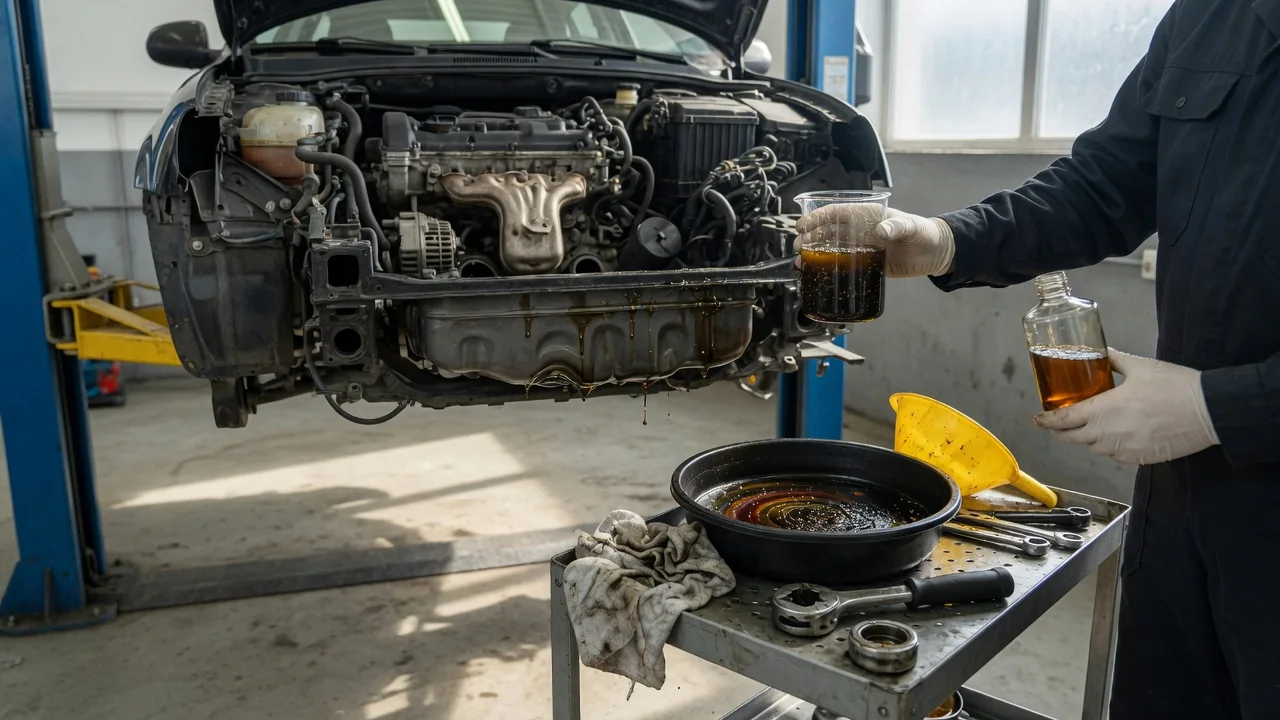
Engine oil keeps moving parts apart with a thin film of pressurized fluid. When that oil carries contaminants, the film protects less and wear speeds up. Contaminated lubricant increases wear for three linked reasons: particles get into the oil, those particles scratch and dent metal surfaces, and filtration only partly controls them. These mechanisms apply broadly to engines and other lubricated automotive systems, although clearances, materials, and service needs vary from one design to another.
Particles: What Contaminates the Oil and Why Size and Hardness Matter
Solid contaminants reach the lubricant by several routes. Airborne dust and sand can enter through a worn or poorly seated air filter, a cracked intake duct, or a loose connection after the filter. Combustion leaves soot and other byproducts, and some of it slips past the piston rings into the crankcase. This is especially noticeable in diesel engines. Normal operation also produces tiny metal fragments from bearings, gears, cams, and cylinder walls. Repairs and manufacturing can leave behind machining chips, casting sand, gasket fragments, or sealant residue. Liquids such as fuel and coolant contaminate oil too, but this article focuses on particles, the main cause of abrasive wear.
Not every particle is equally harmful. The most damaging ones are about the same size as the oil film, or slightly larger. That film is extremely thin in heavily loaded areas. A particle of that size cannot simply float through the gap without touching both surfaces. Very small particles tend to stay suspended in the oil and pass through with less effect. Hardness matters as well. Silica-based dirt is harder than many of the metals used in bearings and other engine components, so it can cut those surfaces instead of being crushed.
Particles also feed on themselves. Each scratch or dent releases more metal into the oil, and that metal becomes a new abrasive. Soot behaves differently from dirt but still causes trouble. Additives can keep small soot particles dispersed, but if soot builds up beyond what they can handle, the particles can clump together. The clumps thicken the oil, contribute to sludge, and act more like solid debris in tight clearances.
Abrasion: How Particles Turn Into Component Wear
Wear specialists often describe abrasion in two forms. In two-body abrasion, a hard particle becomes embedded in a softer surface, such as a plain bearing lining. It then acts like a fixed cutting tool against the harder mating part, such as a crankshaft journal. In three-body abrasion, a loose particle rolls and slides between two surfaces and scratches both of them. Both forms remove material that the designer counted on to keep correct clearances and smooth surfaces.
Dirty oil wears components fastest where clearances are tight and loads are high. Crankshaft and connecting rod bearings, cam lobes and their followers, piston rings and cylinder walls, oil pump gears, and timing chain parts are all exposed. Gears and rolling-element bearings run under very high contact pressure. There, a hard particle can do more than scratch: it can press a small dent into the surface. The edges of that dent concentrate stress, and repeated loading can start fatigue cracks that later appear as pitting or flaking.
The damage builds on itself. As bearing clearances grow, oil escapes more easily, and pressure and film thickness at the bearing can fall. That leads to more metal-to-metal contact and more debris. Worn piston rings and cylinder walls seal less effectively, so more combustion gas and soot reach the crankcase and the oil gets dirtier faster. Abrasion can also polish away the crosshatch finish on cylinder walls that holds oil for the rings, which can raise oil consumption.
Filtration: How Filters Limit Contamination and Where They Fall Short
Filtration works at two points. The air filter stops dirt before it can enter the engine. This is usually the most effective protection, because keeping abrasive material out is easier than removing it later. The oil filter, typically a full-flow design in passenger vehicles, traps circulating particles above the size its media can capture. Filter makers rate efficiency and capacity in different ways, so no single number describes every filter. What matters is that the filter meets the vehicle manufacturer's requirements.
Oil filters have built-in limits. Most systems include a bypass valve that opens when flow through the filter element is too restricted. This can happen when the element is heavily loaded, or when cold, thick oil cannot pass through it quickly enough. The valve exists because unfiltered oil does less harm than no oil at all. Still, while it is open, contaminants circulate without being caught. A filter also has a finite holding capacity. As it fills, it either restricts flow more or bypasses more often.
Some particles are too fine for the filter to catch. Dispersant additives in the oil keep many of them suspended so they do not settle into deposits. These additives are used up over time, and the suspended material stays in the oil until it is drained. That is why oil changes and filter changes work together. The filter removes larger debris continuously, and the oil change removes the fine contaminants and spent additives that filtration cannot.
Practical Implications and Limits
For owners, the most dependable guide is the maintenance schedule in the vehicle's owner's manual. It covers oil, oil filter, and air filter changes. Many manuals list severe-service conditions that call for shorter intervals, such as dusty or unpaved roads, frequent short trips, towing, or extended idling. These conditions match the mechanisms described above. Dust raises the amount of abrasive material entering the engine, and short trips can let moisture and combustion byproducts collect in the oil. Intervals and filter specifications differ between engines, so general advice should not replace the manufacturer's guidance for a specific vehicle.
Looking at oil on a dipstick reveals little about abrasive contamination. Dark oil may only show that dispersants are holding soot in suspension as intended. Oil that looks clean can still carry fine dirt or wear metal too small to see. Laboratory oil analysis can report elements linked to dirt ingress and to specific wear metals. Its results are most meaningful when compared with earlier samples from the same engine, so they should not be read as a pass or fail from a single test.
Careful habits during service reduce contamination at the source. These include wiping the area around the fill cap and dipstick, using clean funnels and containers, confirming that the air filter seals properly, and checking intake ducting for cracks. After major internal repairs, leftover debris is a known risk. Thorough cleaning and the procedures in the service manual help address it. Finally, contamination is only one cause of wear. Fuel dilution, coolant leaks, incorrect oil viscosity, and oil starvation can produce similar damage. Symptoms such as low oil pressure warnings or bearing noise call for proper diagnosis, not an assumption that dirty oil is the only cause.