Why Does Cold Weather Change an EV's Charging Curve?
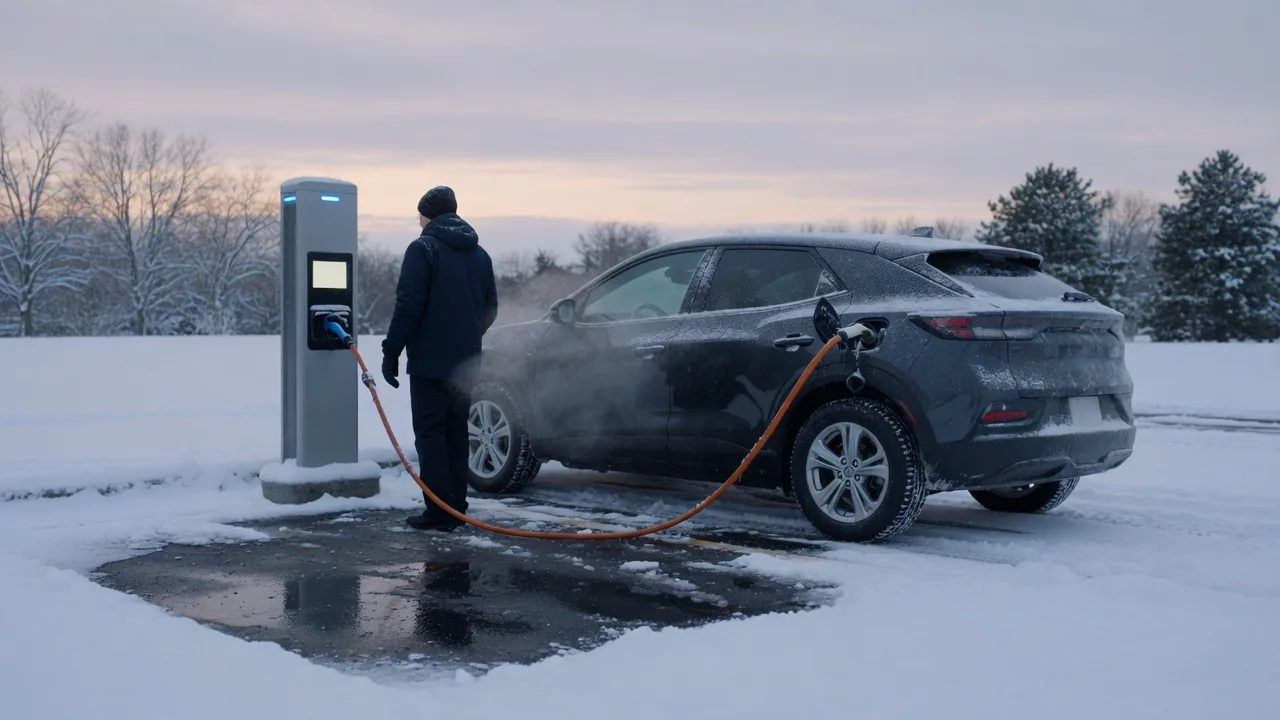
In cold weather, many EV owners notice that a DC fast charging session starts slower than expected, peaks lower, or takes longer to reach the same state of charge. The charger is rarely the main reason. A lithium-ion battery's ability to accept current depends heavily on the temperature of its cells, and the vehicle's battery management system reshapes the charging curve to protect them. Cell temperature, current limits and preconditioning together explain why the EV charging curve changes in cold weather.
Cell temperature
A charging curve describes how much power the battery accepts as its state of charge rises during a session. In general, power is highest somewhere in the lower or middle portion of the charge and tapers as the battery fills. That shape assumes the cells are within a comfortable temperature range. What matters is the temperature inside the battery pack, not the air around the car. A vehicle parked outside overnight in freezing weather can have a pack that has cooled close to ambient temperature, while a car that has just been driven on the highway may have cells that are noticeably warmer than the outside air.
Charging a lithium-ion cell means moving lithium ions through the electrolyte and inserting them into the anode material. Cold slows every part of that process. The liquid electrolyte becomes more viscous, ions diffuse more slowly, and the reactions at the electrode surfaces proceed less readily. The practical result is higher internal resistance: pushing the same current through a cold cell produces a larger voltage rise and more wasted energy. There is also a more serious concern. When ions arrive at the anode faster than they can be absorbed, metallic lithium can deposit on the anode surface, a process known as lithium plating. Plating can permanently reduce capacity and, in severe cases, create safety risks, which is why cold cells must be charged gently.
A battery pack has considerable thermal mass. It cools down slowly after driving, but once it has soaked in the cold, it also warms up slowly. This is why the same car can charge very differently at the same station depending on whether it arrives after a long drive or after sitting parked for many hours.
Current limits
The vehicle, not the charging station, decides how much current the battery will accept. During a DC fast charging session, the car's battery management system continuously reports a requested current and voltage to the charger, and the charger supplies up to that request within its own capability. The battery management system typically bases its request on tables or models that combine cell temperature, state of charge, cell voltage and other conditions. When the measured cell temperature is low, the permitted current is reduced, sometimes sharply. A high-power charger cannot override that limit, so a cold car may draw far less power than the station is rated to deliver.
These limits change the shape of the curve, not just its height. Instead of starting near its peak, a cold battery may begin with a low, flat section and then rise gradually. Part of the reason is that charging current itself generates heat inside the cells, and many vehicles also run their battery heater during the session, so the pack warms and the allowed current climbs. Higher internal resistance has another effect: cell voltage rises faster under load, so the battery can reach its voltage limits earlier and begin tapering sooner than it would when warm. The combined result is a curve that is lower, later to peak and sometimes uneven.
Slower AC charging at home or work is usually less affected, because its power level is already modest relative to what the cells can tolerate. Even so, in very cold conditions some of the incoming power may be used to warm the battery, so the energy added per hour can still be lower.
Preconditioning
Preconditioning means deliberately warming the battery before charging so that the cells are closer to their preferred range when the session starts. Vehicles with liquid thermal management usually do this by heating the coolant that circulates through the pack, using an electric resistance heater, a heat pump, waste heat from the drivetrain, or a combination, depending on the design. In many EVs, battery preconditioning for fast charging starts automatically when a DC fast charger is set as the destination in the built-in navigation system. Some vehicles also offer a manual option. How it is triggered, and what temperature it targets, are vehicle-specific details found in the owner's manual.
Preconditioning is a trade-off. Heating a large battery takes energy from the pack, which slightly reduces the range available for driving, and it takes time. Because of the pack's thermal mass, warming that begins only a few minutes before arrival may not raise the cell temperature enough to make a meaningful difference. The goal is to spend some energy on the way to the charger in order to save more time once connected. Many vehicles do not display cell temperature directly, so the system's own status message is often the only indication that preconditioning is active.
Some vehicles can also warm the battery while plugged in at home, often linked to a scheduled departure time. Doing this from the grid means the energy used for heating does not come out of the battery's stored charge.
Practical implications and limits
For winter trips, it is reasonable to plan for longer fast charging stops than in mild weather, especially for the first stop of the day. Charging soon after a period of driving tends to be more effective than charging after the car has been parked outside for hours, since the pack has not yet lost the heat built up on the road. If a fast charge is needed right after a cold start, allowing extra time is more realistic than expecting the rated power of the station. Using the vehicle's own trip planning to choose chargers can help, because it may account for battery temperature and trigger heating automatically.
The mechanisms described here are general, but the exact behavior is not. Cell chemistry, pack design, cooling and heating hardware, and software calibration all influence how strongly a particular vehicle responds to cold and how quickly it recovers. Software updates can also change charging behavior over time. A slow session is not always the battery's doing, either: a station can be limited by its own hardware, shared power between stalls or a fault. The power figure shown on the screen does not explain which side is limiting the session.
A reduced charging rate in cold weather is generally a protective decision rather than a sign of a problem. If charging behavior seems abnormal even when the battery should be warm, the manufacturer's documentation or an authorized service provider is the appropriate source for a vehicle-specific answer.