Why Does an Interior Panel Need Stiffening Ribs?
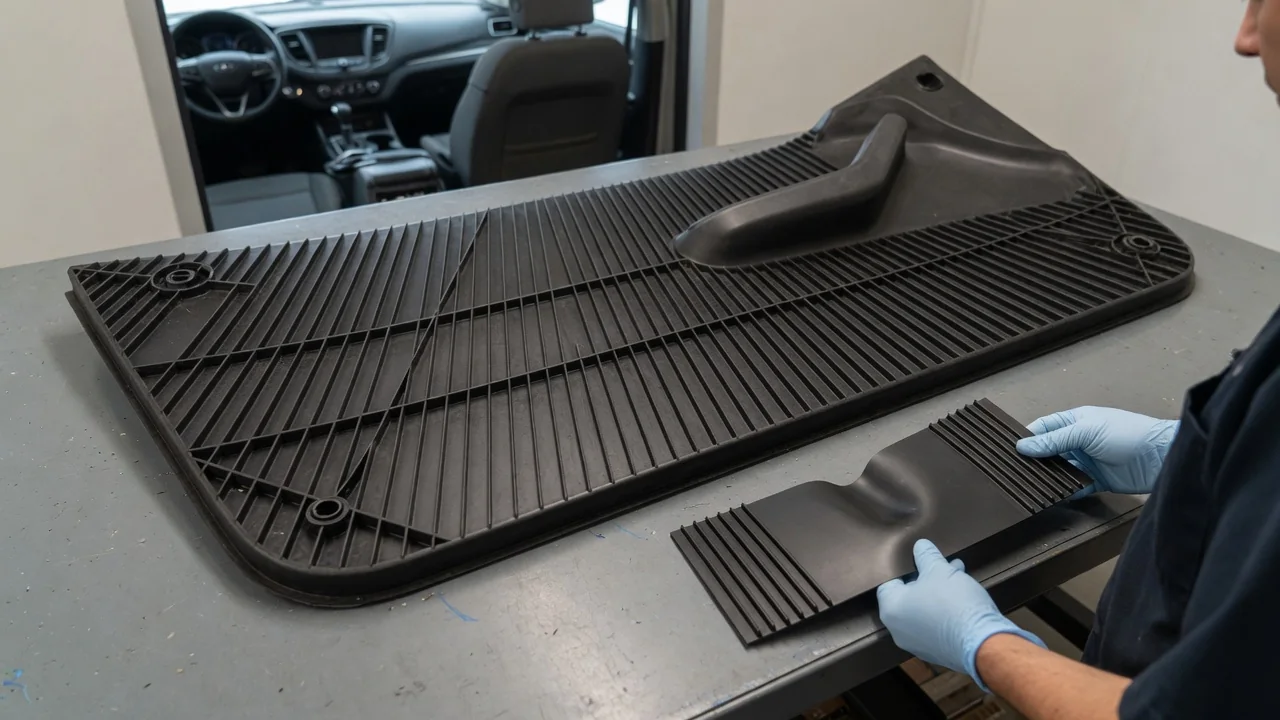
Pop off a door card or a dashboard trim piece and the back side rarely looks like the smooth front. It is usually covered in a grid of thin walls, crossing ribs, and small posts. These stiffening ribs are not decoration. They let a thin molded panel behave like a much thicker one, help keep it quiet over bumps, and make the part easier to mold consistently. Here is how each of those jobs works.
Panel rigidity
Most interior panels are injection-molded thermoplastics, such as polypropylene blends or ABS, with walls only a few millimeters thick. On its own, a flat sheet of that material is flexible. Press the middle and it bows. Hold it by its edges and it can flutter. The reason is geometry more than material. A panel's resistance to bending depends strongly on how far its material sits from the neutral plane at the center of the wall. For a plain flat plate, bending stiffness rises roughly with the cube of thickness. Doubling the wall would make it about eight times stiffer, but it would also make it twice as heavy and use twice the material.
A rib gets much of that benefit without thickening the whole wall. Because the rib stands up from the surface, it moves material away from the neutral plane. That raises the second moment of area of the section along the rib's direction. A crossing pattern spreads the effect in two directions. The panel then resists bending, twisting, and local denting under a hand, knee, or elbow far better than a flat sheet of the same weight. Ribs also tie flat areas to load-carrying features such as clip towers, screw bosses, and mounting flanges. Forces from the fasteners then spread into the panel instead of concentrating at a single point.
Stiffness matters for vibration as well as feel. Every panel has natural frequencies at which it vibrates most easily. A flexible, lightweight panel tends to have low natural frequencies that can fall within the range excited by road inputs, the powertrain, or the audio system. That can turn a large trim surface into something like a drumhead. Adding stiffness with little added mass raises those frequencies and reduces how much the panel moves in response. This is one way engineers try to keep car interior panel vibration from becoming audible in the cabin.
Rattle
A rattle happens when two parts that should stay in steady contact separate and strike each other, or when a loose part bounces within a gap. In a vehicle interior, the usual sources are trim panels meeting each other, panels touching the metal structure behind them, and clips or fasteners that have lost some grip. The industry groups these noises as buzz, squeak, and rattle. A buzz is fast, repeated contact. A squeak is a stick-slip noise from surfaces rubbing together. A rattle is a heavier impact.
Ribs help in several ways. A stiffer panel deflects less under the same vibration, so its edges are less likely to lift off their mating surfaces and slap back. Ribs also keep the panel's shape stable, which helps hold the designed gaps and the preload on the clips. A panel that flexes repeatedly can work its clips loose over time. Ribs can also serve as deliberate contact points or standoffs. The panel then rests against its neighbor or the body at defined spots instead of touching at random along a long, flexible edge. Those controlled contacts are often where designers place felt, foam, or flocked tape to isolate the joint.
Rib design involves trade-offs. A panel that is too stiff in the wrong place can pass vibration efficiently to an attachment point, and hard plastic surfaces rubbing together can squeak. Engineers therefore tune the rib layout together with clip positions, gap targets, and isolating materials instead of treating ribs as a standalone fix. The general mechanism applies across vehicles, but how well it works in a given car depends on that car's design and assembly quality.
Production
Ribs also solve manufacturing problems. In injection molding, molten plastic fills a steel tool and must cool before the part can be ejected. Thick sections cool slowly and shrink unevenly. That can cause sink marks on the visible surface, internal voids, and warping. Manufacturers keep the main wall reasonably thin and uniform and add stiffness with ribs. The result is a part that cools more evenly, uses less material, and spends less time in the mold on each cycle.
Ribs follow their own design rules for the same reasons. They are typically thinner than the wall they stand on. A rib as thick as the wall creates a heavy spot where the two join, and that spot can pull in as it cools, leaving a faint line or depression on the show surface opposite. Ribs also get a slight draft so they release from the tool, small radii at the base to reduce stress concentration, and a limited height so they fill completely. Spacing matters too, because closely packed ribs can be hard to fill and cool.
Ribs also help with handling, assembly, and dimensional control. A molded panel must hold its shape after ejection, during shipping, and when an assembler presses it into place. Ribs resist warpage as the part cools and keep long, thin panels from bending while they are handled. They can also guide molten plastic toward distant areas of the tool and carry locating features, which reduces the need for separate brackets.
Practical implications and limits
For owners, these ribs are a good reason to take care when removing trim. Prying against the panel's face instead of near its clips, or bending a cold panel, can crack ribs or snap clip towers. A cracked rib may be invisible from the cabin, but the panel can lose local stiffness or clip preload and start to buzz. Cutting away ribs to make room for speakers, wiring, or accessories can have the same effect. If material must be removed, keep as much of the surrounding structure as practical and support the area afterward to reduce the chance of a new noise.
When a rattle appears, the panel's structure suggests where to look. Noises often trace back to a loose or broken clip, a contact point that has lost its felt or foam pad, or an object trapped between the panel and the body. The panel's overall stiffness is less often the cause. Adding thin felt tape or foam at contact points is a common general remedy, but it only works if it addresses the actual contact. Clip types, removal sequences, and recommended materials vary by vehicle, so the service manual for the specific model is the right reference.
Ribs have limits. They cannot make up for worn fasteners, misaligned mounting points, or panels deformed during an earlier repair. Plastics also get stiffer in cold weather and softer in heat, so a panel that is quiet in one season may buzz in another. Ribs reduce a panel's tendency to vibrate and rattle, but they do not make it immune. They are one part of a noise-control approach that also depends on fit, fasteners, and isolating materials.