Why Does an EV Reduce Power in Extreme Cold?
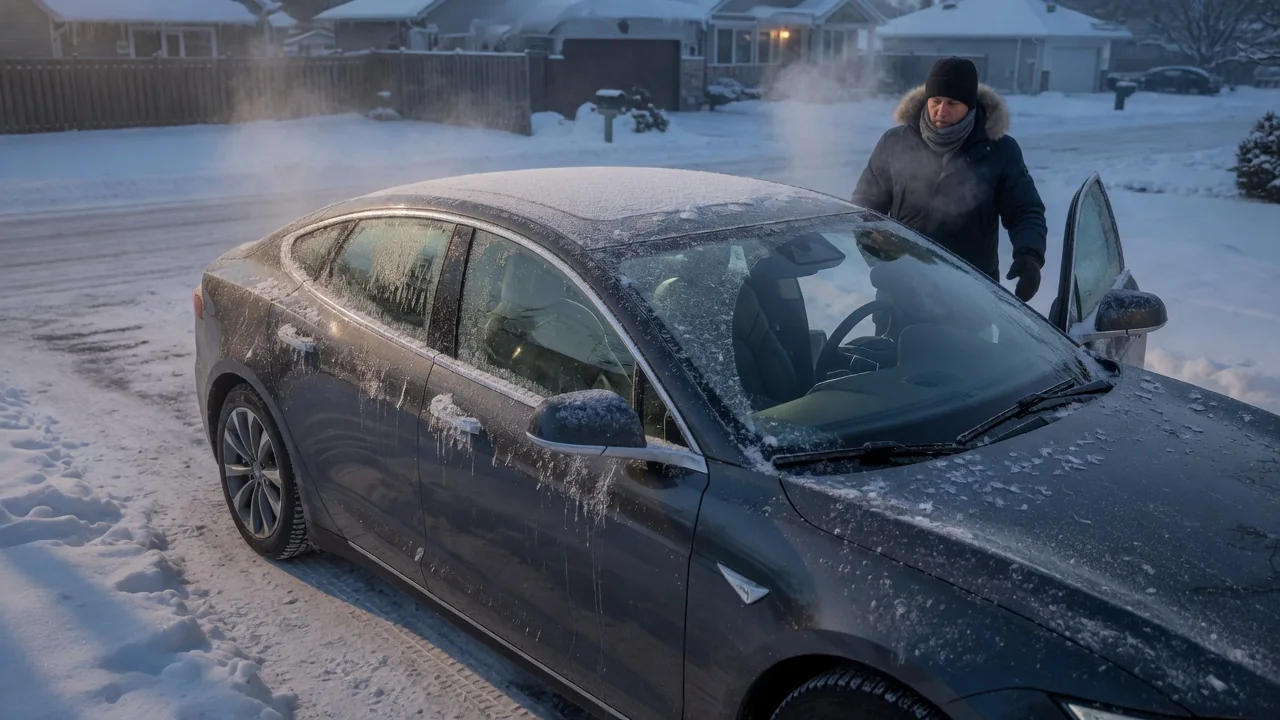
When temperatures drop far below freezing, many electric vehicles feel noticeably slower, limit regenerative braking, or display a message that power is reduced. In most cases this is not a fault. The battery management system is deliberately limiting how much current the pack can deliver and accept until the cells are warm enough to handle it safely. Why an EV reduces power in extreme cold comes down to three linked factors: cell temperature, energy delivery, and how the car warms its battery.
Cell temperature and what cold does inside a lithium-ion cell
A lithium-ion cell produces current through electrochemical reactions. Lithium ions travel through a liquid electrolyte, cross a separator, and move into or out of the electrode materials, while electrons flow through the external circuit. Every step of that process depends on temperature. As a cell gets colder, the electrolyte becomes more viscous, ions move more slowly through it, and the reactions at the electrode surfaces proceed less readily. Diffusion of lithium within the electrode particles also slows. The combined effect is a sharp rise in the cell's internal resistance and a reduction in how quickly it can supply or absorb charge.
Higher internal resistance has a direct electrical consequence. When current is drawn from a cold cell, more voltage is lost inside the cell itself, so the terminal voltage sags further under load than it would in mild weather. Part of the energy that would have gone to the motor is converted to heat inside the cell instead. Usable capacity is also temporarily reduced, because the cell reaches its minimum allowable voltage sooner. This does not mean the energy has disappeared permanently; much of it becomes accessible again once the cell warms.
Charging is the more sensitive direction. Pushing current into a cold cell at a high rate can cause lithium to deposit as metal on the surface of the negative electrode instead of inserting into it, a process known as lithium plating. Plating can permanently reduce capacity and, in severe cases, raise safety concerns. This is why cold-weather limits tend to be stricter on charging and regenerative braking than on discharge.
Energy delivery: how the battery management system limits power
The battery management system, or BMS, continuously monitors cell voltages, pack current, and temperatures from sensors distributed through the pack. From these inputs it calculates how much power the pack can safely discharge and how much it can safely accept at that moment. These limits are passed to the drive inverter and the charging system, which then restrict what the motor and charger are allowed to request. When a driver notices an EV power limited by a cold battery, this calculated limit is usually what they are experiencing.
Several factors push the discharge limit down in extreme cold. Because voltage sag is larger, a high power request could pull individual cells below their minimum voltage threshold, which stresses the cells and can trigger protective shutdowns. Limiting current keeps every cell inside its safe operating window. Since a pack is only as capable as its weakest group of cells, the BMS typically bases its limits on the coldest or lowest-voltage cells rather than the average. A pack that has been sitting outside may also have uneven temperatures, with outer cells colder than inner ones, which further constrains the limit.
Regenerative braking is affected the same way, but in the charging direction. Recovering energy while slowing down means sending current back into the pack, and a cold pack may be allowed to accept very little. Many vehicles reduce or disable regeneration in these conditions and rely more on the friction brakes. How this is communicated, whether through a dashboard message, a marked section on a power gauge, or simply a different pedal feel, varies by manufacturer and is described in each vehicle's owner's manual.
Warmup: how the pack gets back to full capability
Power limits relax as the cells warm, so the thermal management system plays a central role. Most modern EVs use a liquid coolant loop that runs through or around the battery modules. In cold conditions, that loop can carry heat into the pack instead of removing it. Common heat sources include electric resistance heaters, often called PTC heaters, waste heat recovered from the drive motor and power electronics, and in some vehicles a heat pump that can move heat between the cabin, the drivetrain, and the battery. Which of these a specific car uses, and how it prioritizes them, is a design choice that differs between models.
The battery also warms itself during use. The same internal resistance that causes voltage sag turns part of the current flowing through the cells into heat, so driving gradually raises pack temperature even without active heating. Some vehicles can also run the motor in a deliberately inefficient mode while parked to generate heat for the battery. Warming a large pack still takes time, because the cells and surrounding structure have considerable thermal mass, and in extreme cold the pack is continuously losing heat to the outside air.
Preconditioning puts this hardware to work before or during a trip. When a car is set to warm the battery ahead of a scheduled departure, or when a DC fast charger is entered as the navigation destination on vehicles that support it, the system begins heating the pack in advance. Doing this while the car is plugged in lets grid electricity, rather than the battery itself, cover most of the heating load.
Practical implications and limits
In everyday driving, the first several minutes after a long cold soak are when restrictions are most noticeable. Acceleration may be softer, peak power may be capped, and one-pedal driving may feel weaker than usual. As the pack warms, these restrictions typically ease, either gradually or in steps. Fast charging follows a similar pattern: a cold pack often charges slowly at first, and arriving at the charger with a warm battery is one of the most effective ways to shorten winter charging stops. Parking in a garage, or keeping the car plugged in when it supports battery heating from the grid, can limit how cold the pack gets in the first place.
These measures have limits. Heating the battery and cabin consumes energy, so winter range is commonly lower even after power restrictions lift. A very low state of charge in deep cold leaves the BMS with little voltage margin, which can make restrictions more pronounced and longer lasting. Exact thresholds, warning messages, and heating strategies are specific to each vehicle and its software version, so the owner's manual is the authoritative reference for a particular car. A reduced-power message that persists after the battery should be warm, or that appears alongside other warnings, is worth having checked by a qualified service provider rather than assuming the weather is the only cause.