Why Does an EV Motor Need a Gear Reduction?
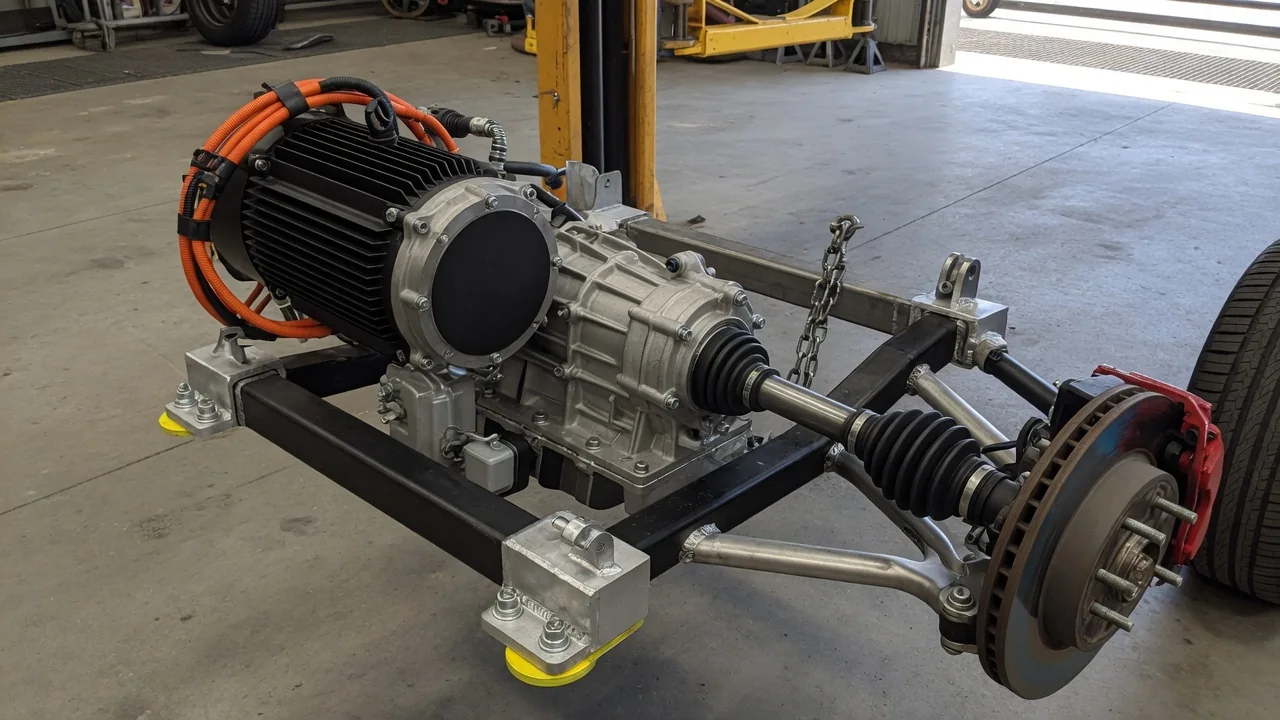
Most electric cars send power from the motor to the wheels through a fixed reduction gear, not a multi-speed transmission or a direct connection. That small gear set does a big job. It lets a compact, fast-spinning motor deliver strong torque at the slower speed of the wheels, and it lets engineers fit the whole drive unit between the suspension components. Three things explain why: how motors like to spin, how fast wheels actually turn, and how much space the drivetrain can occupy.
Motor speed: why EV motors are built to spin fast
An electric motor's output power is its torque multiplied by its rotational speed. Torque depends mainly on the motor's physical size and on how much current it can carry without overheating. A larger rotor diameter and more active material produce more twisting force. Speed is much cheaper to add. Spinning the same rotor faster raises power without making the motor proportionally bigger or heavier. For that reason, traction motor designers generally aim for high rotational speeds, often well beyond what a gasoline engine reaches. That way a modest-sized machine can deliver the power a car needs.
The inverter makes this possible by controlling the frequency and amplitude of the current fed to the motor windings. At low speeds the motor can produce its peak torque, limited mostly by current and heat. As speed rises, the voltage the motor generates internally, called back electromotive force, approaches the available battery voltage. The control system then shifts into a constant-power region, and in permanent-magnet motors it often uses field weakening to do so. Torque tapers while power stays roughly level. The usable speed band ends up much wider than a combustion engine's, which is one reason an EV can get by with a single gear ratio.
High speed brings its own constraints. Rotor parts must withstand centrifugal force, bearings must tolerate the rotation, and iron and switching losses grow with frequency. Every design is a balance, but the general direction is consistent: a smaller, faster motor paired with gearing is usually lighter and more efficient overall than a slow, large one.
Wheel speed: matching the motor to the road
Road wheels turn relatively slowly. Their rotational speed is set by vehicle speed and tire circumference, so even at highway speeds a passenger car tire turns far more slowly than a traction motor is designed to spin. As an illustration only, a tire about two meters around turning at 1,000 revolutions per minute would move the car about 120 kilometers, or roughly 75 miles, per hour. A motor built for high speed and connected straight to that wheel would leave most of its speed range unused.
A reduction gear bridges that gap. When gearing reduces speed by a given ratio, it multiplies torque by nearly the same ratio, minus small friction losses. The motor turns several revolutions for each wheel revolution, which keeps it in a speed range where it produces power efficiently. Meanwhile the wheels receive the much higher torque needed to accelerate a heavy vehicle and climb grades. The reduction stage usually feeds a differential, which splits torque between the left and right wheels and lets them turn at different speeds in corners.
Choosing the ratio is a compromise. A numerically higher reduction gives stronger acceleration from a stop, but the motor reaches its maximum speed sooner, which caps top speed. A lower reduction allows a higher top speed but reduces wheel torque at launch. Because an electric motor's speed band is so wide, one fixed ratio can usually handle both city driving and highway travel acceptably. That is why most EVs do not need a multi-speed gearbox.
Packaging: why a gear set beats a bigger motor
Without reduction gearing, the motor itself would have to produce the full torque the wheels need at their slow speed. Torque scales with motor size, so a direct-drive motor of equal capability would need a larger diameter, a longer stack, or both. It would also need more copper, steel, and magnet material. That adds weight and cost and takes up space that is already scarce between the wheels, the suspension, and the crash structure.
A compact high-speed motor plus a reduction gear avoids that problem. Many EVs combine the motor, reduction gearing, differential, and often the inverter into a single drive unit mounted at one or both axles. Gear arrangements vary. Some use parallel shafts that offset the motor from the axle line, while others use planetary gear sets that keep the motor on the same axis as the axle. Either way, the aim is to fit the drivetrain into a tight envelope and leave room for the battery, cabin, and cargo space.
Mounting the drive unit on the body or subframe also keeps its mass sprung rather than attached to the wheels. Motors built into the wheel hubs exist, and they can either skip a separate gear set or use small hub reductions. However, they add unsprung weight, which can affect ride and handling, and they must survive a harsher environment. That tradeoff helps explain why centralized drive units with reduction gearing remain the common approach.
Practical implications and limits
For drivers, the most visible effect is smooth acceleration with no gear changes. The reduction gear does not shift, so there is no clutch, no shift shock, and no gear to choose. Reverse is typically handled by running the motor backward instead of through a separate gear. The same gear train also works in the other direction during regenerative braking, carrying wheel torque back to the motor so it can act as a generator.
The gear set is not maintenance-free in every case. It runs in lubricant, and requirements differ: some manufacturers specify fluid inspection or replacement at set intervals, while others treat the fluid as long-life. The owner's manual for the specific vehicle is the authority. Gears can also produce a faint whine at some speeds, which stands out more in an EV because there is no engine noise to mask it. A new or changing noise from the drive unit, especially grinding or clunking, should be diagnosed rather than ignored.
A single fixed ratio has limits. Top speed is ultimately bounded by the motor's maximum safe rotational speed divided through the gearing, and efficiency at sustained high speed can be lower than at moderate speeds. Some performance-oriented vehicles use a two-speed transmission to ease that compromise, at the cost of added complexity. Changing tire size also alters the effective overall ratio, which can slightly shift speedometer accuracy and acceleration. Replacement tires should therefore match the manufacturer's specified dimensions.