Why Does an EV Have Friction Brakes If It Has Regen?
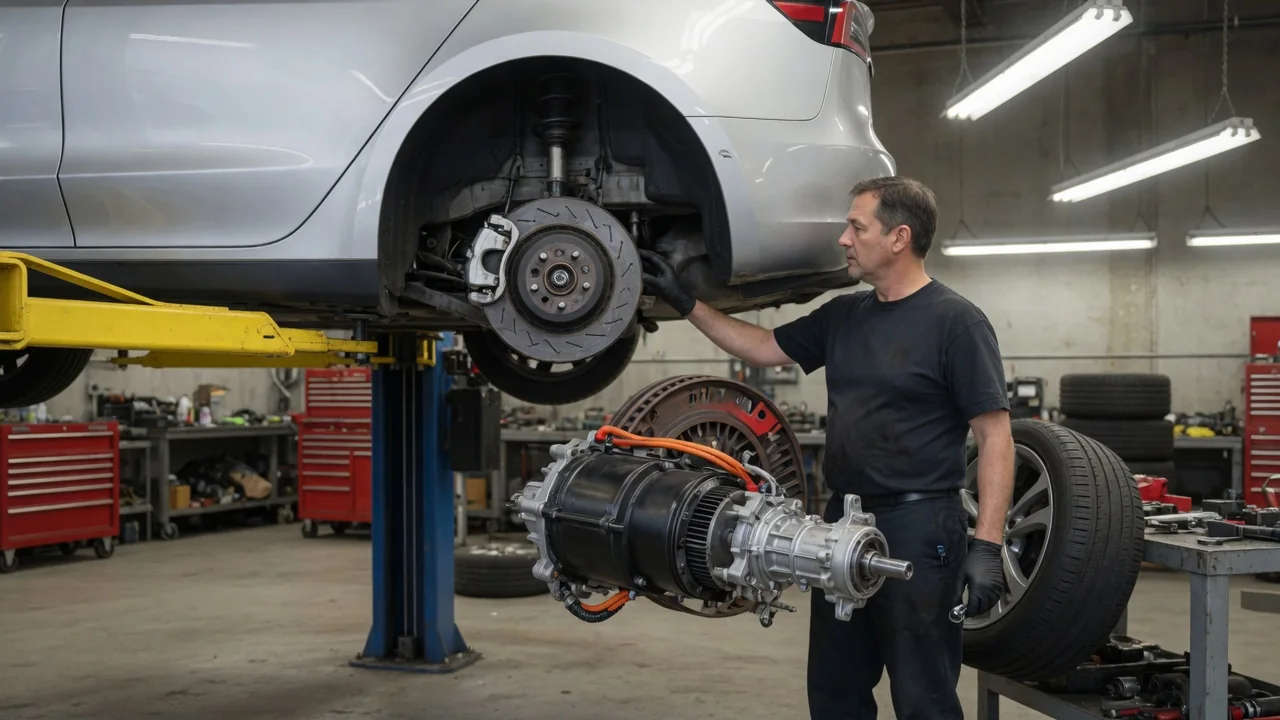
Regenerative braking lets an electric vehicle slow down by turning its drive motor into a generator, sending recovered energy back to the battery. It handles much of everyday deceleration, which raises a fair question: why does an EV have friction brakes if it has regen? The short answer is that regen has physical and electrical limits. Friction brakes supply the full stopping power regen cannot, finish the job at very low speeds, and serve as the backup whenever regeneration is reduced or unavailable.
Stopping Power: Why Regen Can't Handle Every Stop
Regenerative braking force is limited by three things working together: how much torque the motor can produce while acting as a generator, how much current the inverter can handle, and how much charging power the battery can accept at that moment. In gentle or moderate slowing, those limits are rarely reached. A hard stop from highway speed is different. The car's kinetic energy has to be shed in a few seconds, and the power involved is far greater than a typical drive motor and battery are designed to absorb. Friction brakes have no such electrical ceiling. They turn motion into heat at the pads and rotors, and they can do it very quickly, which is why they supply the maximum deceleration an EV is capable of.
Where the braking happens also matters. Regen works only through the wheels connected to a motor, so on a single-motor EV it acts on just one axle. During hard braking, weight shifts toward the front of the car, and the front tires can then carry most of the braking load. If the motor drives the rear wheels, regen cannot provide that front braking, and too much braking on the rear axle can make the car less stable. Friction brakes at all four wheels let the system distribute braking force where the tires have grip, and they allow anti-lock braking and stability control to adjust each wheel individually. When those systems intervene, many EVs reduce regen and rely on friction braking for precise control.
In most EVs the brake pedal controls a blended system. The software uses regen first to recover as much energy as practical, then adds friction braking when the driver asks for more deceleration than regen can provide. The driver presses one pedal, but the mix between the two systems changes continuously. How smoothly that blending is done, and how much braking regen contributes, varies from one vehicle to another.
Low Speed: Where Regenerative Braking Fades
Regen depends on a turning motor, and the energy available to recover shrinks rapidly as the car slows down, because kinetic energy falls with the square of speed. Near walking pace there is very little left to capture, and the motor and inverter operate less efficiently in this range. For these reasons, many systems taper regen as the car approaches a stop and let the friction brakes take over the last part of the deceleration. Drivers may notice a slight change in pedal feel at that point, which is the handoff between the two systems.
Some EVs offer a one-pedal mode that can bring the car to a full stop using motor control alone, typically by actively driving the motor near zero speed rather than purely recovering energy. Whether a particular car does this, and how, is a design choice specific to that vehicle. Holding a stopped car is a separate task. An electric motor can resist rolling, but holding a car on a slope that way draws power and produces heat. Friction brakes and the parking brake hold the vehicle at rest without consuming energy, which is why they remain in charge once the car is stopped, whether in traffic, on a hill, or parked.
Backup: When Regen Is Limited or Unavailable
Regen is not always available at full strength. When the battery is at or near a full charge, it has little room to accept more energy, so regen is reduced. A cold battery also accepts charge slowly, and many EVs limit regen until it warms up. High battery temperature, a fault in the motor or power electronics, a driver-selected low regen setting, or a slippery road where stability control restricts drive-wheel torque can all lower regen braking as well. In every one of these cases, the driver still needs the brake pedal to deliver full, predictable stopping. The friction brakes make that possible, so the car stops reliably regardless of battery state or the condition of the electric drive.
There is also a basic safety principle at work. Vehicle safety standards require a dependable service brake and a parking brake, and a friction system is the established way to meet those requirements without depending on the high-voltage drive system. Hydraulic brakes are commonly split into separate circuits so that a leak in one does not remove all braking, and brake-by-wire designs typically include a mechanical or hydraulic fallback path. Regen improves efficiency, but the friction brakes are the system engineers design to keep working even when other parts of the car are not.
Practical Implications and Limits for EV Owners
Because regen handles much of everyday slowing, brake pads and rotors on an EV often wear more slowly than on a comparable conventional car. Light use brings its own issues. Rotors that are rarely applied firmly can build up rust, particularly in wet or salted-road climates, and caliper slide pins can stick from inactivity. Some vehicles periodically apply the friction brakes to keep the rotors clean, but this behavior is model-specific. Brake fluid still absorbs moisture over time, so following the maintenance schedule for fluid changes and brake inspections matters even when the pads look nearly new.
Deceleration from lifting off the accelerator is not constant. After a full charge or on a cold morning, the car may coast farther than usual before regen ramps up, so drivers should not assume lift-off slowing will always feel the same. Using the brake pedal firmly now and then, where it is safe to do so, keeps the friction components exercised and keeps the driver familiar with how the pedal responds. In an emergency, the brake pedal, not the one-pedal setting, is the control that delivers maximum stopping power.
The general mechanisms described here apply broadly, but the details do not. How regen and friction braking are blended, how much regen a given motor can deliver, whether the car stops fully in one-pedal mode, and whether it runs automatic rotor-cleaning routines all depend on the manufacturer and sometimes on the software version. The owner's manual is the authoritative guide for a specific vehicle. The underlying reason friction brakes remain a necessity in an EV stays the same: regen recovers energy, while friction brakes guarantee the car can always stop.