Why Does an Engine Run Warmer While Towing?
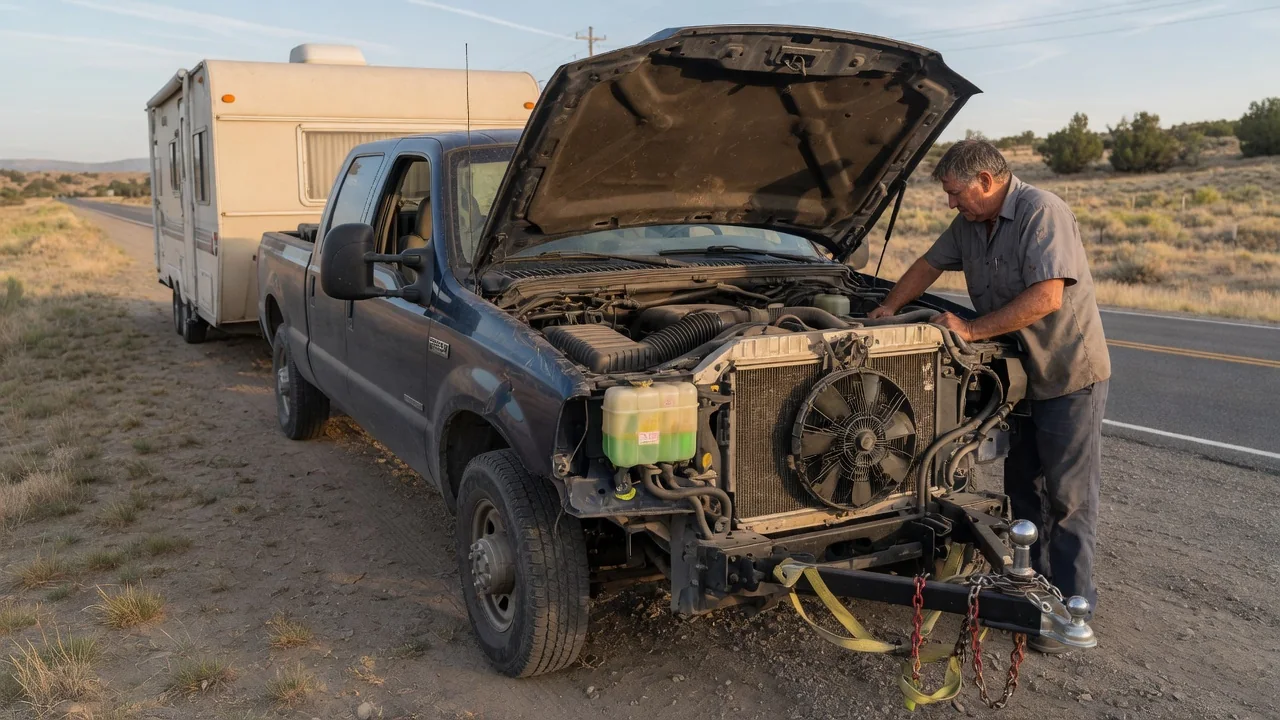
Pulling a trailer changes how an engine works, and the cooling system feels it first. If you have watched the temperature gauge creep upward on a long grade with a camper behind you, you have seen the basic physics at work. The engine makes more heat, and there is often less air to carry it away. This guide explains why an engine runs warmer while towing, what limits the cooling system, and how to monitor engine temperature under towing load.
Higher work: more load means more heat
An engine turns only part of the energy in its fuel into motion at the wheels. The rest leaves as heat through the exhaust, the cooling system, and the engine's metal surfaces. When a vehicle tows, it has to move much more total mass, overcome more rolling resistance, and push a larger shape through the air. To do that extra work, the engine burns more fuel, and burning more fuel releases more heat into the cylinder walls, heads, and coolant passages. The cooling system then has to remove more heat every minute than it would if the same vehicle were driving unloaded.
Grades make the effect stronger. On a climb with a trailer, the engine has to lift the combined weight against gravity, so it may run at high load for many minutes without a break. It often runs at higher rpm in a lower gear. How long the effort lasts matters as much as peak output. The cooling system can easily absorb a short burst of power, but a long climb gives the heat no chance to dissipate.
The engine is not the only component working harder. In an automatic transmission, extra load increases slip and friction inside the torque converter and clutches, and that heats the transmission fluid. On many vehicles, a heat exchanger in or near the radiator cools that fluid, so a hot transmission can add heat to the same airflow the engine depends on. Engine oil also runs hotter under sustained load. On turbocharged engines, the turbocharger and charge-air cooler add their own heat to manage.
Airflow: getting heat out of the radiator
A radiator can only shed heat if air moves through it. At highway speed, the vehicle's forward motion pushes a large volume of air through the grille. Towing often takes that advantage away at the worst moment. Long climbs, construction zones, and stop-and-go traffic combine heavy load with low road speed, so the engine is producing a lot of heat while less air is being forced through the radiator. The cooling fan has to supply much of that airflow on its own, whether it is mechanically driven through a viscous clutch or electrically powered.
The radiator usually sits behind other heat exchangers. The air-conditioning condenser is commonly mounted in front of it, and some vehicles also stack transmission coolers, oil coolers, or intercoolers in the same area. Each layer warms the air before it reaches the next one. If you run the air conditioning on a hot day while towing, the radiator receives air that has already picked up heat from the condenser. Insects, road debris, and bent fins between these layers can also reduce airflow without any obvious sign.
Outside temperature sets the starting point. How much heat the radiator can shed depends on the difference between the coolant temperature and the temperature of the air passing through it. The same climb on a hot afternoon therefore leaves less margin than on a cool morning. A trailer also adds aerodynamic drag, which increases engine load at higher speeds even when plenty of air is moving through the grille.
Monitoring engine temperature under towing load
Most drivers track engine temperature with the dashboard gauge, so it helps to know how that gauge may behave. On many modern vehicles the gauge is buffered. The needle stays near the middle across a broad range of normal temperatures so that routine fluctuations do not alarm the driver. When a buffered gauge does move noticeably above its usual position, the actual temperature may already have risen considerably. The owner's manual describes how a particular vehicle's gauge and warnings are meant to behave.
Some vehicles show more detail, such as a numeric coolant temperature, transmission fluid temperature, or oil temperature, sometimes in a dedicated towing or trailer menu. On vehicles that support it, a scan tool plugged into the diagnostic port can show similar values. Whatever the source, the most useful habit is learning your vehicle's normal reading in everyday driving, so a change while towing stands out right away.
Watch for other signs as well: a warning light or message, steam from under the hood, a sweet smell of coolant, or a sudden loss of power. Some vehicles reduce engine output or switch off the air-conditioning compressor when temperatures get too high. Warmer air from the vents can therefore be a sign of heat stress rather than a separate fault.
Practical implications and limits
A modest temperature rise while towing is normal. The cooling system is designed to operate across a range, and the thermostat and fan respond to changing demand. What matters is whether the reading stays within the range the manufacturer considers normal. Staying within the vehicle's published towing capacity helps keep the heat load within what the cooling system was built to handle. So does following its recommendations for gear selection, tow/haul modes, and speed on grades. Some vehicles offer factory towing packages that add cooling hardware, which is one reason towing ratings can differ between configurations of the same model.
If the temperature climbs during a tow, easing off the throttle and slowing down reduces the heat being produced. Turning off the air conditioning removes the condenser's heat from the airflow. As a short-term measure, you can set the cabin heater to maximum heat with the fan on high to move some engine heat into the cabin. If the reading keeps rising or a warning appears, pull over where it is safe and follow the owner's manual. Never remove the radiator cap or a pressurized reservoir cap from a hot engine, because escaping coolant can cause serious burns.
Driving technique can only do so much. A cooling system may cope with everyday driving yet fall short under towing load if it has any of these problems: low coolant, old or incorrectly mixed coolant, a weak water pump, a failing fan clutch or electric fan, a sticking thermostat, or a partially clogged radiator. If the engine overheats repeatedly while towing within its rating, have the vehicle inspected before the next trip rather than trying to manage the problem from the driver's seat. Before towing season, it is reasonable to check coolant level and condition and to clear debris from the front of the radiator stack.