Why Does a Turbocharger Need Cooling? Hot Exhaust, Bearings and Shutdown
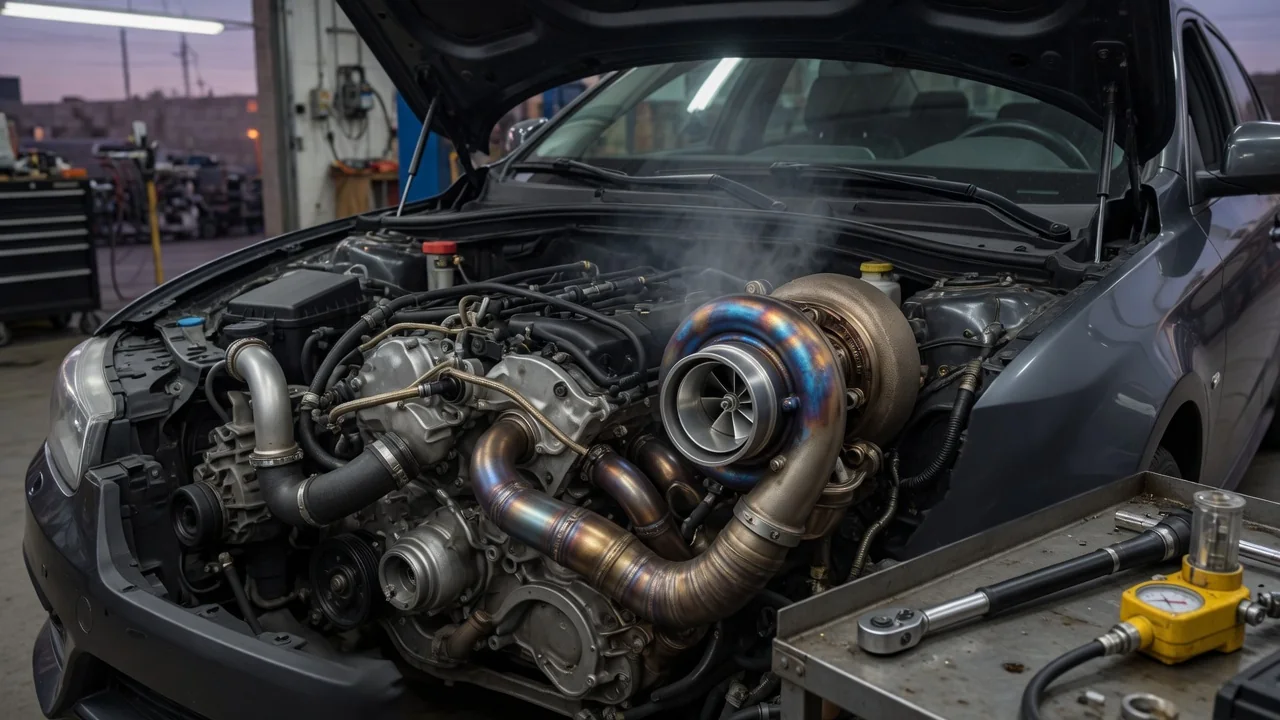
A turbocharger sits directly in the path of exhaust gas leaving the engine. Its shaft must also spin smoothly at very high speed on a thin film of oil. Together, those two facts explain why turbochargers need cooling. Heat from the exhaust side constantly flows toward the bearings and seals, and that flow continues after the engine is switched off. This article explains where the heat comes from, why the bearings are the most sensitive part, and how turbocharger cooling systems deal with shutdown.
Hot exhaust and where the heat comes from
A turbocharger has two wheels on a common shaft. Exhaust gas flowing out of the engine drives the turbine wheel, and the compressor wheel on the other end pushes intake air into the engine under pressure. The turbine housing is bolted to the exhaust side, so it is exposed to some of the hottest gas anywhere in the vehicle. Under heavy, sustained load, such as long climbs, towing or extended high-speed driving, the turbine side can get hot enough to glow visibly. Actual temperatures depend on engine design, fuel type, load and tuning, so no single figure applies to every vehicle.
A short shaft connects the turbine and the compressor and runs through a center section, often called the center housing or bearing housing. Metal conducts heat, so energy from the turbine side travels along the shaft and through the housing toward the middle of the unit. The compressor also heats the air it compresses, which is why many turbocharged engines use an intercooler, but that is a separate cooling task. For the turbocharger itself, the core problem is protecting the center section from heat that migrates in from the exhaust side.
Bearings and the oil film that protects them
The shaft inside the center housing spins at very high speed, far faster than the engine crankshaft. In many designs it rides on journal bearings. These are plain sleeves that let the shaft float on a pressurized film of engine oil instead of touching metal. Other designs use ball bearings in a cartridge, and these still depend on oil for lubrication and cooling. In either case, the oil film keeps the rotating assembly stable and prevents metal-to-metal contact. That makes engine oil the turbocharger's first line of cooling. It brings lubrication in and carries heat out as it drains back to the sump.
Oil has limits, though. When it gets too hot, especially when it sits still against hot metal, it can break down and leave hard carbon deposits. This process is usually called coking. Coked deposits can narrow oil passages, restrict flow to the bearings and damage seals. Over time that may show up as oil consumption, smoke or shaft play. To reduce this risk, many modern turbochargers have a water-cooled center housing connected to the engine's coolant circuit. Coolant passages surround the bearing area and absorb heat that would otherwise reach the oil. Some turbos are cooled by oil alone and others by both oil and coolant, depending on the design. The vehicle's service information is the reliable reference for a given engine.
Shutdown behavior and heat soak
For turbocharger cooling, the most demanding moment often comes after the engine is turned off. While the engine runs, the oil pump keeps fresh oil moving through the bearings and the coolant pump circulates coolant through the housing. At shutdown both flows normally stop, but the turbine housing and exhaust manifold still hold a large amount of stored heat. That heat keeps soaking inward toward the center section, and the oil in the bearing area is no longer being replaced. These are the classic conditions for oil coking, and they are one reason turbocharger cooling systems are designed with shutdown in mind.
A water-cooled center housing helps in two ways. First, the coolant in and around the housing absorbs heat even when it is not being pumped. Second, coolant lines are often routed so that hot coolant can rise and cooler coolant can replace it by natural convection, an effect known as thermosiphon circulation. Some vehicles also use an electric auxiliary coolant pump that keeps running for a while after shutdown when the engine control system judges it necessary. On some vehicles the cooling fan may also run briefly after the ignition is off. These features vary widely, so a pump or fan running after shutdown may be normal on one vehicle and absent on another.
Practical implications and limits
For drivers, the main practical point is that turbo cooling depends heavily on the condition of the oil and coolant. Using the manufacturer's oil specification and following the recommended change interval matters more on a turbocharged engine, because degraded or contaminated oil handles high temperatures poorly and cokes more easily. On a water-cooled turbo, coolant level and condition matter too, since air pockets or low coolant can reduce cooling at the center housing. The oil feed and drain lines, coolant lines and their fittings are part of the system as well. A restricted line can harm the turbo even when the turbo itself is sound.
Driving habits play a supporting role. After sustained hard driving, such as towing up a long grade or a high-speed run, driving gently for the last part of the trip or idling briefly gives the oil and coolant time to carry away some heat before shutdown. After ordinary commuting, the turbo usually has not worked hard enough for this to matter much, and many modern designs are built to handle routine shutdowns. Aftermarket turbo timers exist for this purpose, but whether one is useful depends on the vehicle and how it is driven.
Cooling also has limits. It reduces wear and deposit formation, but it cannot make up for poor maintenance, a failing oil supply or damage from foreign objects entering the turbine or compressor. No single rule fits every engine either, because cool-down advice, coolant routing and after-run features differ between designs. The owner's manual and the manufacturer's service information are the authoritative source for how a specific turbocharged engine should be operated and maintained.