Why Does a Steering Wheel Sit Off-Center After Alignment?
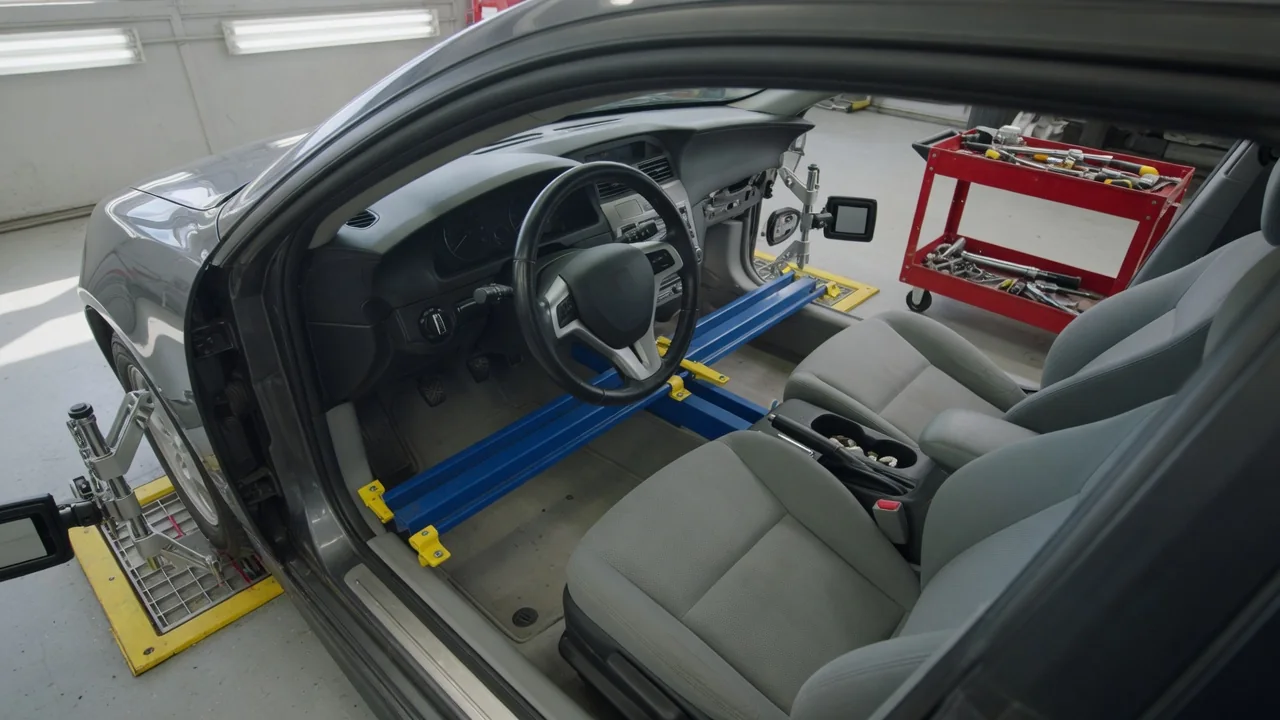
A steering wheel that sits off-center after an alignment is a common complaint. The car may track straight, yet the wheel spokes tilt to one side, or the car drifts unless the driver holds the wheel at an angle. Most often the cause is one of three things: how front toe was split between the two wheels, how the steering was positioned during adjustment, or a condition the alignment did not address.
Toe Setting: How Individual Toe Positions the Steering Wheel
Toe describes whether the front edges of the tires point toward each other or away from each other when viewed from above. Alignment specifications usually list a total toe value for the axle and often a value for each wheel. A technician can bring total toe within specification while leaving one wheel pointed slightly more inward than the other. The vehicle then rolls straight only when the steering is turned enough to even out the two sides, and that turn shows up as a tilted steering wheel.
On most vehicles with rack-and-pinion steering, toe is adjusted by turning the tie rods that connect the steering rack to each steering knuckle. If one tie rod is lengthened and the other shortened by the same amount, total toe stays the same, but the steering rack rotates relative to the wheels, and that moves the steering wheel. This is why centering the wheel is a toe adjustment. The correct fix is to split toe evenly between both sides while the steering is held centered, not to change total toe.
Rear toe matters too. If the rear wheels do not point along the vehicle's centerline, the rear axle pushes the car slightly sideways. The direction the rear axle steers the car is called the thrust line, and its angle from the centerline is the thrust angle. If the front wheels are set to the geometric centerline instead of the thrust line, the steering wheel has to be turned to keep the car going straight. A four-wheel alignment normally sets front toe relative to the thrust line, or corrects rear toe first where the suspension allows it.
Wheel Position: What Happens at the Steering Wheel Itself
Before adjusting front toe, a technician typically centers the steering wheel and locks it in place with a steering wheel holder. If the wheel shifts during adjustment, or was not precisely centered to begin with, the toe values can look correct on the alignment screen while the steering wheel ends up slightly off. Settling can also play a role. After the vehicle is lowered and driven, the bushings and tires take up their normal loaded position, and a small offset may appear that was not visible on the rack.
It is tempting to think the steering wheel can simply be removed and reinstalled one spline over. On most modern vehicles this is not an appropriate fix. The spline steps are usually too coarse for a fine correction, and the airbag and clock spring complicate removal. Moving the wheel without addressing toe also leaves the steering rack off its center point. Many vehicles use a steering angle sensor for stability control or driver-assistance functions. On those vehicles, the sensor may need recalibration after alignment work, and the procedure varies by manufacturer.
Not every off-center wheel comes from the toe setting. Several other conditions can make the car pull: • a side-to-side difference in caster or camber; • a tire with an internal construction issue; • uneven tire pressure; • worn steering or suspension parts; The driver then holds the wheel off-center to go straight. From the driver's seat this looks the same as an uneven toe split, but the cause is different.
Shop Follow-Up: Getting the Steering Wheel Centered
If the steering wheel is off-center after an alignment, return to the shop soon and describe the symptom precisely. Note which direction the wheel tilts, roughly how far, and whether the car also drifts on a flat, straight road. Mention whether the offset appears at all speeds or only on certain road surfaces. Some shops treat a crooked wheel right after their own alignment as a correction to that job, but policies differ, so ask how they handle it.
Bring the alignment printout to the conversation and ask these questions: • Were the readings taken with the steering wheel locked in the centered position? • Was thrust angle checked? • Were the individual front toe values balanced side to side? • If caster or camber differ noticeably between sides, is that difference within the manufacturer's side-to-side specification? • On vehicles with a steering angle sensor, was a reset or calibration performed after the adjustment?
If the shop suspects the tires rather than the alignment, it may swap the front tires side to side or rotate them front to rear to see whether the pull follows a tire. This separates a tire-related pull from an alignment problem without guesswork. If worn components are found, they generally need to be replaced and the alignment repeated, because adjusting around loose parts does not hold.
Practical Implications and Limits
When the only cause is an uneven toe split, an off-center steering wheel is mostly a comfort and confidence issue. Total toe, which has the largest effect on tire scrub, may still be correct. It still deserves correction. A tilted wheel makes it harder to judge the straight-ahead position and can feel unsettling during lane changes. On vehicles with driver-assistance features, it can sometimes affect systems that rely on steering angle input. When the offset comes from a pull, mismatched angles, or worn parts, uneven tire wear and less precise steering become more likely over time.
Some offset is normal under certain conditions. Most roads are crowned so water runs off, which can make a vehicle drift slightly toward the edge of the road. As a result, the wheel may sit a little off on one road but not on another. Strong crosswinds and uneven pavement have similar effects. A fair check is a level, straight, lightly traveled road, ideally driven in both directions.
There are limits to what any alignment can achieve. Each manufacturer sets its own tolerances for steering wheel position, toe, and other angles, and they are found in the service information for the specific vehicle. Some vehicles offer limited or no adjustment for certain angles without aftermarket parts, and bent or damaged components cannot be aligned back into specification. Adjusting tie rods at home without alignment equipment can change total toe and cause tire wear problems. A measured correction on an alignment machine remains the dependable approach.