Why Does a Gearbox Need Different Ratios?
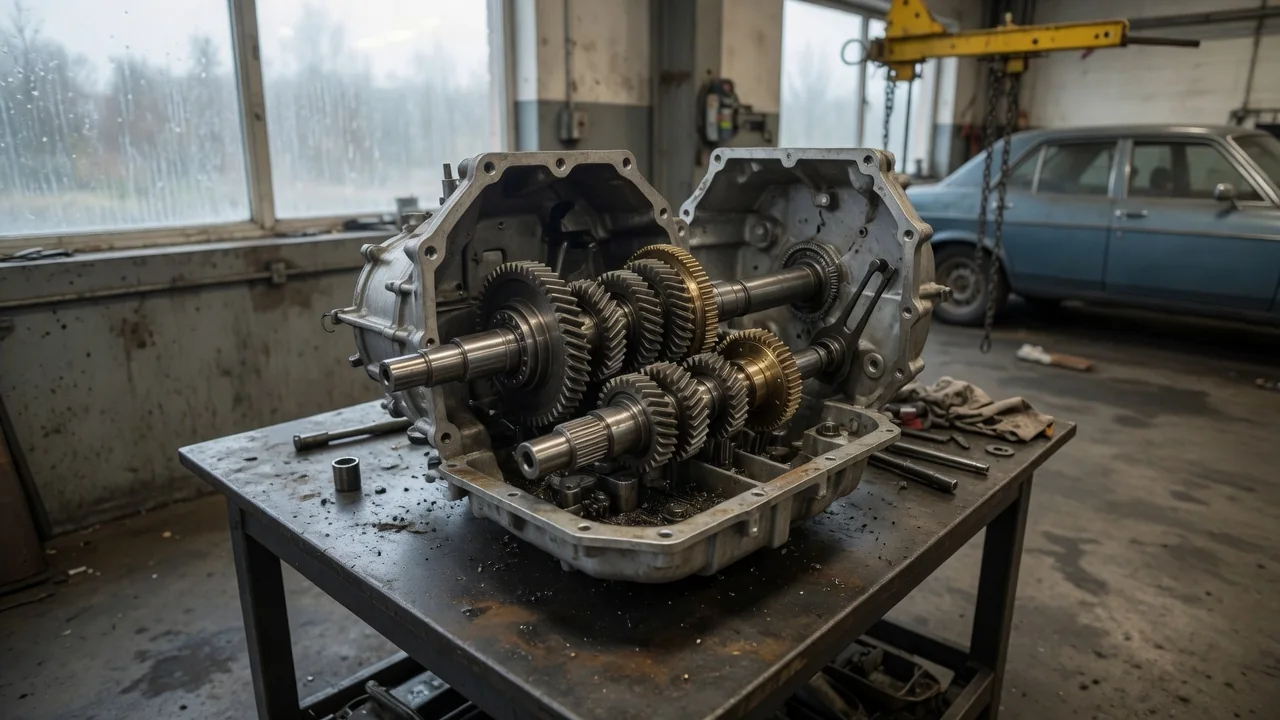
An engine and a set of wheels want very different things. The engine works only within a limited speed range, while the wheels must turn anywhere from a crawl to highway speed. A gearbox bridges that gap. Its different ratios let the same engine deliver strong pulling force from a standstill, turn slowly and quietly at cruise, and stay near its most efficient operating zone. A single fixed ratio cannot do all three jobs, and the sections below explain why.
Launch Force: Multiplying Torque From a Standstill
A gear ratio describes how many times the input shaft turns for each turn of the output shaft. When a small gear drives a larger one, output speed drops and output torque rises in nearly the same proportion, minus a small amount lost to friction. This trade is the core reason a gearbox exists. Moving a stationary vehicle requires overcoming its inertia, rolling resistance and, on a slope, the force of gravity pulling it backward. The engine alone often cannot supply that much twisting force at the wheels, especially at the low engine speeds at which the car first begins to move.
The lowest gear therefore uses the deepest reduction in the transmission. Combined with the final drive in the axle or transaxle, it multiplies engine torque substantially before that torque reaches the tires. The cost is speed: in first gear the engine approaches its upper rpm limit while the vehicle is still moving slowly, which is why the gearbox must eventually shift. There is also a second problem at launch. An internal combustion engine cannot produce torque at zero rpm, so something must allow the engine to keep running while the wheels are stopped. In a conventional automatic, the torque converter handles this by coupling the engine to the transmission through fluid, with slip. Many torque converters also provide some torque multiplication of their own while the turbine turns much slower than the engine-driven impeller, which helps further during takeoff. Other automatic designs, such as dual-clutch units, use controlled clutch slip for the same purpose.
Cruising: Letting the Engine Turn Slowly
Once the vehicle reaches a steady speed on level ground, the force required to keep it moving is far smaller than the force needed to accelerate it. The main resistance comes from aerodynamic drag and tire rolling resistance. Drag grows rapidly as speed rises, but at typical cruising speeds the engine is usually supplying only a fraction of what it can produce. If the car stayed in a low gear, the engine would have to spin very fast to maintain highway speed, wasting energy on internal friction, raising noise and adding wear for no useful gain.
Higher gears solve this by using a numerically smaller ratio, so each engine revolution moves the car farther. Many automatics include one or more overdrive gears, in which the output shaft turns faster than the input shaft. This lets the engine run at a relaxed speed on the highway while keeping some reserve for gentle grades or a headwind. At cruise, a lockup clutch inside the torque converter typically engages to create a mechanical connection between engine and transmission, removing the slip that was useful at launch but wasteful at steady speed. When the driver asks for more acceleration to pass or climb, the transmission downshifts to a lower ratio and regains the wheel torque it gave up for quiet, economical cruising.
Efficiency: Keeping the Engine in Its Best Range
An engine does not convert fuel into work equally well at every combination of speed and load. In broad terms, many engines are most efficient at moderate to fairly high load and at low to middle rpm. Gasoline engines in particular lose energy at very light throttle, because the partly closed throttle makes the pistons work harder to draw in air, an effect often called pumping loss. Choosing a taller gear for a given road speed lowers rpm and asks the engine to work at a higher load, which often moves it toward a more efficient operating point.
This is where the number of ratios and the spread between them matter. The transmission gear ratio range, often called ratio spread, is the lowest gear's ratio divided by the highest gear's ratio. A wider range allows a deep first gear for launch and a tall top gear for cruising within the same unit. More individual gears between those extremes reduce the rpm drop at each upshift, so the control system can keep the engine closer to its preferred zone during acceleration and across varying road speeds. A continuously variable transmission pursues the same goal by changing its ratio smoothly instead of in fixed steps.
More ratios are not free, though. Additional gears, clutches and planetary sets add weight, cost, packaging difficulty and internal friction, and frequent shifting can feel busy to some drivers. Every gear mesh, bearing and spinning clutch pack loses a little energy, as does the pump that circulates transmission fluid. Designers balance these losses against the gains from better engine operation, which is why the right number of gears depends on the engine, vehicle weight and intended use rather than on a single universal answer.
Practical Implications and Limits
For drivers, the most visible result of different ratios is how the transmission responds to the accelerator. Pressing firmly usually triggers a kickdown to a lower gear, while gentle driving brings early upshifts. On long climbs or when towing, a transmission may shift back and forth between two gears if neither ratio suits the load well; tow or haul modes, where fitted, change shift timing to reduce this. Selecting a lower gear manually on a long descent uses engine braking to help control speed and reduce brake heating. Exactly how and when a given transmission shifts is set by its control software and varies between vehicles, so the owner's manual is the right reference for available modes and recommendations.
It is also worth remembering what gearing cannot do. Ratios trade speed for torque, but they cannot create power; the maximum power reaching the wheels is always limited by what the engine produces minus drivetrain losses. Changes that alter the effective overall ratio, such as fitting tires of a noticeably different diameter, can affect acceleration, cruising rpm, speedometer accuracy and shift behavior. Heavy loads at low speed with a slipping torque converter generate heat in the transmission fluid, which is one reason towing guidance and fluid service intervals deserve attention. Knowing why a gearbox needs different ratios makes these behaviors easier to interpret and to use sensibly.