Why Does a Dual-Clutch Gearbox Have Two Input Shafts?
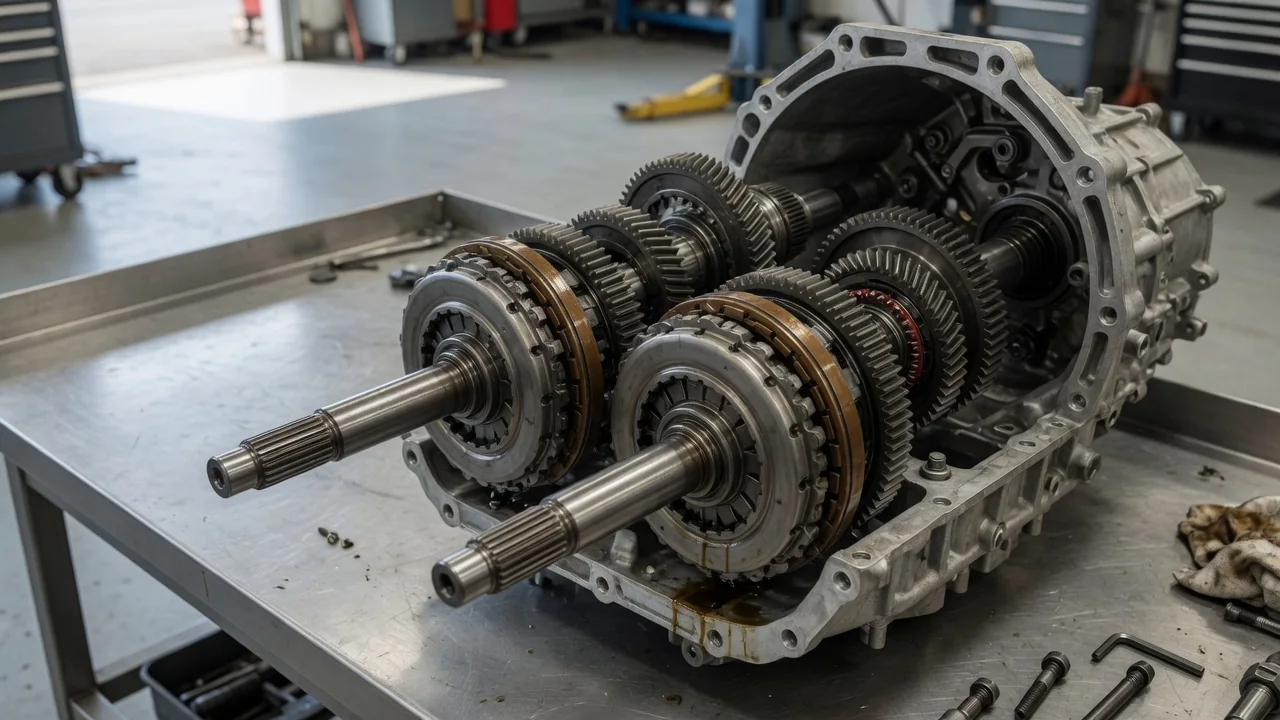
A dual-clutch gearbox behaves like an automatic from the driver's seat, but inside it works more like two manual gearboxes sharing one case. The reason is a pair of input shafts, each driven by its own clutch. So why does a dual-clutch gearbox have two input shafts? Splitting the gears between them lets the transmission get the next gear ready before it is needed, then swap clutches instead of interrupting power. The sections below explain how that works and what it means in everyday use.
Odd and even gears
In a conventional manual gearbox, a single clutch connects the engine to a single input shaft, and every forward gear is driven from that shaft. To change gear, the clutch must open, cutting the flow of torque, while a synchronizer disengages the old gear and engages the new one. A dual-clutch transmission avoids that gap by dividing the gear set into two groups. In the typical layout, one input shaft carries the odd-numbered gears (first, third, fifth and, where fitted, seventh), while the other carries the even-numbered gears. Each shaft has its own clutch, so either group can be connected to the engine independently of the other.
The odd and even split is not arbitrary. In normal driving the gearbox moves up or down one ratio at a time, so consecutive gears always sit on opposite shafts. That means the gear currently in use and the gear most likely to be needed next never compete for the same shaft. Reverse is also assigned to one of the two shafts, and its placement varies by design. Which shaft carries the odd gears, and whether first gear sits on the inner or outer shaft, likewise differs among transmissions, but the alternating principle is common to dual-clutch designs in general.
Shift preparation
Because the two halves of the gearbox are separate, the half that is not transmitting torque can be prepared in advance. While the car accelerates in second gear through the even-gear clutch, the odd-gear clutch is open and its shaft is not carrying load. The control system can use the shift forks and synchronizers on that idle side to engage third gear ahead of time. Nothing changes at the wheels yet, because the clutch feeding third is still disengaged. This step is usually called preselection.
When the shift is commanded, the actual change is a handover between clutches. The clutch for the current gear releases while the clutch for the preselected gear applies, and the control unit times the overlap so that torque passes from one path to the other without a deliberate break. The mechanical work of moving synchronizers has already been done, so the shift itself becomes a matter of clutch control. This is the core reason for the two input shafts: a single shaft cannot have two different ratios engaged and ready at once without the gearbox binding against itself.
Preselection depends on prediction. The control unit typically judges the next gear from inputs such as road speed, throttle position, and whether the car is accelerating or slowing, then prepares an upshift or downshift on the idle shaft accordingly. If the driver does something unexpected, such as pressing hard for a downshift while an upshift has been prepared, the idle shaft has to be reselected before the clutch swap can happen. Shifts between two gears on the same shaft, for example from sixth to fourth, cannot be preselected directly while the current gear is engaged, so the transmission may pass through a gear on the other shaft or accept a slightly slower shift.
Packaging
Two input shafts would be impractical if they sat side by side with two separate clutch housings. Most dual-clutch transmissions instead arrange the input shafts concentrically: a hollow outer shaft surrounds a solid inner shaft, and the two rotate independently on bearings. The inner shaft extends farther into the gearbox and carries its drive gears beyond the end of the outer shaft, while the outer shaft carries its gears closer to the clutch end. Both clutches sit at the engine side of the gearbox, either nested one inside the other or placed one behind the other, and each connects to its own shaft.
This arrangement lets the gearbox take power from the engine through a single connection while still offering two independent power paths. Overall length can stay close to that of a comparable manual gearbox, which matters especially in transverse front-wheel-drive layouts where space across the engine bay is limited. Many designs also spread the driven gears across more than one output shaft to shorten the case further, and some share gearwheels between ratios. These details change from one transmission to another, but the concentric input shafts are the feature that makes a compact two-path layout possible.
Practical implications and limits
For the driver, the two-shaft layout mostly shows up as quick, smooth shifts under steady acceleration, when the gearbox's predictions are usually right. Its limits appear in other conditions. Pulling away and creeping in traffic rely on controlled clutch slip, much as a driver slips a manual clutch, and slipping generates heat. Designs with dry clutches generally have less capacity to shed that heat than designs with clutches running in fluid, so prolonged creeping, holding the car on a hill with the throttle, or repeated stop-and-go maneuvers may lead to shudder, warnings, or protective behavior in some transmissions.
The split design also means a fault can affect only part of the gearbox. A problem with one clutch, its actuator, or a shift fork on one shaft may leave the other gear group working, and many transmissions respond by restricting operation to the remaining gears in a fail-safe mode. Symptoms that appear only in odd or only in even gears can therefore point a technician toward one half of the unit. Clutch engagement points also shift with wear, which is why many dual-clutch gearboxes use adaptation routines. Maintenance needs, such as fluid service or clutch relearning after repairs, should be taken from the specific vehicle's service information rather than assumed.