Why Does a Driveshaft Need Universal Joints?
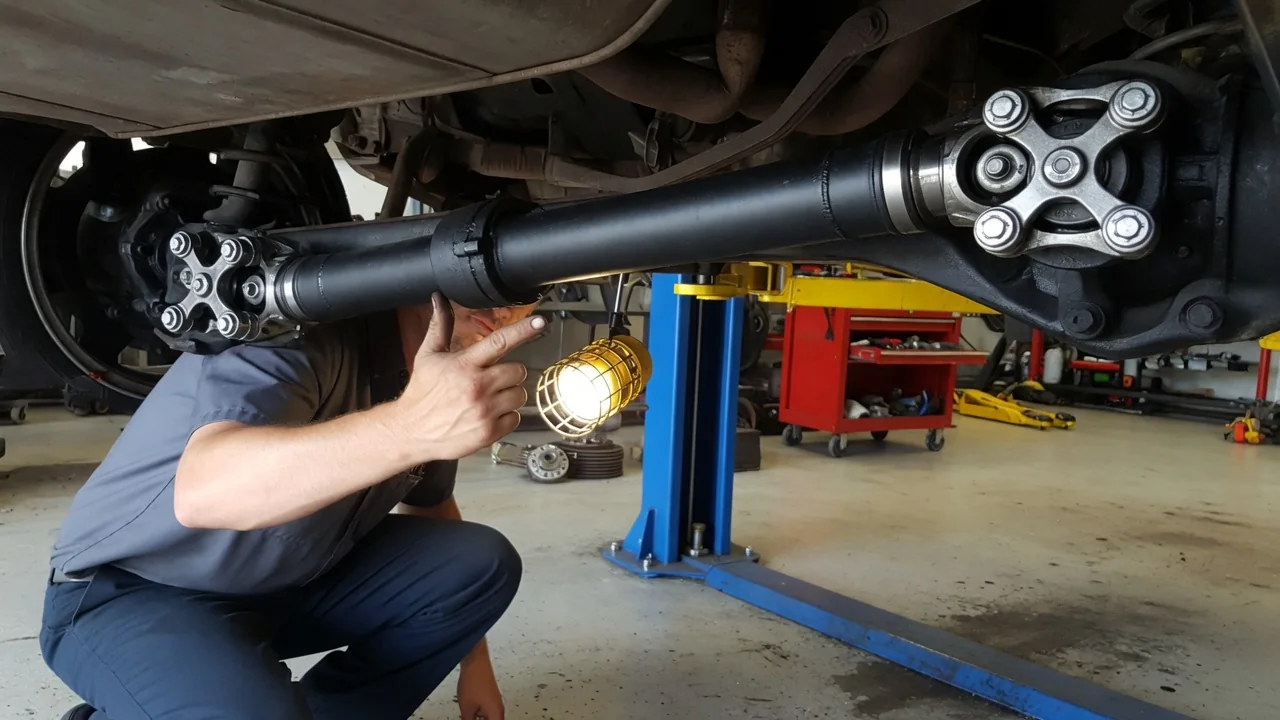
A driveshaft carries torque from the transmission or transfer case to a drive axle, but the parts it connects are rarely in a straight line, and they do not stay in one position. Universal joints let a solid shaft keep turning through those angles. Understanding how a driveshaft universal joint works explains why the joints are built the way they are, why their angles matter, and why worn joints cause the clunks and vibrations many owners eventually notice.
Changing angle
In a typical rear-wheel-drive or four-wheel-drive layout, the transmission output sits higher than the axle pinion and is usually tilted at its own angle. The driveshaft has to bridge that offset. The axle end also moves. On a vehicle with a solid rear axle, the housing rises and falls as the suspension compresses and extends over bumps, sags under passengers or cargo, and can twist slightly under acceleration and braking. Because of this movement, the angle between the driveshaft and the parts at each end changes continuously while the vehicle is moving. A rigid coupling cannot follow that motion. It would force the shaft to bend or would overload the bearings and seals at the transmission and axle, and something would eventually fail.
A universal joint solves this problem with a simple arrangement. Two yokes, one on the driveshaft and one on the mating component, are set at right angles to each other. They are connected by a cross-shaped part called a spider or cross. Each of its four arms, called trunnions, rides in a bearing cap, usually filled with needle bearings. One yoke pivots on one axis of the cross and the other yoke pivots on the perpendicular axis, so the joint can flex in any direction while still transmitting torque. Changes in shaft length as the suspension moves are a separate issue. A slip yoke or splined section usually handles length changes, while the universal joint handles angle.
Rotation
A universal joint transmits rotation through an angle, but not perfectly smoothly. When a single Cardan-type joint runs at an angle, its output side does not turn at a constant speed even if the input does. During each revolution, the output speeds up and slows down twice relative to the input. The average speed stays the same, but the fluctuation grows as the operating angle increases. When the two shafts are perfectly in line, the fluctuation disappears. This behavior comes from the geometry of the joint itself. It is not a manufacturing defect, and a new joint does it just as much as an old one.
Driveshafts usually use joints in pairs so that this effect cancels out. With one joint at each end, the yokes on the two ends of the shaft are aligned in the same plane, which is called being in phase. When the front and rear operating angles are also close to equal, the second joint undoes the speed variation introduced by the first. The shaft between them still speeds up and slows down slightly, but the axle pinion receives rotation that matches the transmission output. This is why yoke phasing and the relationship between pinion angle and transmission angle matter. Depending on the design, a vehicle may instead use a two-piece shaft with a center support bearing, a double Cardan joint, or constant velocity joints. The arrangement varies from vehicle to vehicle.
Wear
The working surfaces of a universal joint are the needle bearings and the trunnions they ride on. Because the joint flexes back and forth instead of spinning freely, the needles roll through a partial arc on every revolution rather than turning completely. Grease inside each bearing cap, held in by seals, keeps these surfaces from wearing directly against each other. Some joints have grease fittings for periodic service, while many are sealed and cannot be lubricated. If a seal fails, the grease can escape and water, road salt and dirt can enter. Corrosion and abrasive wear then develop, and the joint gradually gains play.
Operating angle affects wear in both directions. A large angle increases the load on the bearings and the speed fluctuation described above, which speeds up wear and can cause vibration. A joint that runs at essentially no angle can also suffer, because the needles barely move. They press against the same spots on the trunnion and can dent the surface, a condition known as brinelling. For this reason, many driveline designs intend the joints to run at a small working angle rather than perfectly straight. Front and rear angles that do not match also put extra stress on the joints, because the vibration they create loads the bearings on every revolution.
Worn joints commonly cause a clunk when shifting between drive and reverse or when getting on and off the throttle. They can also cause a squeak or chirp at low speed that follows wheel rotation, a vibration that grows with road speed, or rust-colored residue around the bearing caps. None of these symptoms is unique to universal joints. Other driveline and suspension parts can produce similar effects, so a physical inspection is needed before drawing a conclusion.
Practical implications and limits
Anything that changes ride height or axle position can change driveline angles. Examples include lift kits, lowering kits, tired springs, worn suspension bushings and different load conditions. A vehicle that was smooth from the factory may develop vibration or faster joint wear after such changes, even with new parts. Corrections such as pinion angle shims, adjustable control arms or different joint types exist for this reason, but the correct angles depend on the vehicle. They should come from the manufacturer's service information or the component maker's guidance, not from a general rule.
Before removing a driveshaft, it is good practice to mark its orientation at each end. Reinstalling it the same way preserves the phasing and balance. With the vehicle safely supported, a joint can be checked by hand for play and roughness, and greaseable joints should be serviced on the schedule in the owner's or service manual. Keep the limits of this explanation in mind. Front-wheel-drive axle shafts use constant velocity joints rather than conventional universal joints. Joint type, layout and angle specifications differ between vehicles. Driveline vibration can also come from shaft balance, tires or mounts, so a worn joint is only one possible cause to rule in or out.