Why Does a Driveline Clunk When Load Reverses?
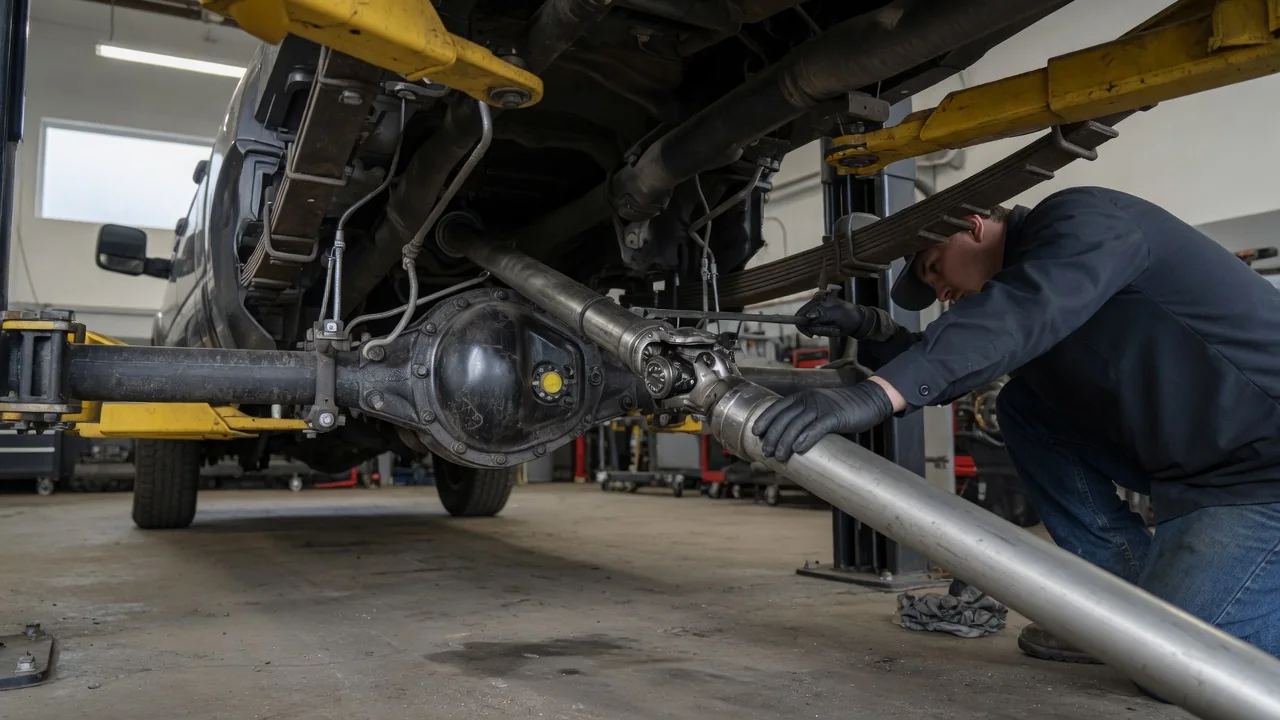
A single clunk when you lift off the throttle, get back on it, or shift between drive and reverse is one of the most common driveline complaints. In most cases the sound is slack being taken up as torque changes direction. Every driveline has some built-in clearance. The noise appears when that clearance grows, when mounts let parts move too far, or both. Here is how clearance, mounting, and diagnosis fit together.
Clearance
Under acceleration, the engine drives the wheels, so every gear tooth and spline in the driveline presses against one side of its mating part. On deceleration the wheels drive the engine instead, and contact shifts to the opposite flank. Between those two states the parts rotate freely through whatever gap exists, then stop abruptly against the other side. That sudden stop is the clunk. The gap is the sum of small clearances in several places: transmission gears, the ring and pinion, the differential side and spider gears, axle shaft splines, slip yoke splines, and universal or constant velocity joints. Each one may be small. Together they can let the driveline rotate a noticeable amount before torque is transmitted in the new direction.
Wear usually turns acceptable clearance into an audible complaint. Universal joints develop play when their needle bearings or trunnions wear. Constant velocity joints loosen as balls, cages, and races wear, and that wear speeds up quickly once a torn boot lets dirt and water in. Splines on slip yokes and half-shafts can wear. Dry slip yoke splines may also bind and then release with a clunk as the driveshaft changes length. Inside the differential, several faults add free movement: worn pinion bearings, lost bearing preload, worn side gear thrust washers, or increased ring and pinion backlash. Loose axle hub nuts or wheel fasteners can make a similar knock and need immediate attention.
Some clearance is intentional. Gears need backlash for lubrication and thermal expansion, and splines need room to slide. A faint, consistent clunk can therefore exist on a healthy vehicle, especially one with a long driveline or many joints. The acceptable amount of play is specific to each component and vehicle. Judging whether it is excessive requires the manufacturer's service information, not a general rule.
Mounting
Clearance determines how far parts rotate before contact. Mounts determine how far the whole assembly moves while that happens. Engine and transmission mounts resist reaction torque, which tries to twist the powertrain opposite to the direction the driveline turns. When torque reverses, the powertrain rocks the other way. Healthy rubber or fluid-filled mounts control that motion and absorb the shock. Mounts fail in several ways: the rubber cracks, separates from its metal plates, or collapses, or a hydraulic mount loses its fluid. The engine and transmission can then travel farther and strike internal stops or nearby components. The extra motion also briefly changes driveshaft and axle angles, which can load joints unevenly and make existing play more audible.
The axle end matters as much as the engine end. On a solid rear axle, worn leaf spring bushings, loose U-bolts, worn shackles, or tired control arm bushings let the housing rotate as torque changes. This movement is often called axle wrap. Independent rear suspension designs mount the differential to a subframe with bushings that wear in the same way. Two-piece driveshafts rely on a center support bearing whose rubber cushion can tear. Any of these can let a component shift and hit something when load reverses.
Loose fasteners create similar symptoms. Driveshaft flange bolts, U-joint straps or clamps, and mount bolts that have backed off allow movement at the joint itself. A rocking powertrain can also push the exhaust pipe or a heat shield against the body or a crossmember. The resulting knock sounds like a driveline fault but is really a clearance problem around the exhaust.
Diagnosis
Start by describing exactly when the noise happens. A clunk that appears only between acceleration and deceleration, or when engaging drive or reverse, points toward driveline lash or mounts. A noise that follows bumps regardless of throttle suggests suspension or steering parts. A clunk or click mainly while turning is more typical of constant velocity joints. A knock when the vehicle first moves after stopping can also come from brake calipers or pads shifting in their brackets. That is another form of load reversal, outside the driveline.
Support the vehicle safely on stands, chock the wheels as appropriate, and put the transmission in a position that lets the driveshaft turn. Rotate the driveshaft back and forth by hand and watch where the movement occurs. Free rotation that stops at the differential is mostly gear backlash. Movement visible inside a U-joint cap, at the slip yoke, or between a flange and its yoke indicates play at that point. Try to move each U-joint across its axis and feel for looseness. Grab the pinion flange and check for in-and-out or up-and-down movement, which can indicate worn or improperly preloaded pinion bearings. On front-wheel-drive and independent setups, inspect CV boots for tears and grease spray, and check half-shafts for rotational play at the joints. Low or metal-laden differential fluid supports a wear diagnosis.
Inspect mounts for cracks, separation, and fluid leakage, then watch how the powertrain moves. A common method uses a helper in the driver's seat, who holds the brakes firmly while gently shifting between drive and reverse or applying light throttle. Observe the engine from the side, and keep everyone clear of the front and rear of the vehicle. Excessive lift or rocking identifies a weak mount, and witness marks on the exhaust or body show contact points. Harsh engagement from inside an automatic transmission can sound similar, and it requires separate transmission diagnosis.
Practical implications and limits
Urgency depends on change, not on whether a clunk exists. A faint noise that stays the same over months may simply reflect normal clearance. Get prompt attention for a clunk that grows louder or comes with new vibration, grinding, clicking, or leaks. Worn U-joints and CV joints can progress to failure, and a separated driveshaft or broken axle shaft can cause loss of drive or vehicle damage. Smooth throttle transitions reduce the shock on worn parts, but they only mask the symptom.
Because lash is cumulative, replacing one part often reduces the noise without eliminating it. A new U-joint will not remove play in worn differential gears, and new mounts will not stop clunking from worn splines. Finding the largest contributor first avoids replacing parts by guesswork. Some repairs are straightforward component swaps. Differential work is different: it involves measuring backlash and bearing preload with special tools, following vehicle-specific procedures and torque values. Sound also travels through the body structure, so a clunk heard near the rear seat may come from somewhere else entirely.