Why Does a Car Still Have a 12-Volt Battery if It Is Electric?
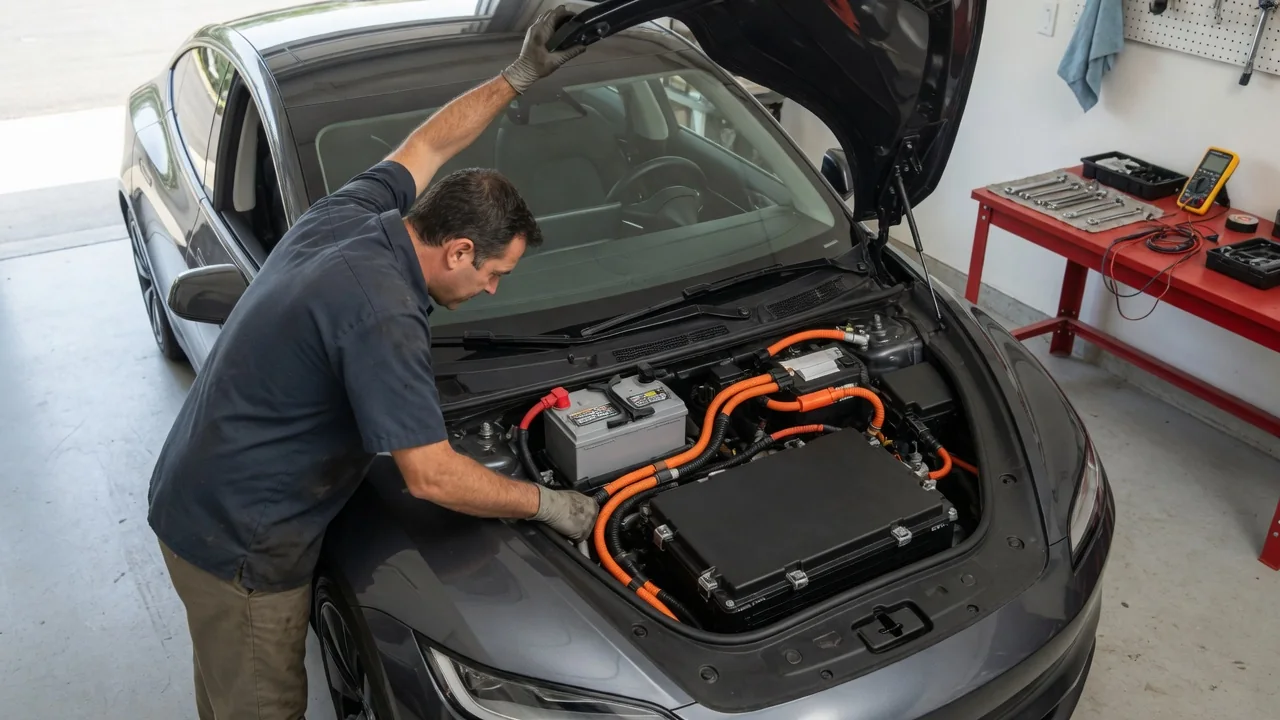
It seems odd at first: a vehicle carrying a huge traction battery still relies on a small 12-volt one. People often ask why does a car still have a 12 volt battery if it is electric, and the answer lies in how the car is organized. The high-voltage pack moves the vehicle, while a separate low-voltage system wakes it up, runs its computers, and keeps it safe.
Control systems
An electric car's traction pack operates at hundreds of volts, far too much for the small electronics spread throughout the cabin and body. Control modules, door locks, window motors, lighting, wipers, the infotainment screen, and airbag circuits are designed around a low-voltage supply, much as they are in gasoline vehicles. Keeping that architecture lets manufacturers use proven, widely available components and keeps dangerous voltage confined to a few heavily insulated, clearly marked cables and enclosures rather than running through every switch and connector.
The low-voltage battery also plays a gatekeeping role. When the car is parked, the traction pack is normally isolated by heavy switches called contactors, which stay open until the control computers decide it is safe to close them. Those computers and the contactor coils need power before the big battery is connected, so the small battery supplies it. Drivers see this as the brief moment between unlocking the car and the ready indicator appearing. Exact wake-up behavior differs by manufacturer and model.
Power conversion
Electric cars have no belt-driven alternator. Instead, a DC-to-DC converter steps the traction pack's high voltage down to the level the accessory system needs, powering low-voltage loads and recharging the small battery whenever the vehicle is on or charging. In that sense the converter does the alternator's job without any moving parts. Once the car is in its ready state, most of the accessory demand is carried by the converter, with the small battery acting as a buffer that steadies the supply.
What happens while parked varies. Some vehicles periodically wake themselves to top up the low-voltage battery from the main pack, while others only do so under certain conditions or when plugged in. The battery itself may be a conventional lead-acid unit, an absorbent glass mat type, or a compact lithium design, and a few newer platforms use a different low-voltage level altogether. Because of these differences, the owner's manual is the best guide to how a particular car maintains its accessory supply.
No-start symptoms
A weak or discharged low-voltage battery can leave an electric car immobile even when the traction pack shows plenty of range. Without enough power to boot the control modules and close the contactors, the high-voltage energy stays locked away. Typical signs include a car that will not unlock or wake, a dark or flickering display, a refusal to shift into drive or enter the ready state, and a cluster of warning messages that appear at once.
Low supply voltage can also make modules behave erratically, storing communication or voltage-related fault codes that point in many directions. Those codes are evidence to interpret, not proof that a particular part has failed, and their meaning is often manufacturer-specific, so they need to be confirmed against information for the exact vehicle. A technician will usually test the low-voltage battery and its charging path first, since restoring a stable supply sometimes clears a confusing list of secondary warnings.
Everyday Use and Observations
In daily driving the small battery is nearly invisible. It is what lets the key fob or phone app wake the car, keeps alarm and telematics functions alive while parked, and powers hazard lights if the high-voltage system shuts down. Owners may notice the car clicking softly shortly after unlocking, which is often the contactors closing, or hear pumps and fans running briefly as systems come online. These sounds and their timing vary by design.
Usage habits influence how hard the low-voltage battery works. Features that keep the car awake while parked, such as cabin monitoring, frequent app check-ins, or accessories plugged into power outlets, draw from it between converter top-ups. Long periods of storage, very short trips, and extreme temperatures can also wear it. Some cars display a low-voltage battery warning well before trouble starts, while others give little notice, so an unexpected message of that kind deserves prompt attention rather than a wait-and-see approach.
Limits and Next Steps
The small battery has clear limits: it cannot move the car, and the traction pack cannot help if the low-voltage side is too depleted to wake the electronics that connect it. Many electric vehicles provide a designated way to supply external low-voltage power in that situation, but the location, method, and precautions differ widely, and some manufacturers restrict using the car to boost another vehicle. Following the owner's manual, or calling roadside assistance, is safer than improvising.
Orange cables and the components attached to them belong to the high-voltage system and should be left to trained technicians. For the low-voltage battery, sensible next steps are having it tested during routine service, asking whether software updates affect how it is charged, and replacing it with the type the manufacturer specifies, since some cars need the new battery registered with the control system. Replacement timing depends on climate, usage, and battery chemistry, so vehicle-specific guidance matters more than general rules.