Why Does a Car Need a Steering Column Joint?
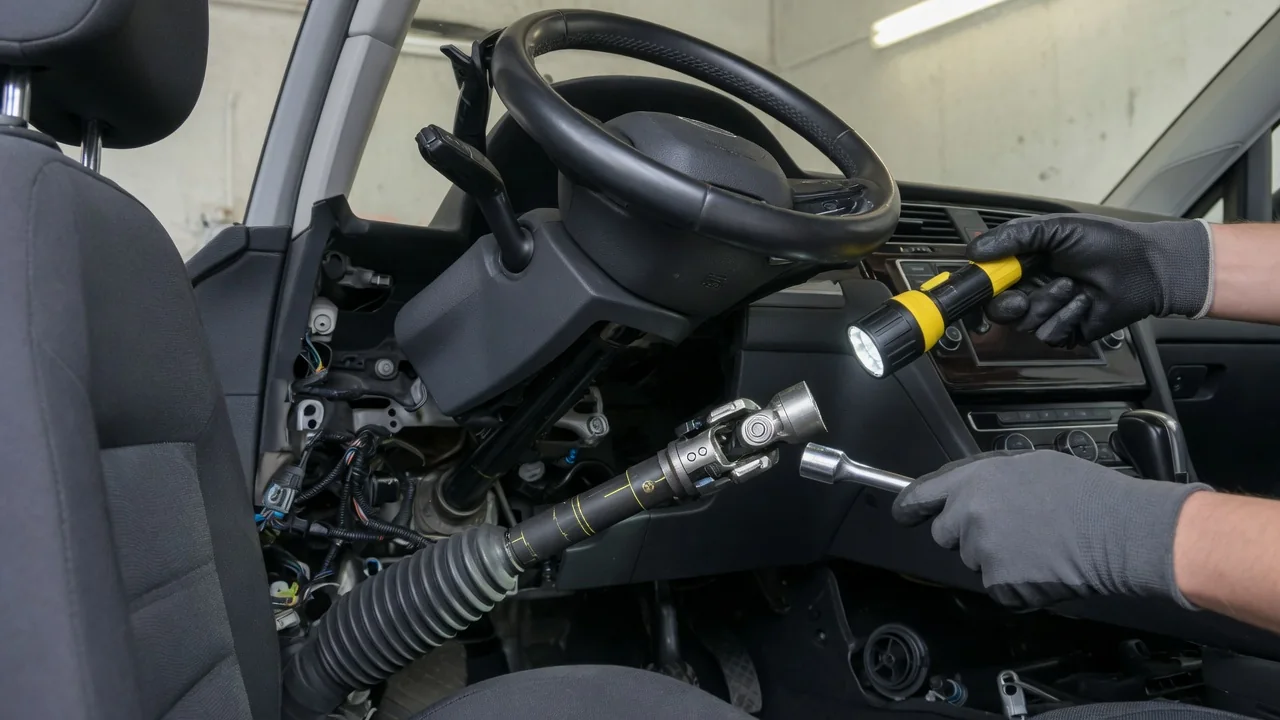
A steering column joint sounds like a minor part, but most cars cannot steer without one. The steering wheel sits in front of the driver. The steering rack or gearbox is mounted low in the engine bay, often off to one side and at a different angle. So why does a car need a steering column joint? It lets one shaft turn another through an angle and carries the driver's effort to the steering gear. It also has to cope with tight packaging, crash safety requirements, and wear.
Angle change: linking a wheel and a gear that do not line up
The steering wheel is placed for the driver's comfort and visibility, usually tilted toward the driver's chest. The steering gear, whether a rack-and-pinion unit or a recirculating-ball box, is placed to suit the suspension geometry, the front subframe, and the engine. These two points rarely share a straight axis. A single rigid shaft between them would have to pass through the engine, the brake booster, or the exhaust, which is not possible in a typical engine bay. A steering column universal joint solves this by letting the shaft bend at a defined point while the whole assembly still rotates as one.
Most layouts use an upper column inside the cabin and a shorter intermediate shaft that passes through the firewall to the steering gear input. One or more joints connect these pieces, so the shaft can route around other components. The most common design is a Cardan-type universal joint, in which two yokes are connected by a cross-shaped spider that pivots in bearing caps. Adjustable columns are another reason the shaft must articulate. When the driver tilts the wheel, the angle between the column and the intermediate shaft changes, and the joint must accept that whole range without binding.
Angle change also matters for crash protection. Many intermediate shafts include a sliding or collapsible section alongside the joints. In a frontal impact, an angled, jointed shaft is less likely than a straight rigid bar to push the column back toward the driver. The exact arrangement differs between vehicles, but this jointed layout is widespread.
Torque transfer: carrying steering effort smoothly
The joint's second job is to transmit torque. When the driver turns the wheel, that twisting force must reach the steering gear's input shaft with as little slack or delay as possible. Any free play in a joint creates a dead zone, where the wheel moves but the front tires do not respond. For this reason, steering joints are built to close tolerances. They usually connect to the shafts through splines clamped by pinch bolts, so the parts cannot rotate relative to each other.
A single Cardan joint working at an angle does not deliver perfectly uniform rotation. Even when the input turns at a steady rate, the output speeds up and slows down twice per revolution, and the effect grows as the angle increases. In steering, this can feel like uneven effort or a slightly irregular response as the wheel turns. Designers counter it by keeping joint angles moderate. Where two joints are used, they arrange the joints so the speed variations of one cancel those of the other. This relationship is called phasing, and it depends on how the yokes are oriented relative to each other and on the two joint angles being similar. That is why some intermediate shafts use a master spline or alignment marks.
Power assistance changes how much torque the joint carries. With hydraulic assistance or a rack-mounted electric motor, the assist is applied at or near the steering gear, so the column and intermediate shaft mainly carry the driver's input. With column-mounted electric power steering, the assist motor adds torque above the intermediate shaft, so the joints carry the combined driver and motor torque. Some designs also include a flexible coupling or rubber element that reduces how much road vibration and noise reaches the steering wheel.
Wear: what happens as steering joints age
A universal joint relies on small bearings, often needle bearings, inside the caps where the spider's arms pivot. Many steering joints are sealed and not meant to be greased in service. Over time, the bearings can lose lubrication, the seals can harden, and moisture can get in. The lower joint and intermediate shaft are especially exposed because they sit in the engine bay or near the firewall. Depending on the vehicle and climate, they face heat, water spray, road salt, and dirt there.
Wear usually shows up in one of two ways. In the first, the bearings loosen and create play. A driver may notice this as a clunk when turning the wheel back and forth, or as a little free movement before the car responds. In the second, corrosion or dry bearings make the joint bind. The steering then feels notchy or sticky, or it is reluctant to return smoothly to center. A binding joint can cause a stepped feeling at certain wheel positions even when the steering gear itself is healthy. Worn sliding sections of the intermediate shaft can also knock over bumps or while turning. Because these symptoms resemble worn tie rod ends, rack mounts, or column bearings, finding the cause usually means watching each joint while someone rocks the steering wheel.
Practical implications and limits
In conventional cars, the steering column joint is part of the only mechanical link between the driver's hands and the front wheels, so it is treated as a safety-critical component. A worn joint is generally replaced, either on its own or as a complete intermediate shaft, rather than rebuilt. Fasteners should be tightened to the specification in the vehicle's service information, and some manufacturers specify that certain pinch bolts must not be reused. Guessing the torque or reusing a damaged bolt is not a sensible shortcut on this part.
Disconnecting the shaft affects more than the joint itself. If the steering wheel spins freely while the shaft is disconnected, the airbag clock spring in the column can be damaged, and the wheel can end up off-center after reassembly. Service procedures typically call for centering and securing the steering wheel and front wheels before separating the shaft, then reinstalling it in the same spline position. If the steering wheel sits crooked right after this kind of work, the shaft may have been reinstalled one spline off. That is a different problem from a wheel alignment fault.
A general explanation has limits. Vehicles differ in the number of joints, whether they use a flexible coupling or slip section, the type of power assistance, and the recommended inspection points. The vehicle's own repair manual remains the reference for a specific car. A joint also cannot correct problems elsewhere in the system. It does not affect camber, caster, or toe, so replacing it will not fix pulling, uneven tire wear, or vague steering caused by other components. Its role is narrower: it lets the steering path bend and delivers the driver's input accurately. When it wears, it reveals itself through play, notchiness, or noise that should be checked promptly.