Why Does a Car Downshift on a Descent?
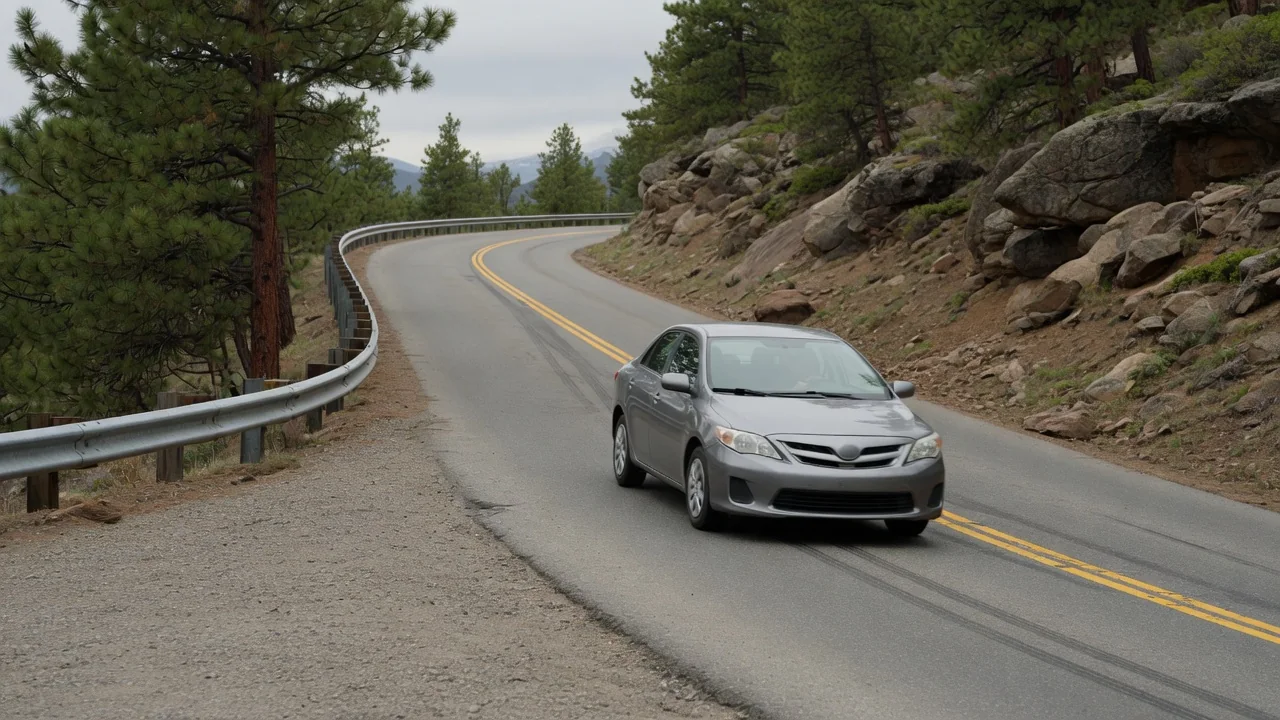
Many drivers notice the engine note rise on a long hill and wonder why does a car downshift on a descent when no extra power is needed. The short answer is speed control: a lower gear lets the engine help hold the vehicle back, easing the load on the brakes. How and when it happens depends on the transmission and its software.
Engine braking
Engine braking is the retarding force created when the wheels turn the engine instead of the engine turning the wheels. With the throttle closed, a gasoline engine works against intake vacuum and its own internal friction, and most modern fuel-injected engines cut fuel delivery during this overrun condition. A lower gear multiplies that resistance because the engine spins faster for a given road speed, so the same hill produces more holding force in a lower ratio than in a tall overdrive gear.
The practical benefit is heat management. Friction brakes convert motion into heat at the pads and rotors, and a long downhill can raise temperatures enough to reduce stopping performance, a condition known as brake fade. Shifting some of that work to the drivetrain keeps the brakes cooler and in reserve for real stops. Drivers will notice higher revs, a louder engine, and the car holding speed with less pedal pressure. The strength of the effect varies with engine size, gearing, vehicle weight, and whether the vehicle is towing.
Grade logic
Many automatic transmissions include grade logic, software that recognizes a downhill and chooses a lower gear without being asked. The control module does not see the hill directly. It infers the slope from clues such as the vehicle gaining speed with the accelerator released, repeated or sustained brake application, and in some vehicles signals from an inclination or acceleration sensor. When those conditions line up, the transmission may hold its current gear rather than upshifting, or step down one or more ratios.
Adaptive cruise and conventional cruise control often use the same strategy, downshifting to keep the set speed from creeping upward on a grade. Tow or haul modes typically make the logic more assertive because a trailer adds momentum the brakes would otherwise have to absorb. Continuously variable transmissions may raise engine speed smoothly instead of producing distinct shifts. Calibration differs widely between manufacturers and even between model years, so one vehicle may respond to a light brake tap while another waits for firmer, longer input.
Driver controls
Drivers are not limited to whatever the software decides. Most automatics offer some way to request a lower gear, whether through a manual gate on the shifter, steering wheel paddles, a low range position, or a button that locks out the highest gears. Selecting a lower ratio before the grade steepens is generally smoother than waiting until speed has already built up. With a manual gearbox, the driver simply chooses a gear that holds a comfortable speed with only occasional braking.
Some vehicles add dedicated features such as hill descent control, which uses the brake system and traction electronics to maintain a slow, steady crawl on steep or loose surfaces. That is a different tool from engine braking and is usually intended for low speeds. Hybrids and electric vehicles often provide a mode that increases regenerative braking, recovering energy while slowing the car. The labels, positions, and behavior of these controls are specific to each model, so the owner's manual is the right place to confirm what each setting does.
Everyday Use and Observations
In daily driving, a descent downshift usually announces itself by sound before anything else. The tachometer climbs, the engine gets louder, and the car stops gaining speed or slows gently, even though the accelerator is released. On a familiar mountain road or a long highway grade, this can happen in the same spot every trip. A slight tug as the gear engages is normal, and the transmission typically upshifts again once the road levels or the driver presses the accelerator.
Conditions change how noticeable the behavior is. A fully loaded vehicle, a trailer, or a roof box increases the push from gravity, so the transmission may downshift sooner or hold a lower gear longer. A cold drivetrain, a sport mode, or active cruise control can also alter shift timing. Elevated revs during a controlled descent are not harmful in themselves, because the control system is designed to keep engine speed within its permitted range and will refuse a shift that would exceed it.
Limits and Next Steps
Engine braking has limits. On a very steep grade or with a heavy load, even a low gear may not hold speed on its own, and the brakes are still needed. Firm, deliberate applications that bring speed down, followed by a release, generally keep temperatures lower than resting on the pedal continuously. On ice, snow, or wet leaves, an abrupt downshift can unsettle the driven wheels, so smoother inputs and lower entry speeds matter more than the gear itself.
It also helps to separate normal strategy from a possible fault. Harsh, banging shifts, a flare in engine speed with no corresponding pull, downshifts on level ground, a burning smell, or a warning light deserve attention. A stored fault code is evidence to interpret alongside other testing rather than proof that a particular part has failed, and many transmission codes are manufacturer-specific and need confirmation for the exact vehicle. A qualified technician can check fluid condition, software updates, and stored data to determine whether anything is wrong.