Why Does a Car Battery Voltage Change Under Load?
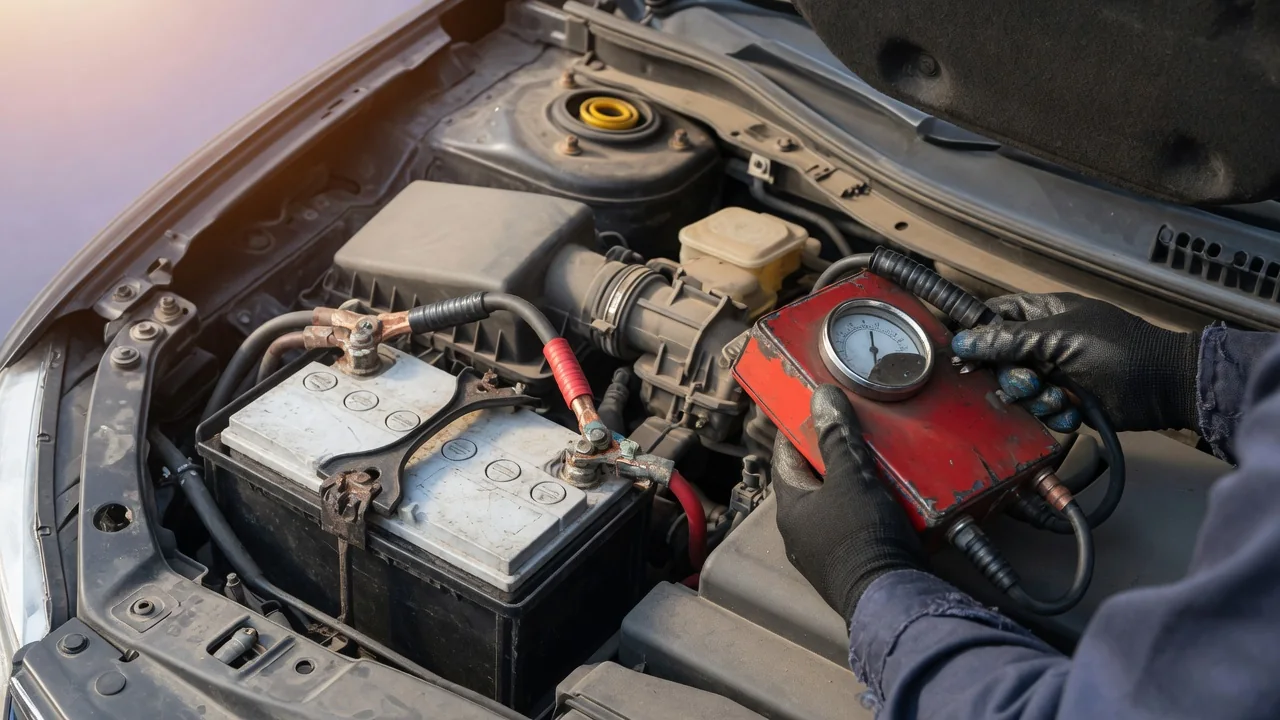
A car battery that reads healthy on a voltmeter at rest can show a much lower number the moment the starter engages or the headlights come on. This is normal behavior, not a meter error. Battery voltage under load changes because every battery has internal resistance, because different loads draw very different amounts of current, and because the chemistry inside the cells cannot respond instantly. These factors explain why a load test reveals more than a simple resting-voltage check.
Internal Resistance: Voltage Lost Inside the Battery
A 12-volt lead-acid battery is not an ideal voltage source. Its plates, the active material on them, the electrolyte, the internal connecting straps and the terminal posts all resist the flow of current to some degree. Together, these effects are called internal resistance. When no current flows, that resistance costs nothing, so the terminal voltage reflects the open-circuit voltage set by the cell chemistry and state of charge. As soon as current flows, part of the battery's voltage is used up pushing current through its own internals. By Ohm's law, the voltage lost inside equals current multiplied by internal resistance, and the terminals see only what remains.
Internal resistance is not fixed. It rises as the battery discharges, because active material converts to lead sulfate and the electrolyte becomes weaker. It rises in cold weather, because chemical reactions slow and the electrolyte becomes more viscous. It also rises with age, as sulfation that no longer reverses during charging, shedding of active material and grid corrosion reduce the battery's ability to deliver current. A battery with high internal resistance may still show a respectable resting voltage yet sag sharply when asked to work. There is also a slower effect often described as polarization: under heavy discharge, acid near the plate surfaces is consumed faster than fresh electrolyte can diffuse in, so voltage keeps drifting down during a sustained load and recovers gradually after it stops.
Current Demand: Why Bigger Loads Cause Bigger Drops
Because the internal voltage drop is proportional to current, the size of the load determines how far voltage falls. Small loads such as a clock, alarm module or interior light draw little current, so terminal voltage barely moves. Headlights, a blower fan or a heated rear window draw more and produce a noticeable but modest drop. The starter motor is in a different class. Cranking an engine requires the largest current a car battery normally delivers, which is why voltage dips most deeply during starting and why weak batteries often reveal themselves first on a cold morning.
The starter's demand is not constant. At the instant it engages, the motor is stationary and draws its highest inrush current. As it spins up, it generates back-EMF that opposes the supply, current falls and voltage partially recovers. Compression strokes make the load pulse, producing a rippling voltage pattern during cranking. Cold, thick engine oil increases the mechanical effort required, raising current demand at the same moment low temperature has raised the battery's internal resistance. These two effects stack, which is a large part of why winter starting is hard on batteries.
Resistance outside the battery matters too. Corroded or loose terminals, damaged cables and poor ground connections add resistance in series with the load. Under high current, each creates its own voltage drop, so the starter may receive noticeably less voltage than the battery posts show. Once the engine is running, the alternator normally supplies the vehicle's electrical demand and raises system voltage above the battery's resting level to recharge it, so a reading taken with the engine running describes the charging system rather than the battery alone.
Testing Battery Voltage Under Load
A resting voltage reading is a useful starting point, but it indicates state of charge, not the ability to deliver current. For a meaningful result, the battery should sit for a while after charging or driving so surface charge dissipates; otherwise the reading can look higher than the true state of charge. As a common general reference, a fully charged 12-volt flooded lead-acid battery at rest reads roughly 12.6 volts, with lower readings indicating partial discharge. Battery constructions differ, so the manufacturer's information for the specific battery takes precedence.
A load test applies a controlled, heavy current and observes how far voltage falls and whether it holds. A traditional carbon-pile procedure loads the battery at a fraction of its rated cold cranking amps for a short, fixed period and compares the final voltage against a temperature-adjusted minimum. Many modern battery testers instead apply a brief, small signal to estimate conductance or internal resistance and compare the result with the battery's rating. Both methods address the same question: how much voltage is lost inside the battery when current flows. Results are reliable only when the battery is adequately charged first, because a discharged but otherwise sound battery can fail a load test.
A simpler check uses a digital voltmeter on the battery posts while the engine cranks, following the vehicle's service instructions for preventing it from starting if a longer crank is needed. The lowest reading gives a rough sense of how the battery handles its heaviest real-world load. Measuring from the battery positive post to the starter terminal, and from the engine block to the battery negative post, during cranking can expose excessive voltage drop in cables and connections. Acceptable values depend on the system, so interpretation should follow the vehicle or test equipment documentation.
Practical Implications and Limits
For everyday ownership, a single number rarely tells the whole story. A battery can read well at rest and still struggle to start the car, while a deep dip during cranking is expected rather than alarming by itself. What matters is how low voltage falls relative to the load, how quickly it recovers, and whether the pattern worsens over time or in cold weather. Slow cranking, dimming lights during starting or repeated jump starts point toward rising internal resistance or connection problems worth investigating.
Voltage under load also has limits as a diagnostic. On its own, it cannot separate a worn battery from a discharged one, a parasitic drain, a weak alternator or a high-resistance cable, so readings should be combined with charging and connection checks. Vehicles with start-stop systems, battery monitoring sensors, or AGM and EFB batteries may need specific testers, settings or battery registration procedures, and their electronics can alter what a basic meter shows. Heavy-current testing carries real hazards, including sparks near the hydrogen gas lead-acid batteries can release and burns from shorted tools, so eye protection, careful connections and the equipment maker's directions are essential. When results are borderline or conflicting, a professional test with suitable equipment is the most dependable next step.