Why Does a Cabin Filter Restrict Airflow When Dirty?
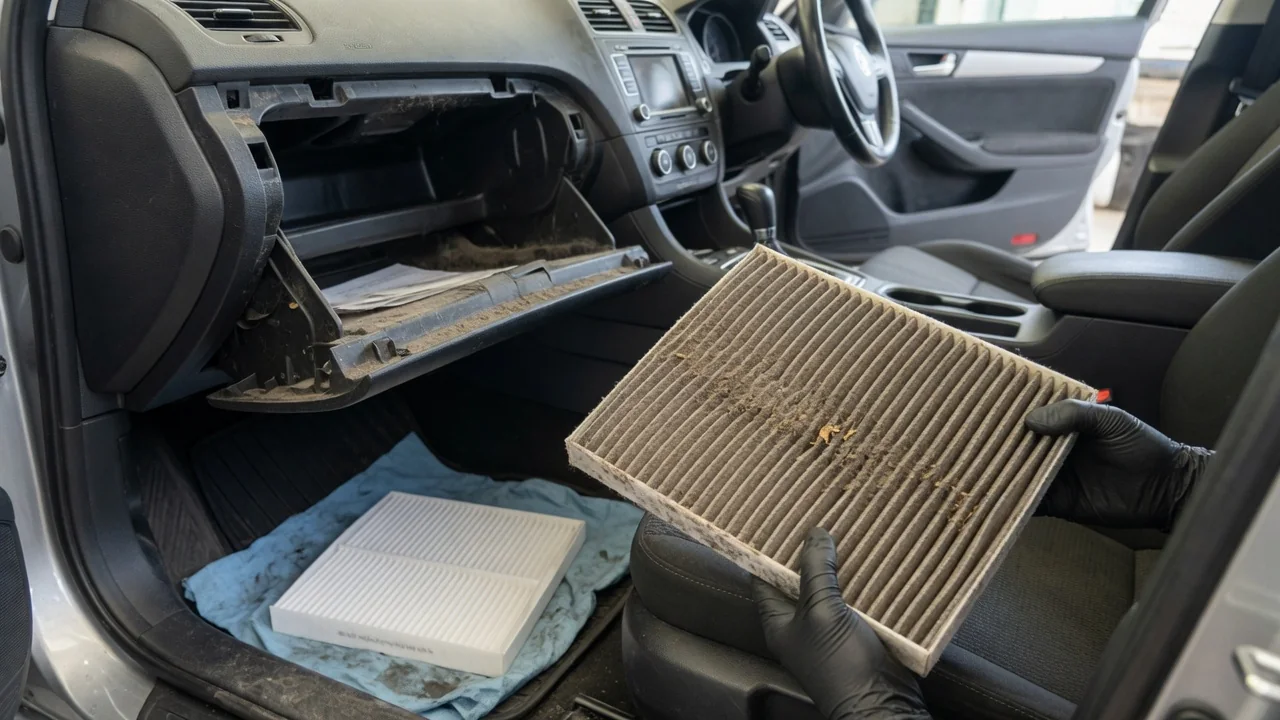
A cabin air filter sits in the path of the outside or recirculated air that the climate system sends into the passenger compartment. When it is new, air passes through its pleated media with little effort. As it collects dust, pollen, soot, and debris, that same media becomes harder to push air through. Why a dirty cabin filter restricts airflow comes down to three linked ideas: how the filter loads, how the blower responds to added resistance, and what replacement actually restores.
Filter Loading: How a Clean Filter Becomes a Barrier
A cabin filter works by forcing air through a maze of fine fibers. Particles that are too large to follow the air around those fibers, or that drift into them, stick to the fiber surfaces. Early in the filter's life, much of the capture happens inside the depth of the media, and the open spaces between fibers remain largely clear. Over time, captured particles begin to bridge the gaps between fibers and then build a layer on the upstream face of each pleat. This layer, often called a dust cake, acts as a filter of its own, and a dense one. Each new deposit narrows the channels that air must travel through, so the pressure difference needed to move a given volume of air across the filter keeps rising.
Several things can make loading worse than fine dust alone would suggest. Pleats can pack with leaves or seed debris, effectively closing off part of the filter's surface area. Moisture from humid intake air, rain, or snow can make deposits clump and cling, and fibrous material such as pollen and lint can mat together into a tighter layer. Filters that include an activated carbon layer for odor control place additional material in the airflow path, and that layer collects particles as well. Resistance tends to build gradually at first and then more noticeably as open area shrinks, which is why a filter can seem fine for a long time and then feel restrictive relatively quickly.
Fan Effort: Why the Blower Cannot Simply Push Harder
Automotive HVAC systems typically use a centrifugal blower driven by an electric motor. The blower does not deliver a fixed volume of air; it delivers whatever flow matches the resistance of the whole system, including the intake, filter, evaporator core, heater core, blend doors, and ducts. Engineers describe this relationship with a fan curve: as system resistance rises, the fan settles at an operating point with lower flow. A clogged filter adds resistance near the start of that path, so at any given blower setting, less air reaches the vents. Turning the fan speed up raises motor speed and partly compensates, but the blower is still working along a curve that the restriction has already pushed toward lower flow.
That added resistance has side effects beyond weaker vent output. The blower works against a higher pressure difference, which can change how the system sounds; some owners notice more motor noise or a whistling as air is drawn through gaps around a loaded filter. Air that leaks around a poorly sealed or distorted filter bypasses filtration altogether. Reduced flow across the evaporator can also affect cooling and dehumidifying performance, and weaker airflow onto the windshield can lengthen the time it takes to clear fog. How strongly a particular vehicle shows these effects depends on its blower design, controls, and duct layout, so symptoms vary from one system to another.
Replacement: Restoring the Air Path
Because the restriction comes from material trapped in the media, the dependable remedy is a new filter. Tapping or vacuuming the face of a disposable filter may remove loose surface debris, but it does not clear particles embedded in the fibers and can damage the pleats. The vehicle's owner's manual or service information gives the recommended interval and the filter location, which is often behind the glove box or in the cowl area near the base of the windshield, though placement varies by vehicle. Regular driving on dusty roads, in heavy traffic, or in areas with high pollen generally justifies more frequent inspection than a standard schedule suggests.
Installation details matter as much as the part itself. Many cabin filters are marked with an airflow direction arrow, and installing one backward can reduce its effectiveness. The filter should sit fully in its housing with the frame or seal seated, the pleats undamaged, and the access cover closed securely, so air goes through the media rather than around it. It is also worth clearing leaves and debris from the housing and, where it is accessible, from the outside air intake, because a clean filter cannot restore flow if the passage ahead of it is blocked. The replacement should match the size and type specified for the vehicle.
Practical Implications and Limits
A loaded filter is a common reason for weak vent airflow, but it is not the only one. If airflow stays low after a new filter is installed, other causes become more likely: a blower motor or speed control fault, a stuck blend or mode door, an obstruction in the ducts, debris on the evaporator, or ice forming on the evaporator during air conditioning use. Symptoms such as airflow at only certain fan speeds, air coming from the wrong vents, or flow that fades during a drive point toward the system rather than the filter, and they call for diagnosis using the vehicle's service information.
There are also limits to what a filter change can accomplish. It restores airflow and filtration, but it does not remove odors that originate from microbial growth on a damp evaporator or from contamination inside the ducts. Higher-efficiency or carbon filters capture finer particles or odors, yet their denser media can start with more resistance than a basic particle filter, so the choice involves a tradeoff between filtration and flow that depends on the vehicle and the part. Recirculation mode changes where the air comes from, but in many systems that air still passes through the same filter, so switching modes does not get around a clogged one.
For an interested owner, the useful habit is to treat airflow as information. A gradual decline across months, especially after seasons with heavy dust or pollen, fits the pattern of filter loading and is easy to check. A sudden change, an unusual noise, or a problem limited to one function is a cue to look further. Some vehicles have no cabin filter at all, and some place it where reaching it requires partial disassembly, so checking the owner's manual before buying a part saves time and avoids forcing panels or housings.