Why Do Wheels Crack Near Spokes? Loads, Impacts and Inspection
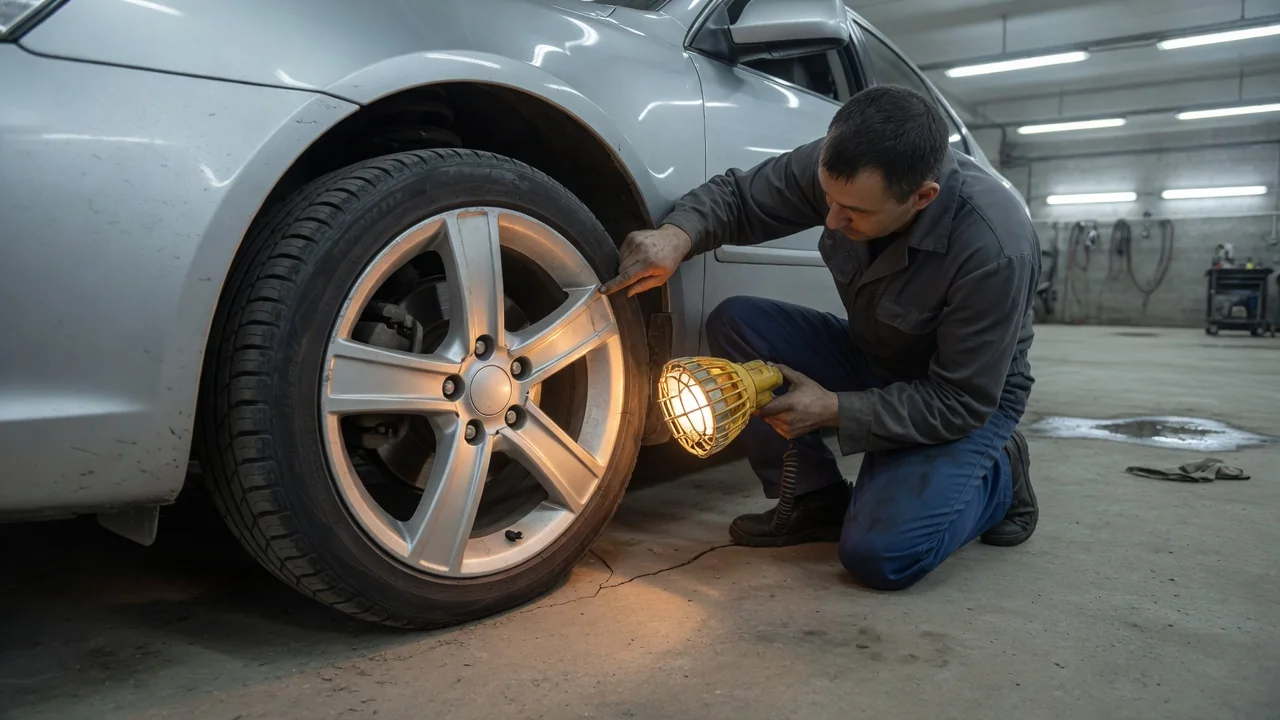
Wheel cracks rarely appear in random places. They usually start where the shape of the wheel changes, and the junction between a spoke and the rim or hub is one of the most common spots. To answer why wheels crack near spokes, look at three things. The first is the repeated loads every wheel carries. The second is the sudden impacts that go beyond normal service. The third is the inspection habits that catch damage early. This guide covers each one in general terms that apply to most alloy wheel designs.
Loads
A wheel carries the vehicle's weight from the hub, through the spokes, into the rim, and then through the tire to the road. The load is not shared evenly as the wheel turns. The part of the wheel above the tire's contact patch carries the most load at any moment. Each spoke therefore moves through a high-load zone and a low-load zone once per revolution. Over the life of a wheel, that adds up to a very large number of stress cycles. This repeated loading is called fatigue loading. Fatigue lets a part crack at stress levels well below what would break it in a single application of force.
Vertical load is only part of the picture. In a corner, sideways force at the tire contact patch tries to bend the rim relative to the hub, and the spokes resist that bending. Braking and acceleration add twisting forces between the hub and the rim, and the spokes must carry those too. In normal driving these loads overlap. A spoke may be bent, twisted, and compressed at the same moment, and the mix changes with every turn of the wheel and every change in speed or direction.
Stress does not spread evenly through a spoke. It builds up where the cross-section changes, such as the root where the spoke blends into the rim barrel or the center hub. Engineers call this stress concentration, and designers reduce it with generous fillet radii and smooth transitions. Small surface flaws in these zones raise local stress even further. Examples include casting porosity, tool marks, deep scratches, and corrosion pits. A fatigue crack typically starts at such a flaw in a highly stressed area and then grows slowly with each load cycle. This is the main reason the spoke roots are a recurring location among wheel spoke crack causes.
Impacts
Potholes, curbs, sharp-edged expansion joints, and road debris deliver brief, intense loads that are far larger than normal driving forces. When the tire hits a sharp edge, the sidewall compresses. If it compresses fully, the rim flange can take the blow almost directly. That energy travels through the rim and into the spoke roots, the same areas already stressed by everyday loads. Low-profile tires have less sidewall height to absorb a hit. Underinflated tires are more likely to compress fully. Both conditions raise the chance that an impact reaches the wheel itself.
Impact damage does not always show right away. A severe hit can crack or bend a wheel on the spot. A moderate one may leave a tiny crack or a small zone of permanent deformation that is not visible at a glance. Once that initial damage exists, normal fatigue loading can extend it with every revolution. As a result, a crack found weeks or months later may have started with a single impact the driver has long forgotten. That delay is one reason a hard hit deserves attention even if the car seems to drive normally afterward.
Several other factors can make a wheel more prone to cracking. If lug nuts are tightened unevenly or beyond specification, they can distort the mounting face and add stress around the center of the wheel. Earlier repairs that involved heating, straightening, or welding can change the metal's properties near the repaired area. Corrosion that creeps under damaged paint or clear coat, especially where road salt is used, can pit the surface in the same zones where fatigue cracks tend to start.
Inspection
An effective inspection focuses on the areas where cracks are most likely to begin. Check where each spoke meets the rim, on both the outer face and the inner barrel. Check where the spokes meet the center hub, the area around the lug holes, and the full circumference of the rim flange. The inner barrel is easy to miss because the spokes and brake components hide it. Seeing it properly often means lifting the vehicle or removing the wheel. Clean the wheel first, since brake dust and road grime can hide a hairline crack.
Common warning signs include a thin line that does not wipe away, or a straight split in the paint or clear coat that follows a spoke root. You may also see dark or discolored residue seeping from a seam. A tire that slowly loses air with no puncture can point to a crack through the rim barrel. Spraying soapy water on a suspect area of an inflated tire and wheel may reveal bubbles at the leak. While driving, new vibration, a wobble, or a change in steering feel can mean the wheel is cracked or bent, though these symptoms also have many other causes.
Some damage cannot be judged by eye alone. A tire shop can dismount the tire, spin the bare wheel on a balancer, and check for runout or bends that suggest a hidden problem. In industrial settings, cracks are often found with methods such as dye penetrant inspection, which highlights fine surface cracks that are otherwise hard to see. For an owner, the practical step is to have the wheel professionally examined after any significant impact, or whenever a visual check raises doubt.
Practical implications and limits
A crack near a spoke affects a load-bearing part of the wheel, not just its appearance. Because fatigue cracks can keep growing under ordinary driving, continuing to use a cracked wheel carries a risk of sudden air loss or structural failure. Replacing the wheel is generally the cautious choice. Repairing cracks in structural areas is often discouraged. If repair is being considered, rely on the wheel or vehicle manufacturer's guidance and a qualified shop's assessment, not on general advice.
There are also limits to what any general explanation can tell you. Not every line on a wheel is a crack. Scratches, finish crazing, and paint defects can look similar, and a careful visual check can still miss a crack that has not yet reached the surface. How likely a wheel is to crack depends on its design, material, manufacturing method, tire choice, road conditions, and how the car is driven, so no single rule predicts the outcome for a specific wheel. Owners can still lower the risk in several ways. Keep tires at the pressure shown on the vehicle placard, and steer around potholes and curbs when it is safe to do so. Have lug nuts tightened to specification in the correct pattern, and use routine tire rotations as a regular chance to look closely at each wheel.