Why Do Suspension Bushings Deflect? Movement, Comfort and Wear
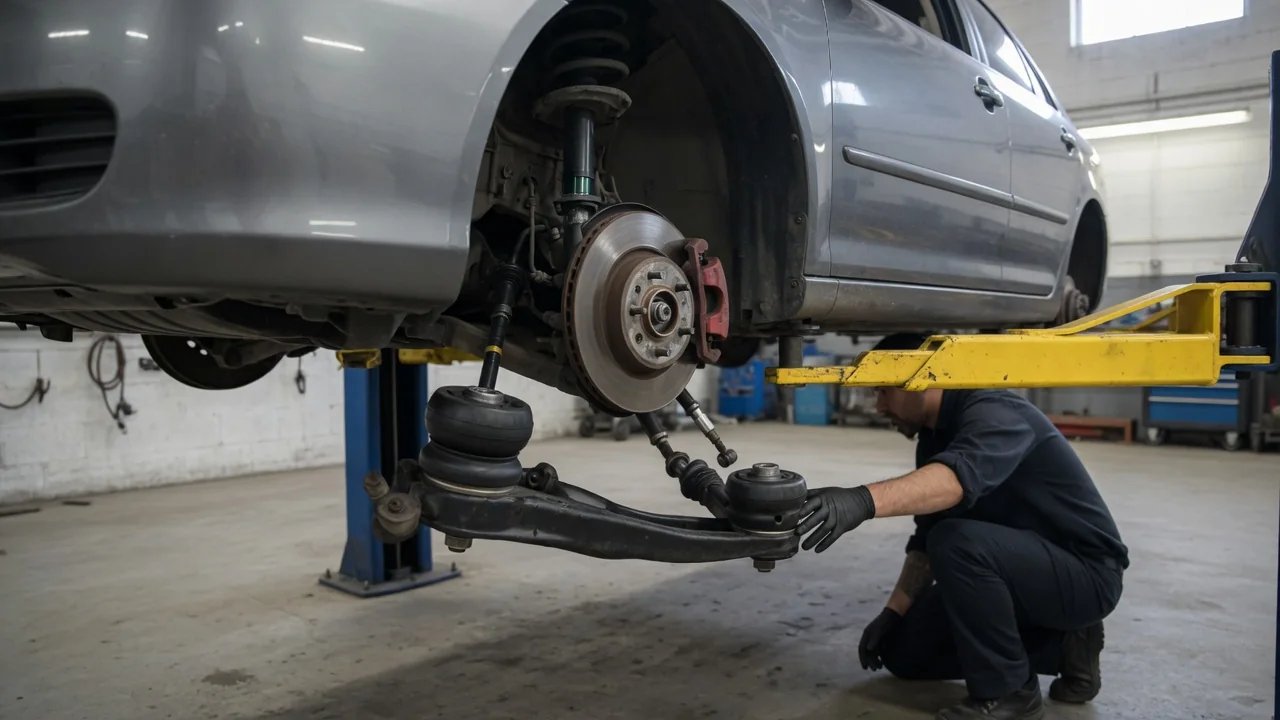
Suspension bushings deflect because they are designed to. Most are rubber or similar elastomer elements clamped between a control arm and the chassis, and every load that passes through the suspension makes them twist, squeeze, or shift slightly. This built-in suspension bushing compliance lets arms pivot without sliding friction, filters road vibration, and shapes how the wheel moves under force. Understanding why bushings deflect also explains why they eventually wear out.
Controlled Movement: Flexing by Design
A conventional bushing is an elastomer sleeve bonded or pressed between an inner metal tube and an outer shell. The bolt clamps the inner tube to a bracket, so when the control arm swings up and down, the rubber twists rather than letting metal surfaces slide against each other. That torsional deflection is how many bushings act as pivots. Because nothing slides, the joint needs no lubrication and is far less prone to the play and rattles that a loose metal pivot would develop.
Bushings also deflect in other directions. Cornering, braking, and acceleration push the wheel sideways, rearward, and forward, and the bushings compress radially or shift axially in response. Engineers do not treat this as an accident. Stiffness can be made different in each direction by changing the rubber compound or sleeve geometry, or by molding voids into the elastomer, so a bushing may be relatively firm against side loads while softer fore and aft. The result is controlled movement: the wheel is allowed to move a small, predictable amount where the design wants it to, and is held more firmly where it does not.
This compliance can be used deliberately to influence handling. In many suspension designs, the way bushings yield under cornering or braking loads causes a small change in toe or camber, sometimes called compliance steer. Designers can arrange bushing stiffness and arm geometry so these changes support stability rather than undermine it. How large the effect is, and which direction it takes, depends entirely on the specific vehicle.
Comfort: Filtering Vibration and Impact
Deflection is also a filter. Road texture, expansion joints, and tire imperfections send rapid, small vibrations into the suspension. A rigid metal connection would pass much of that energy straight into the body as noise and buzz. An elastomer bushing absorbs part of the input by deforming, and because rubber converts some of that deformation into heat as it flexes and recovers, it adds a modest amount of damping. Together these effects reduce noise, vibration, and harshness, often grouped under the abbreviation NVH.
Fore-aft compliance is especially important for impact harshness. When a tire strikes a sharp bump, the wheel is pushed rearward as well as upward. Bushings that allow a small rearward movement soften that jolt before it reaches the cabin. Some designs use fluid-filled or hydraulic bushings, which add internal passages to increase damping over certain frequencies while keeping overall stiffness reasonable.
The trade-off is that the same deflection that improves comfort can blur precision. A softer bushing isolates better but lets the wheel move more under load, which can make steering response feel less immediate. Every production suspension represents a balance between isolation and control, and that balance differs according to what the vehicle is meant to do.
Wear: Why Flexing Parts Age
Because bushings work by flexing, they are subject to fatigue. Each deflection cycle stresses the elastomer and the bond to its metal sleeves, and a vehicle accumulates an enormous number of cycles over its life. Heat, ozone, sunlight, road salt, and contamination from oil or certain fluids can accelerate aging. Over time, rubber may harden, crack, take a permanent compression set, or separate from its sleeve.
Installation affects wear too. If a bushing's bolt is fully tightened while the suspension hangs at full droop, the rubber is clamped in a twisted position. When the vehicle then sits at normal ride height, the bushing carries a constant preload, which can shorten its life. For this reason many service procedures call for final tightening with the suspension loaded or set to a specified height; the correct method depends on the vehicle and its service information.
A worn bushing deflects more, and less predictably, than a healthy one. The extra movement can let alignment shift under braking or cornering, contributing to wandering, pull, clunks over bumps, vague steering, or uneven tire wear. These symptoms are not unique to bushings, since ball joints, tie rod ends, and other components can produce similar complaints, so diagnosis requires looking at the whole system.
Practical Implications and Limits
For owners, the key point is that visible bushing movement is not automatically a defect. A bushing that twists or shifts somewhat under load is often doing exactly what it was designed to do. What matters is whether the movement exceeds the intended range, allows metal-to-metal contact, or comes with tears through the rubber or separation from the sleeve. Fine surface crazing on an older bushing may be largely cosmetic, while a deep crack or an inner sleeve sitting noticeably off-center is more significant. Judging the difference reliably usually takes experience and the manufacturer's inspection guidance.
Replacement choices also have consequences. Stiffer aftermarket bushings, such as many polyurethane designs, reduce deflection and can sharpen response, but they usually transmit more noise and vibration. Some do not twist the way bonded rubber does and instead rely on surfaces rotating against each other, which may require lubrication and can squeak. In suspensions that depend on bushing compliance for geometry or ride quality, changing stiffness can alter behavior in ways that are hard to predict without vehicle-specific knowledge.
Finally, a static wheel alignment measures geometry with the vehicle at rest. It cannot show how much the wheels move once bushings deflect under real driving loads, so a car can align within specification and still behave poorly if its bushings are tired. Treat bushings as part of a system: their condition, installation, and design intent all shape how the suspension performs.