Why Do Some Wheels Use Directional Spokes?
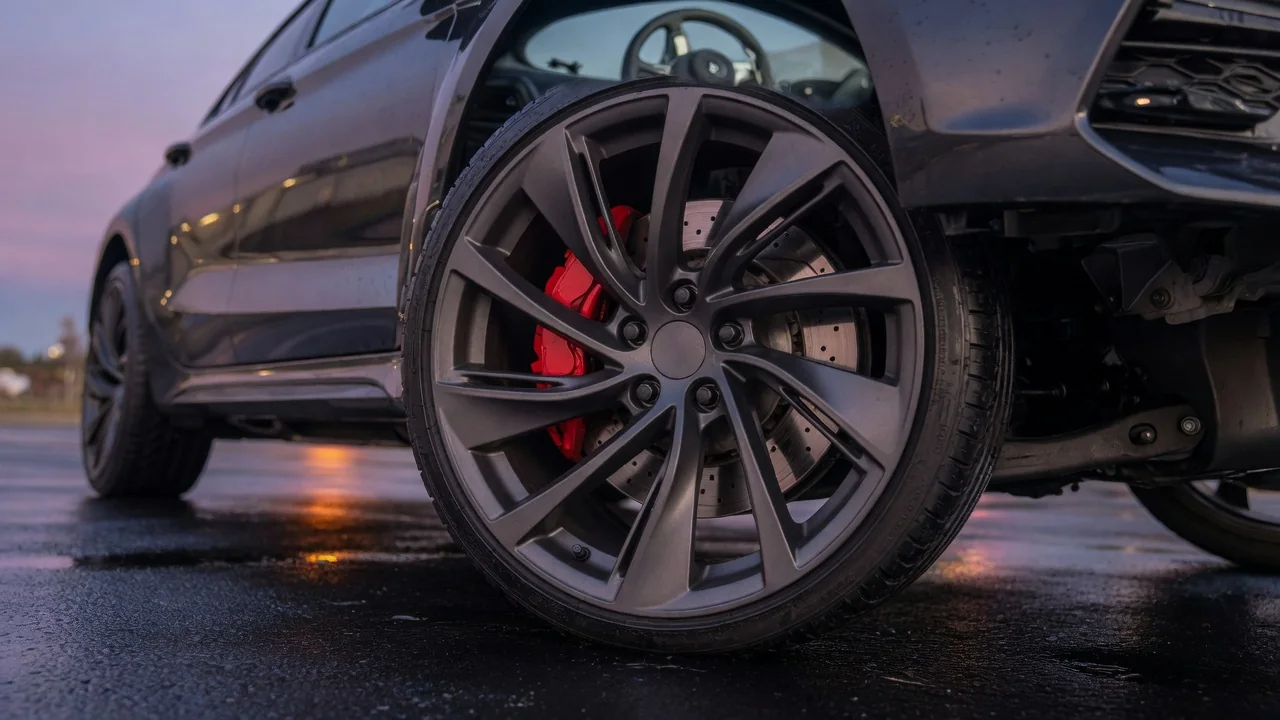
Most wheels look the same whether they are bolted to the left or right side of a car. Some, however, have spokes that curve, twist, or sweep in one rotational direction. These directional spokes appear on factory and aftermarket wheels for three main reasons: ideas about moving air around the brakes, a consistent look on both sides of the vehicle, and styling. Directional wheel design also comes with fitment rules that owners should understand.
Airflow ideas behind swept spokes
A spoke that is angled or twisted along its length behaves a little like a fan blade or turbine vane. As the wheel turns, each spoke meets the surrounding air at an angle. Depending on which way the spokes lean and which way the wheel spins, this can push air inward toward the brake area or draw it outward away from the brakes. That is the core airflow idea behind many directional designs: the spinning wheel gets a deliberate pumping effect instead of moving air around randomly. Brakes turn motion into heat. If that heat leaves the rotor and caliper area more easily, the brakes can stay closer to their intended working temperature during repeated hard stops.
How much a particular wheel actually does is hard to judge by eye. It depends on the open area between the spokes, the shape of each spoke's cross-section, the brake ducting and underbody airflow of the specific vehicle, and road speed. Air passing through a wheel also adds to aerodynamic drag, so some designs aim to manage turbulence rather than maximize flow. Because these effects interact, a directional pattern alone does not prove better cooling or lower drag. On many wheels the swept look is mainly a styling choice that borrows from fans and turbines, and any airflow effect is secondary.
Left-right appearance and mirrored designs
The second reason is visual consistency. Wheels on opposite sides of a car rotate in opposite directions when seen from the outside. On the right side, the wheels turn clockwise as the car moves forward. On the left side, they turn counterclockwise. Fit the same swept-spoke wheel at all four corners, and the spokes will appear to sweep back from the direction of travel on one side and sweep forward into it on the other. The car looks different depending on which side you stand on.
To avoid this mismatch, directional wheels are typically made as mirrored pairs: a left-hand version and a right-hand version. Each is shaped so that, on its intended side, the spokes sweep the same way relative to forward motion. Seen from either side, the car then shows the same sense of motion. This matters to designers who want a wheel to look as though it is turning even when the car is parked. Wheels with straight, symmetrical spokes avoid the issue entirely, because they look the same whichever way they rotate.
Fit: sides, rotation, and clearance
Because the designs are mirrored, directional wheels are side-specific parts. They are usually marked in some way, such as an arrow showing the intended rotation, an L or R stamp, or separate part numbers. These markings are sometimes on the back of the wheel or only visible with the tire removed. Checking them before mounting is the simplest way to confirm each wheel goes where it was designed to go. Marking practices vary by manufacturer, so the wheel documentation or the vehicle owner's manual is the reference for a specific set.
Side-specific wheels also limit tire rotation. A wheel and tire assembly can normally move only from front to rear on the same side, not across the car. On a staggered setup, where front and rear wheel widths or tire sizes differ, rotation may not be possible at all without dismounting the tires. Directional tires add another constraint. A directional tire mounted on a directional wheel must still have its tread pointing the correct way, so both requirements have to line up at each corner.
The usual fitment checks still apply, just as with any wheel: bolt pattern, center bore, offset, width, load rating, and clearance to suspension and brake components. Spoke shape can matter here. On many vehicles the back of each spoke sits close to the brake caliper, and a curved or twisted spoke may sit differently than a straight one. Confirming caliper clearance for the specific vehicle and brake package is part of choosing any wheel, directional or not.
Practical implications and limits
In daily ownership, the main consequence is logistics rather than performance. Replacing a single damaged wheel means ordering the correct side, and a shop or seasonal storage facility needs to keep each wheel matched to its corner. Marking positions before removal, with chalk or tags, prevents confusion during tire changes, brake service, or winter storage. A temporary spare is usually not directional, so the mirrored look and any intended airflow effect are absent while it is fitted. The spare's own usage limits still apply.
It is also worth keeping expectations realistic. A wheel mounted on the wrong side will look reversed and lose whatever airflow pattern the designer intended, so the manufacturer's side markings should be followed. Even a correctly mounted directional wheel should not be assumed to deliver a measurable brake or efficiency benefit on a given car, because that outcome depends on the whole vehicle, not the wheel alone. For most drivers, the practical reasons to choose directional spokes are appearance and a coherent design. The trade-off is the extra care needed at every rotation and tire change.