Why Do Some Wheels Have Beadlock Rings?
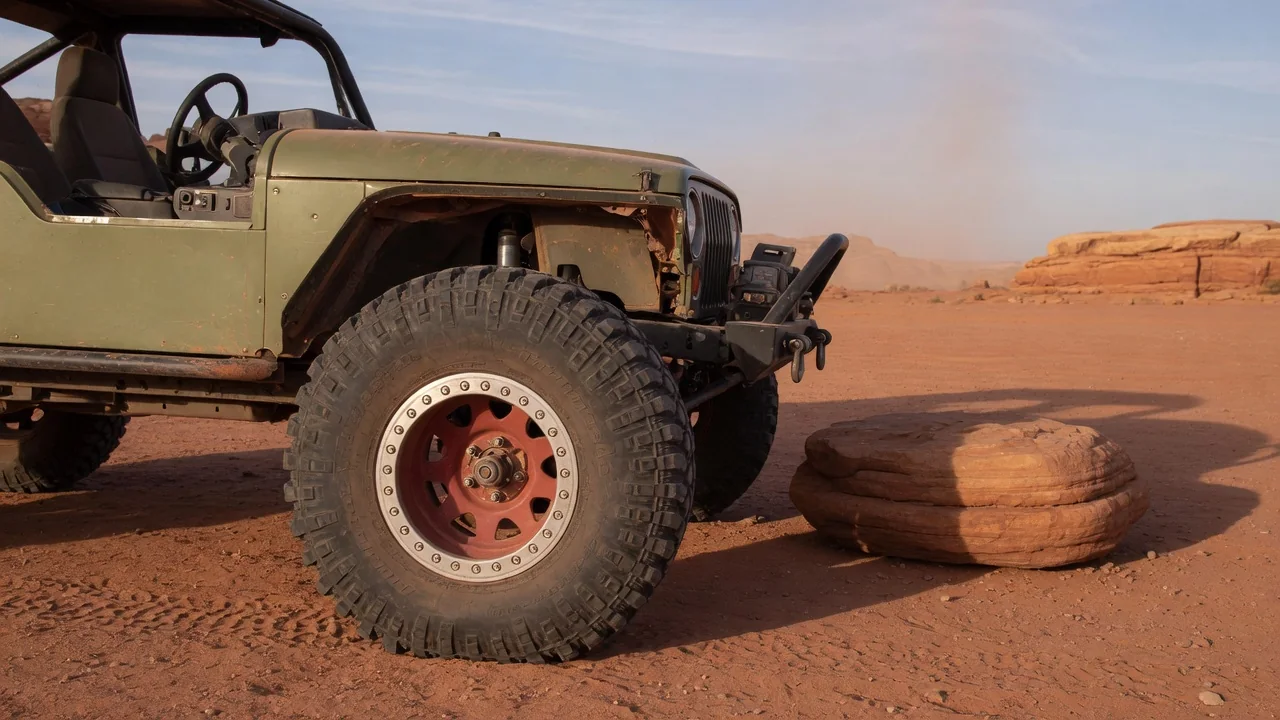
Most wheels hold a tire in place with nothing more than air pressure and a precisely shaped rim. Beadlock wheels add a mechanical clamp: a bolted ring that pinches the tire's outer bead against the wheel. The reason is simple once you understand how a normal tire stays seated and what happens when drivers run very low pressure off-road. This guide explains the beadlock wheel concept, where it makes sense, how to maintain it, and the limits that come with it.
Tire retention
On a conventional wheel, the tire bead is a stiff hoop, usually reinforced with steel wire, that sits on the rim's bead seat. The seat is slightly tapered, so as the tire inflates, the bead is pushed outward and wedged tightly against the rim flange. Many passenger wheels also have a small raised ridge, often called a safety hump, just inboard of the bead seat to help keep the bead from sliding into the center well if pressure drops. In normal driving, inflation pressure is what keeps that wedge tight and the air sealed.
The weakness appears when pressure falls. Less air means less force pressing the bead onto its seat, and a strong sideways load, such as a tire pushed hard against a rock or a vehicle sliding sideways on a slope, can pry the bead away from the flange. Air escapes in a sudden burp, or the bead drops off entirely and the tire goes flat. Under high torque, a low-pressure tire can also slip and rotate on the rim, which may break the air seal and throw off wheel balance.
A beadlock wheel answers this with a mechanical clamp. The outer bead is sandwiched between the wheel's outer lip and a separate ring, and a series of bolts around the circumference squeezes the two together. The tire is held in place by that clamping force rather than by air pressure alone, so it stays seated and resists spinning even when pressure is very low. In most common designs only the outer bead is clamped; the inner bead still seats conventionally. Internal variants also exist that use an insert or inflatable device inside the tire to press the beads outward, but the bolted external ring is what most people mean by a beadlock.
Off-road context
Beadlocks are closely tied to the practice of airing down. Off-road drivers often lower tire pressure well below street values so the tread lengthens and flattens, putting more rubber on the ground. A softer tire wraps around rocks, floats better on sand, and absorbs impacts that would otherwise jolt the chassis. The tradeoff is the reduced bead retention described above, and that is exactly the gap a beadlock fills: it lets a driver run pressures that would risk unseating a conventional tire.
Different disciplines value this for different reasons. In rock crawling, the main concern is sideways force as the tire is pressed against ledges at very low pressure. In sand and desert driving, low pressure aids flotation, while speed and hard landings add impact loads. In mud and snow, a soft tire helps traction, and clamping the bead helps keep the tire from slipping on the rim under wheelspin. Some forms of drag racing use beadlocks for a related reason, since very soft rear tires under hard launches can otherwise rotate on the rim. Some military and heavy-duty vehicles have also used beadlock designs, often combined with run-flat inserts, so a damaged tire can stay on the wheel long enough to keep moving.
It is worth separating function from appearance. Some wheels have a decorative outer ring with bolt heads that imitates a beadlock but does not clamp the tire, and these are often sold as simulated or faux beadlocks. Because the two can look nearly identical, the reliable way to tell them apart is to check the wheel's documentation or confirm whether the tire bead is actually captured by the ring.
Maintenance
A beadlock wheel needs more attention than a standard wheel because its clamping force depends on many fasteners staying correctly tightened. The ring bolts are generally torqued in a crisscross or star sequence, in several passes, so the ring pulls down evenly and the bead is compressed uniformly around its circumference. Uneven tightening can leave a gap that leaks or a section that clamps too hard. Wheel makers specify the torque value, the sequence, and how often to recheck it, and those instructions should be followed rather than general rules of thumb.
Rechecking matters most after the tire is first mounted and after hard use. Rubber can compress and settle under the ring, which lowers bolt tension over time. Owners commonly inspect the bolts before and after trips, looking for loose, missing, stretched or damaged fasteners and for stripped threads in the wheel. Dirt, sand or water trapped between the ring and the bead can cause leaks and corrosion, so the clamping surfaces should be clean when the tire is mounted.
Mounting and balancing also take more effort. The outer bead has to be positioned evenly against the wheel lip before the ring is fitted, and poor alignment can leave the tire off-center. Not every tire shop is equipped or willing to service beadlocks, and balancing can be harder because the ring and bolts add mass that must be accounted for. A slow leak on a beadlock wheel should be traced carefully, since it may come from the ring clamp, the inner bead, the valve or the tire itself.
Practical implications and limits
For vehicles that stay on pavement, beadlocks offer little benefit. Road tires run at pressures where conventional bead retention is reliable, and the added complexity buys nothing in daily driving. Many true beadlock wheels are labeled by their makers for off-road use only, and their suitability for highway use depends on the specific product and local rules. Anyone considering them for a street-driven vehicle should check the manufacturer's stated intended use and applicable regulations first.
Even off-road, a beadlock is not a cure for every tire problem. On a single-sided design the inner bead can still unseat under severe loads. The ring does not protect against sidewall cuts or punctures, and it does not make extremely low pressure safe at higher speeds, where heat buildup and sidewall flex remain limits of the tire itself. The extra ring and hardware usually add weight at each corner, increasing unsprung mass, and an exposed ring can be struck by rocks, which may damage its clamping surface or bolts.
The decision comes down to how the vehicle is actually used. If a driver regularly airs down for rocks, sand or similar terrain and has had beads come loose, beadlocks address that specific failure directly. If low-pressure driving is occasional, a more conservative pressure choice and slower pace may be enough. In either case, the wheel only works as intended when its ring bolts are maintained, the tire is mounted correctly, and the product is used within the conditions its manufacturer describes.