Why Do Some EVs Have More Than One Motor?
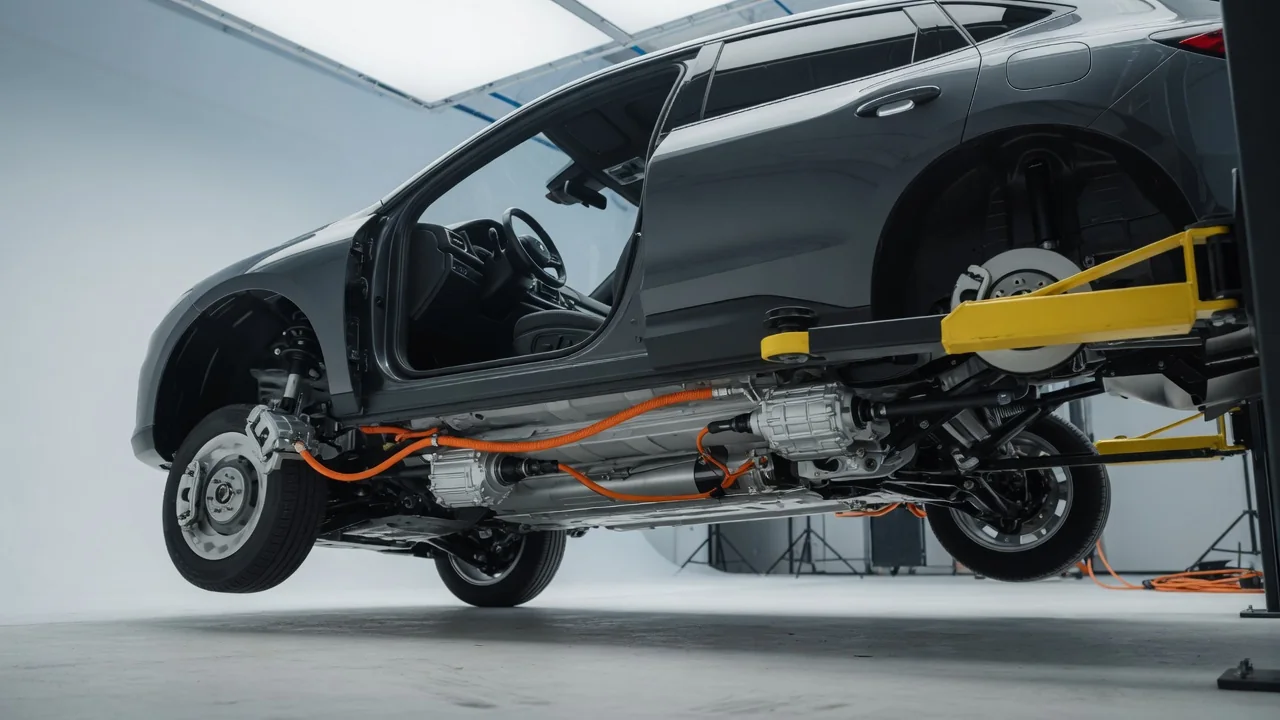
Many electric vehicles drive with a single motor, while others carry two, three, or even four. The reason is not simply more power. Adding motors changes how torque reaches each axle, how the car finds grip, and how it uses stored energy. Understanding the logic behind a dual motor EV layout explains why some drivers treat it as a performance or all-weather choice and why others are well served by one motor. This guide covers the general engineering principles, not the behavior of any particular vehicle.
Axle Control: Powering Front and Rear Separately
In a conventional all-wheel-drive car, one engine sends power through a transmission, a center coupling or transfer case, and a driveshaft to reach both axles. An EV can skip much of that hardware. Placing one motor at the front and another at the rear gives each axle its own power source, typically with its own inverter and reduction gear. The two axles are not mechanically connected; the link between them is electronic. A vehicle control unit decides how much torque each motor should produce, and each inverter adjusts the current it feeds to its motor to deliver that request.
Because the split is handled in software, torque can be shifted between front and rear very quickly and in fine increments. Designers can bias the car toward the rear for a sportier feel, toward the front for stability, or change the balance continuously depending on speed, steering angle, and wheel slip. The absence of a driveshaft also frees packaging space, since there is no need for a tunnel running the length of the floor. Layouts with three or four motors go further by placing separate motors on the left and right wheels of an axle. That allows torque vectoring across the axle, where the outer wheel in a turn can receive more drive than the inner wheel, without relying only on brake intervention.
Axle control also applies when slowing down. With a motor on each axle, regenerative braking can be shared between front and rear rather than loading only one end of the car. Spreading that deceleration helps keep the vehicle balanced, particularly on slick surfaces where strong regeneration on a single axle could make that axle lose grip.
Traction: Putting Torque Where the Grip Is
Every bit of acceleration has to pass through four small tire contact patches, and each patch can transmit only so much force before it slips. When torque is split between two driven axles, each tire carries a smaller share of the work, so it is less likely that any single tire exceeds its grip limit. This matters most on rain, snow, gravel, and loose surfaces, and on steep or slippery inclines where a two-wheel-drive car might spin its driven wheels while the other pair simply rolls along.
Electric motors are well suited to traction management because their output can be changed almost instantly. When a wheel begins to spin, the traction control system can trim that motor's torque directly through the inverter instead of waiting for brake pressure to build. With two motors, the system can also move effort toward the axle that still has grip. The result is usually smoother and more controlled progress on low-friction surfaces. It is worth remembering that driving more wheels improves the ability to accelerate and climb, but it does not raise the tires' grip limit for cornering or braking.
Traction is also a performance concern on dry pavement. Electric motors can produce strong torque from a standstill, and a single driven axle can overwhelm its tires during a hard launch. Distributing that torque across both axles lets more of it become forward motion rather than wheelspin, which is why multi-motor configurations are common in performance-oriented EVs.
Efficiency Choices in Multi-Motor Designs
Adding a second motor might seem like a recipe for wasted energy, but it gives engineers additional choices. Every motor has an efficiency map: it converts electricity to motion most effectively across certain combinations of speed and load, and less effectively at very light loads, where fixed losses make up a larger share of the total. With two motors, the controller can rely mainly on one motor during steady cruising, keeping it in a more efficient operating zone, and call on the second motor only for acceleration, climbing, or low-grip conditions.
Motor type plays a role here. Permanent-magnet motors are generally efficient under load, but when one is spun by the wheels without being needed, its magnets still create drag losses. Some designs address this by pairing a permanent-magnet motor on one axle with an induction or electrically excited motor on the other, since those types produce little magnetic drag when not energized. Another approach is a disconnect mechanism that decouples an idle motor from its wheels. Which strategy a given vehicle uses, if any, is a manufacturer decision and is not implied by the motor count alone.
Designers can also give each axle a different reduction gear ratio, tuning one motor for strong low-speed response and the other for efficient higher-speed operation. These benefits are offset by added weight, extra inverters, and additional cooling and wiring. Depending on how those factors balance, a dual motor version of a vehicle may have slightly more or slightly less rated range than a single motor version, so the official figures for the specific vehicle are the only reliable guide.
Practical Implications and Limits
For most drivers, the decision comes down to climate, terrain, and how the car will be used. Someone who regularly faces snow, unpaved roads, steep driveways, or trailer towing may value the added traction and control of a second driven axle. A driver in a mild climate who mostly commutes on paved roads may find a single motor perfectly adequate, and it generally means less hardware to buy and maintain. Driving style also matters: frequent hard acceleration uses more energy regardless of how many motors share the load.
More motors mean more components that eventually need attention, such as additional inverters, reduction gearboxes, and coolant circuits. Service intervals and fluid requirements for each drive unit vary by manufacturer, so the owner's manual and maintenance schedule are the right references. Some vehicles are programmed to continue in a reduced-power mode if one drive unit reports a fault, while others may restrict driving more severely. That behavior depends on the vehicle's software and should not be assumed.
Finally, hardware layout does not tell the whole story. Two vehicles with similar motor arrangements can feel and perform quite differently because of calibration, tire choice, weight distribution, and the control strategy in their software. Motor count is a useful starting point for understanding a vehicle's capabilities, but manufacturer specifications and documentation describe how a particular model actually distributes torque, recovers energy, and handles real-world conditions.