Why Do Some EVs Have Charging Timer Overrides?
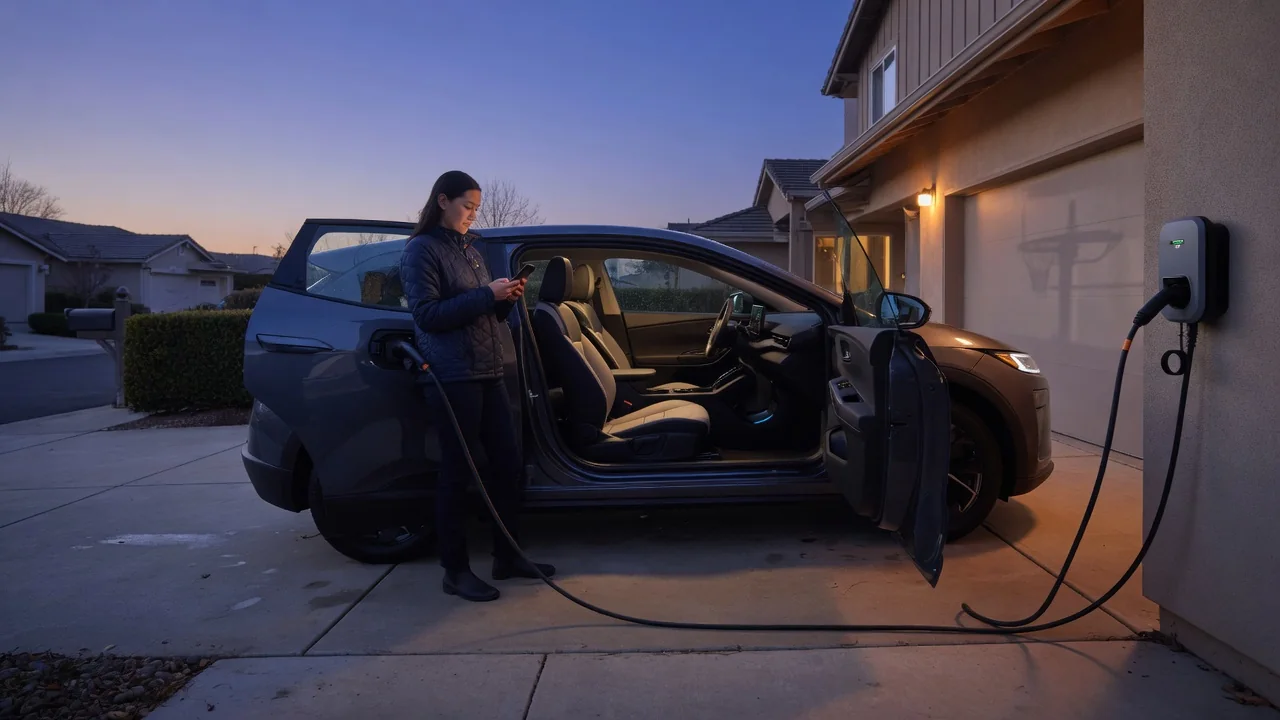
Many electric vehicles let owners schedule charging for set hours, then offer a way to skip that schedule once. If you have wondered why do some EVs have charging timer overrides, the short answer is flexibility: a timer suits the routine, while a one-time immediate charge covers the day that does not follow it.
Scheduled default
A charging schedule tells the car to wait after it is plugged in rather than draw power right away. Owners commonly set this up to match cheaper overnight electricity rates, to ease the load on a home circuit shared with other appliances, or to finish charging close to departure so the battery is not sitting full for hours. Once saved, the schedule becomes the default behavior every time the connector is latched, which is exactly what makes it convenient on ordinary days.
That same default can look like a fault to someone who forgets it exists. The car is plugged in, the connector locks, and nothing seems to happen because the vehicle is simply waiting for its start time. Depending on the manufacturer, the schedule may live in the car's infotainment menus, in a phone app, in the wall unit itself, or in more than one of these. Some vehicles also tie schedules to a saved location, so the timer applies at home but not elsewhere.
Temporary need
An override exists because real life interrupts routines. A driver may come home at midday with a low battery and need to leave again in two hours, or an unexpected trip may come up in the evening before the off-peak window opens. Waiting for the scheduled start would leave too little range. A one-time immediate charge lets the car begin drawing power now without forcing the owner to delete or rewrite a schedule they will want back tomorrow.
The key design idea is that the override is temporary. In most implementations it applies to the current plug-in session only, and the saved schedule resumes the next time the car is connected. How it is triggered varies widely: an on-screen charge-now button, an app command, a button near the charge port, or a particular sequence such as unplugging and reconnecting within a short period. Because these methods differ by make, model year, and software version, the owner's manual is the reliable reference.
Check completion
After requesting immediate charging, it is worth confirming that the car actually started. Typical signs include a change in the charge port indicator light, a charging animation or power reading on the instrument display, an estimated completion time, and a status update in the phone app. Some vehicles make an audible click as contactors close, and cooling fans or pumps may run. If the display still shows a scheduled start time, the override probably did not register.
Completion deserves a second look as well. An override usually bypasses the start time but may still respect the charge limit the owner has set, so the session may stop below full if a lower target is saved. Checking the projected finish time against the planned departure shows whether the available charging speed is enough. If the estimate runs past the time you need to leave, you at least know in advance how much range to expect and can plan the trip accordingly.
Everyday Use and Observations
In daily use, most owners rarely touch the override. The schedule quietly handles overnight charging, and the immediate option comes out only occasionally, perhaps after an unusually long day of driving or before an early start. People who share a vehicle often find it especially useful, since one driver can top up right away without changing settings another driver relies on. Charging immediately may cost more on a time-of-use plan, which is the tradeoff being accepted.
Owners also notice that timers can interact with other features. A wall unit with its own schedule can hold back power even when the car is ready, so an override issued from the vehicle may appear to do nothing until the charger's schedule is also addressed. Public stations begin charging without regard to home schedules on many vehicles, though this is not universal. Cabin preconditioning and departure-time settings can also draw power outside the window, which sometimes gets mistaken for an override.
Limits and Next Steps
An override cannot make charging faster than the equipment allows. The rate is still bounded by the car's onboard charger, the wall unit, the circuit, and the battery's temperature and state of charge. A very cold or hot battery may charge slowly at first while the car manages its temperature. The override also does not bypass safety checks, so a session that will not start despite a correct request may point to a connector, cable, supply, or communication issue rather than a timer.
If immediate charging will not begin, a sensible sequence is to confirm the connector is fully seated, review schedules in both the car and the charger, and look for any warning message on the display. A different charging station can help show whether the vehicle or the home equipment is responsible. Any stored warning or fault code is a clue to interpret, not proof that a component has failed, and persistent trouble is best handled by a dealer or qualified EV technician using vehicle-specific information.