Why Do Some Engines Use an Open Deck Block?
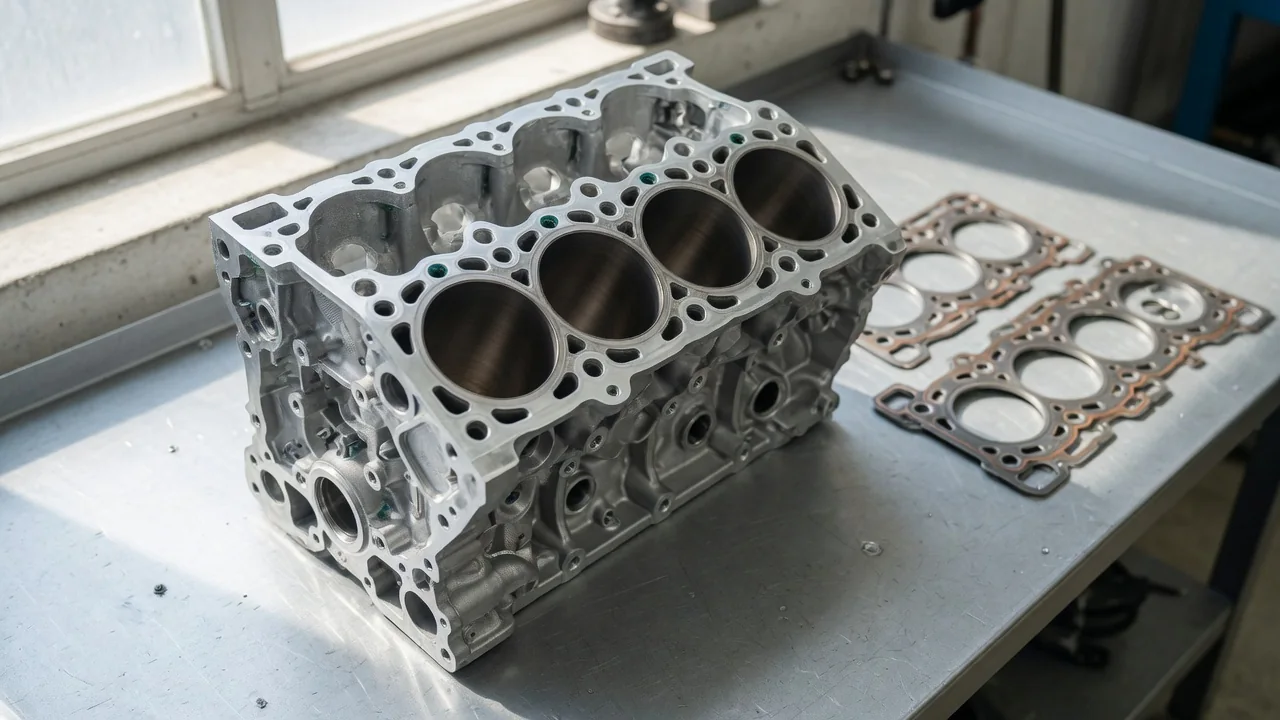
An open deck engine block leaves the coolant jacket open at the top surface, where the cylinder head bolts on. The cylinders stand inside that jacket like freestanding tubes, joined to the outer block mainly at the bottom. This can look like a shortcut, but it is a deliberate engineering choice. Why do some engines use an open deck block? The answer comes down to a trade between cooling, manufacturing, weight, and how firmly the cylinders are held in place.
Coolant space
In an open deck design, the water jacket runs all the way to the deck surface with no material bridging the gap between the cylinder walls and the outer block wall. Coolant can circulate around the full circumference of each cylinder, including the uppermost section near the combustion chamber. That upper zone is where combustion heat is most intense, so having coolant reach it directly helps pull heat away from the area that needs it most. A closed deck block, by contrast, covers most of the top of the jacket with metal and lets coolant pass to the head only through smaller drilled or cast holes.
The open layout also tends to make coolant flow more even. Fewer restrictions near the top of the cylinders reduce the chance of trapped air or localized steam pockets forming around the bores, which can cause uneven temperatures and local hot spots. More uniform cylinder temperatures help keep the bores closer to round as the engine warms up, supporting consistent piston ring sealing. The head gasket becomes the component that closes off the jacket, and its coolant openings, together with the head's own passages, shape how coolant moves from block to head.
Cylinder support
The main compromise of an open deck block is how the cylinders are supported. Because nothing ties the top of each cylinder to the outer block wall, the bores are held mostly from below. Under combustion pressure and heat, the upper part of an unsupported cylinder can flex slightly, both outward and in its shape. In a closed deck block, the metal across the deck acts like a brace, holding the top of the cylinders in place and resisting that movement.
Cylinder movement matters because pistons and rings depend on a round, stable bore. If the top of a cylinder distorts under load, ring sealing can suffer, which may raise blow-by and oil consumption over time. Movement at the deck also puts more demand on the head gasket, since the surface it clamps against is less rigid. Modern multi-layer steel head gaskets, careful bolt placement, and stiff cylinder heads help compensate, which is part of why open deck construction works well in many production engines operating within their design limits.
Engineers also use an in-between approach called a semi-closed deck. Here, small bridges of metal connect the cylinders to the outer wall at intervals around the top of the jacket, leaving coolant openings between them. This adds some bracing while keeping much of the cooling benefit. The choice among open, semi-closed, and closed deck designs reflects how much cylinder pressure an engine is expected to handle and how much cost and complexity the manufacturer is willing to accept.
Applications
Open deck blocks are common in mass-produced passenger car engines, and manufacturing is a major reason. When the water jacket is open at the top, the shape that forms it in the casting process can be pulled straight out or supported easily from above. This suits high-volume aluminum casting methods that use reusable metal molds, including high-pressure die casting. A closed deck jacket is enclosed and usually requires a sand core that must be broken up and cleaned out afterward, which adds steps and cost.
Weight and cost savings follow from the same layout. Less material at the deck and a simpler casting process reduce both the mass of the block and the expense of making it. For everyday engines that spend most of their lives at moderate loads, these gains are meaningful, and the reduced cylinder bracing rarely becomes a limiting factor. Better cooling around the upper bores also supports emissions and efficiency goals, since stable temperatures help with consistent combustion and ring sealing.
Closed and semi-closed deck blocks are more often associated with engines meant to handle very high cylinder pressures, such as heavily boosted or heavy-duty designs, where bore stability takes priority over casting simplicity. However, the line is not fixed. Some factory turbocharged engines use open deck blocks reinforced through other means, such as stronger cylinder liners, stiffer block structures, or improved gasket technology. Which approach a specific engine uses depends on the manufacturer's design targets, and the details for any given engine are best confirmed in its official service information.
Practical implications and limits
For an owner running a stock engine as intended, an open deck block is not something to worry about. The manufacturer has matched the block, head gasket, fasteners, and cooling system to the engine's power output. What matters most is keeping that system healthy: using the coolant type specified by the manufacturer, changing it at the recommended interval, and fixing leaks promptly. Corrosion or scale in an open jacket can affect how evenly the cylinders are cooled, and overheating puts stress on the head gasket joint that seals the open deck.
The limits become relevant when an engine is modified to produce substantially more cylinder pressure, especially through added boost or aggressive tuning. Builders sometimes address this with aftermarket inserts often called block guards, which fit into the top of the water jacket to brace the cylinders. Some racing builds go further and partially fill the jacket with a hardening filler, sacrificing cooling capacity for rigidity, which generally makes the engine unsuitable for street use. Any such change alters coolant flow, so it involves trade-offs and should be planned as part of a complete engine build rather than a simple add-on.
It also helps to keep expectations realistic. An open deck block is not inherently weak, and a closed deck block is not automatically stronger in every respect; overall durability depends on materials, liner design, gasket choice, assembly quality, and how the engine is used. Deck type is usually visible only with the cylinder head removed, so if it matters for a repair or modification plan, check the engine's service manual or factory documentation rather than relying on general assumptions.