Why Do Some Cars Have Multiple Radiators?
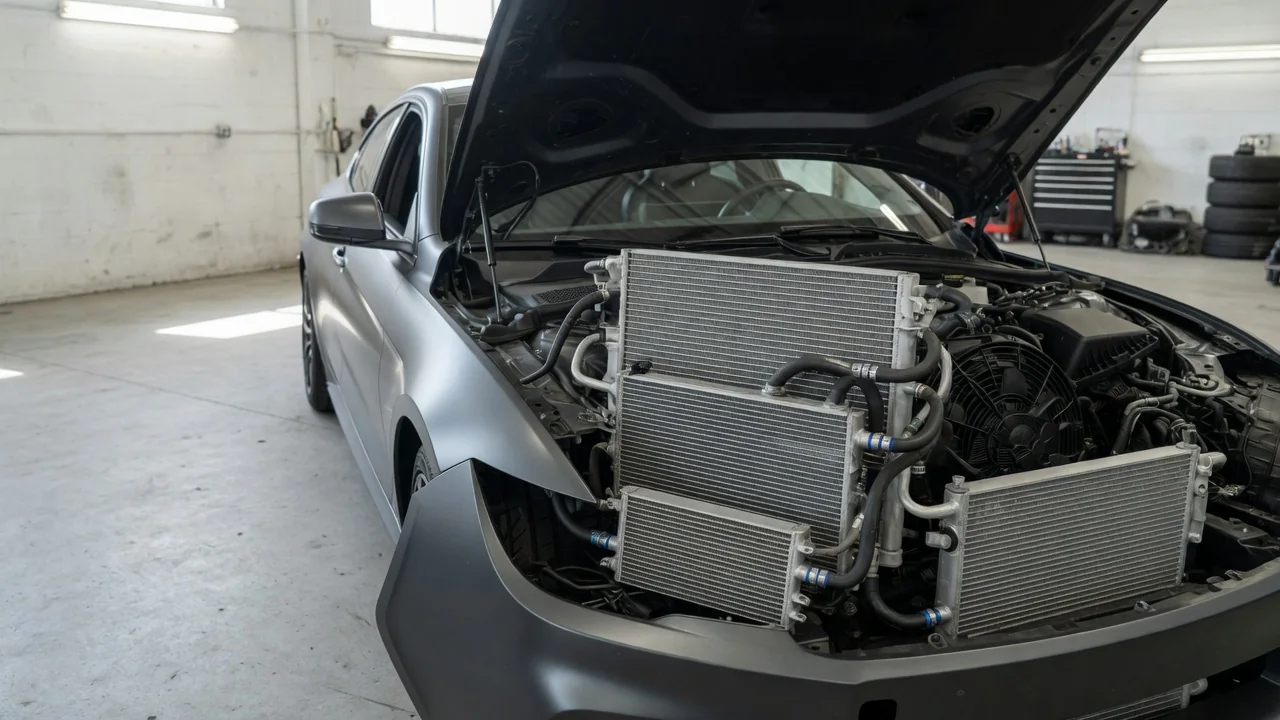
Look through the grille of many modern vehicles and you may find more than one heat exchanger stacked behind it or tucked into the bumper corners. That raises a fair question: why do some cars have multiple radiators? In most cases, the vehicle is managing several separate heat loads, each with its own fluid and temperature target. This article explains the systems involved, how they share space at the front of the car, and what that means for service.
Different systems with different temperature needs
The main radiator removes heat from engine coolant, which circulates through the engine block and cylinder head and keeps the engine within its intended operating range. On many vehicles, though, it is only one of several heat exchangers in the cooling package. An air conditioning condenser releases heat from the refrigerant. A transmission fluid cooler, engine oil cooler or power steering cooler may handle fluids that should not run as hot as they otherwise would. From the outside, each of these exchangers looks much like a radiator. That is why owners often count them all as multiple cooling radiators, even though they serve different circuits.
Turbocharged and supercharged engines add another load: compressed intake air gets hot, and cooler air is denser. An air-to-air intercooler sends that charge air through its own core. Some designs instead use a liquid-to-air charge cooler, which needs a separate low-temperature coolant loop with its own radiator, because the cooler that loop runs, the more effectively it can cool the intake charge. Hybrids and electric vehicles follow similar logic. Batteries, inverters, electric motors and onboard chargers generally prefer lower temperatures than a combustion engine, so they are commonly served by one or more low-temperature circuits kept apart from the engine loop. Some high-output engines also split engine cooling between a main radiator and auxiliary radiators simply to gain more total surface area.
Front packaging and shared airflow
All of these exchangers usually depend on air entering through the same front openings, and that air can only carry away so much heat. When cores are stacked one behind another, the air warms as it passes through each layer, so the rear cores receive warmer air than the front ones. Designers therefore commonly place the exchangers that need the coolest air, such as the A/C condenser or a low-temperature radiator, ahead of the main engine radiator, which runs hotter and can still shed heat into partly warmed air. Every added layer also increases airflow resistance, which affects how hard the cooling fans must work at low speed and when the vehicle is stationary.
Stacking is not the only option. Some vehicles mount auxiliary radiators side by side or place them in the bumper corners, fed by their own ducts, so each core sees fresher air. Packaging decisions are shaped by more than cooling: hood height, pedestrian protection, crash structures, aerodynamic drag and styling all limit the size and location of the front openings. Active grille shutters, where fitted, close when less cooling is needed to reduce drag and help warm-up, then open as heat loads rise. Splitting the job across several smaller exchangers often fits these constraints better than one very large radiator.
Service considerations
Separate circuits mean separate maintenance. A vehicle with an engine loop and one or more low-temperature loops may have more than one coolant reservoir, and the circuits may not share the same coolant specification, fill procedure or service interval. Low-temperature circuits often rely on electric pumps, and some require a specific bleeding sequence, occasionally triggered with a scan tool, to purge trapped air. Air left in a small loop can reduce cooling of the components it serves, such as a charge cooler or battery pack. The vehicle's service information is the reliable source for which reservoir feeds which circuit and how each should be filled.
Stacked cores also trap debris. Leaves, insects and dirt can collect in the gap between the condenser and radiator, where they are hard to see from the grille. Gentle cleaning with low water pressure helps avoid flattening the soft fins, and some debris can only be reached with parts removed. Because exchangers are layered, replacing one may require removing others, and disconnecting an A/C condenser requires proper refrigerant recovery. Where a transmission or oil cooler is built into a radiator tank or shares a housing with coolant, an internal leak can let fluids mix, so contaminated coolant or fluid deserves prompt diagnosis.
Practical implications and limits
For owners, the main practical point is that a heat-related symptom should be traced to the right circuit. A rising engine temperature gauge points toward the engine loop, while weak air conditioning at idle can relate to condenser airflow, and a reduced-power or system warning in a hybrid or turbocharged vehicle may involve a separate low-temperature loop. Knowing that several exchangers exist explains why checking the main radiator alone may not account for every complaint. It also explains why minor front-end collision damage can affect more than one system at once.
Multiple radiators are also not a cure for unrelated faults. Extra surface area cannot compensate for low coolant, a stuck thermostat, a failing pump, an inoperative fan or a core blocked with debris. Adding aftermarket coolers to a vehicle not designed for them can restrict airflow to existing exchangers or slow warm-up, so any change should consider the whole front-end airflow path and the manufacturer's guidance. Owners who tow, drive in very hot climates or use a vehicle on a track place higher demands on every circuit; in those situations, keeping each exchanger clean, correctly filled and undamaged matters more than the number of cores alone.