Why Do Side Mirrors Create Wind Noise?
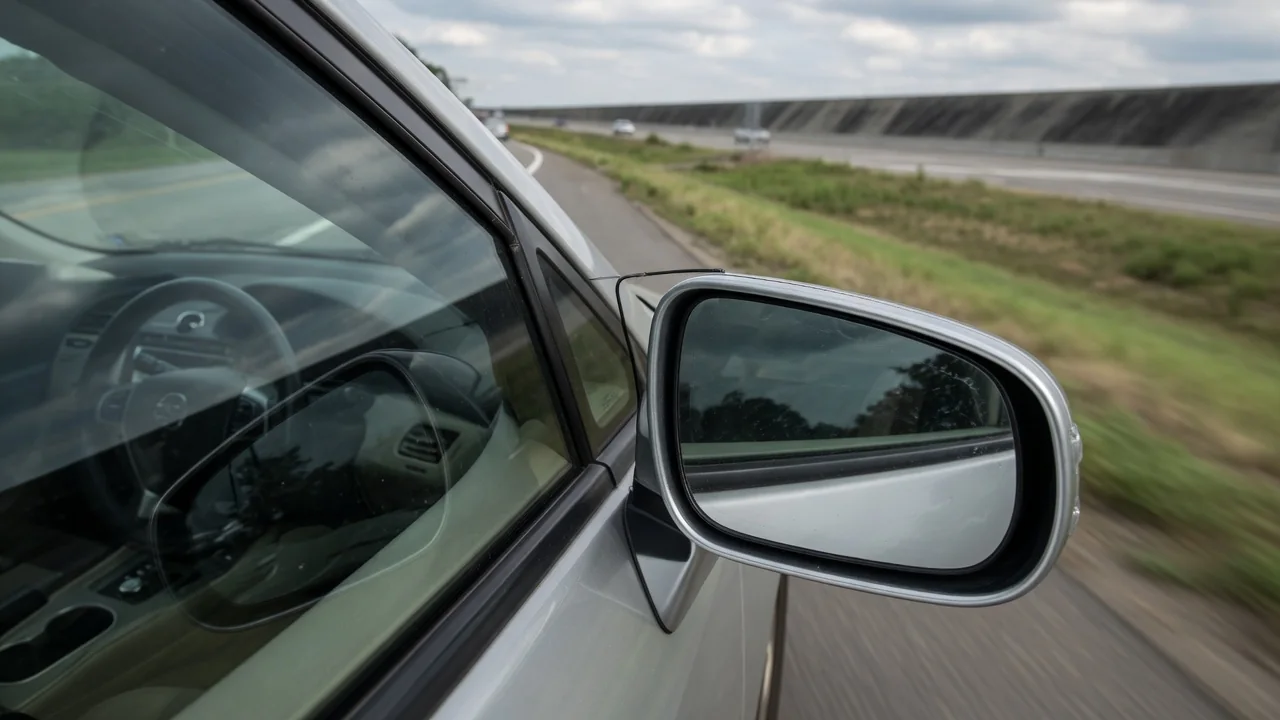
Drivers who ask why do side mirrors create wind noise are usually hearing air being forced around a blunt object that sticks out from an otherwise smooth body. The mirror housing interrupts the flow along the door and window, and the disturbed air it leaves behind produces rushing, whistling, or buffeting sounds right beside the driver's ear.
Turbulence
Air approaching a side mirror splits around the housing and tries to follow its surface. A mirror is short and bluff, so the flow cannot stay attached all the way around the back edge. It separates and leaves a wake of swirling, low-pressure air behind the glass. Those swirls form and break away in an irregular rhythm, and each pressure pulse radiates as sound. Because the wake sits just outside the front side window, the noise reaches the cabin with very little distance to fade.
The mirror also sits in air that is already disturbed. Flow coming off the windshield wraps around the front pillar and forms a spinning vortex along the side glass, and the mirror wake mixes with it. The stalk or base that mounts the mirror adds its own small wake, as does the gap between the housing and the door. Housing shape varies widely between vehicles, so a rounded, tapered mirror on one model may sound noticeably calmer than a large, squared towing mirror on another.
Speed
Road speed is the strongest influence on how loud a mirror becomes. The energy in the air striking the housing rises sharply as speed climbs, and aerodynamic noise grows much faster than speed itself. A mirror that is silent in town can produce a steady rush on the highway simply because the pressure fluctuations in its wake have become many times stronger. At the same time, tire and engine sounds increase more gradually, so wind noise stands out more as the vehicle goes faster.
Speed also changes the character of the sound. A broad hiss or roar usually comes from general turbulence, while a whistle that appears in a narrow speed band points to air passing over a small gap, edge, or cavity that resonates at a particular flow velocity. The speed that matters is airspeed, not the number on the speedometer, so a strong headwind can bring on highway-level noise earlier. Crosswinds shift the flow angle and may make one mirror louder than the other.
Seal interaction
Turbulent air outside the car becomes cabin noise mainly through the glass and the seals around it. The mirror wake presses on the side window with rapid pressure changes, and the door and window seals have to hold against that pulsing load. At speed, lower pressure outside the cabin also tends to pull the top of the door frame slightly outward. If a seal is hardened, flattened, torn, or out of position, the disturbed flow finds a path inward and the sound becomes sharper and more localized.
The mirror has seals of its own. A gasket usually sits between the mirror base and the door or the corner of the window frame, and an interior trim piece often covers the mounting area. A gasket that has shrunk, shifted, or been pinched after a mirror or door repair can leave a small opening that whistles. Folding mirrors add a seam between the head and the base. Designs differ, with some mirrors mounted on the door skin and others at the window corner, so the likely leak points vary.
Everyday Use and Observations
In daily driving, the sound from a healthy mirror is a soft, even rush near the front of the side window that rises smoothly with speed and is similar on both sides. Rain offers a visible clue to the same airflow, since water streaks and droplets on the side glass trace where the wake is sweeping. Noise that changes when a mirror is folded in while parked and the car is later driven on a private road, or that differs clearly from left to right, suggests something specific about one housing.
Changes over time are more telling than the baseline level. A new whistle after a car wash, a mirror replacement, bodywork, or a knock in a parking lot often traces to a loose cover, a cracked housing, or a displaced gasket. Accessories matter too, because clip-on towing extensions, rain guards, and window deflectors alter the flow around the mirror. Roof racks and open windows create their own noise that is easy to mistake for mirror sound, so it helps to note exactly where the noise seems to originate.
Limits and Next Steps
Some mirror noise is unavoidable. Any object in the airstream that is large enough to give a useful rear view will leave a wake, and manufacturers balance that against visibility, styling, and legal requirements. Larger vehicles with tall, wide mirrors generally carry more of it, and no adjustment will make a bluff housing silent at highway speed. Judging what is normal is easier by comparing against the same model in good condition than against a different vehicle with a different mirror shape and glass thickness.
When the sound is new, one-sided, or whistling, a careful look is the sensible first move. Check that the mirror cap and trim are fully seated, the housing is not cracked or loose, and the visible seals are intact and evenly compressed. A passenger can help pinpoint the source by listening while the car is driven. If the cause is not obvious, a body shop or dealer can test for air leaks with proper equipment and confirm the correct parts and fit for that specific vehicle.