Why Do Rear Lamps Use Multiple Compartments?
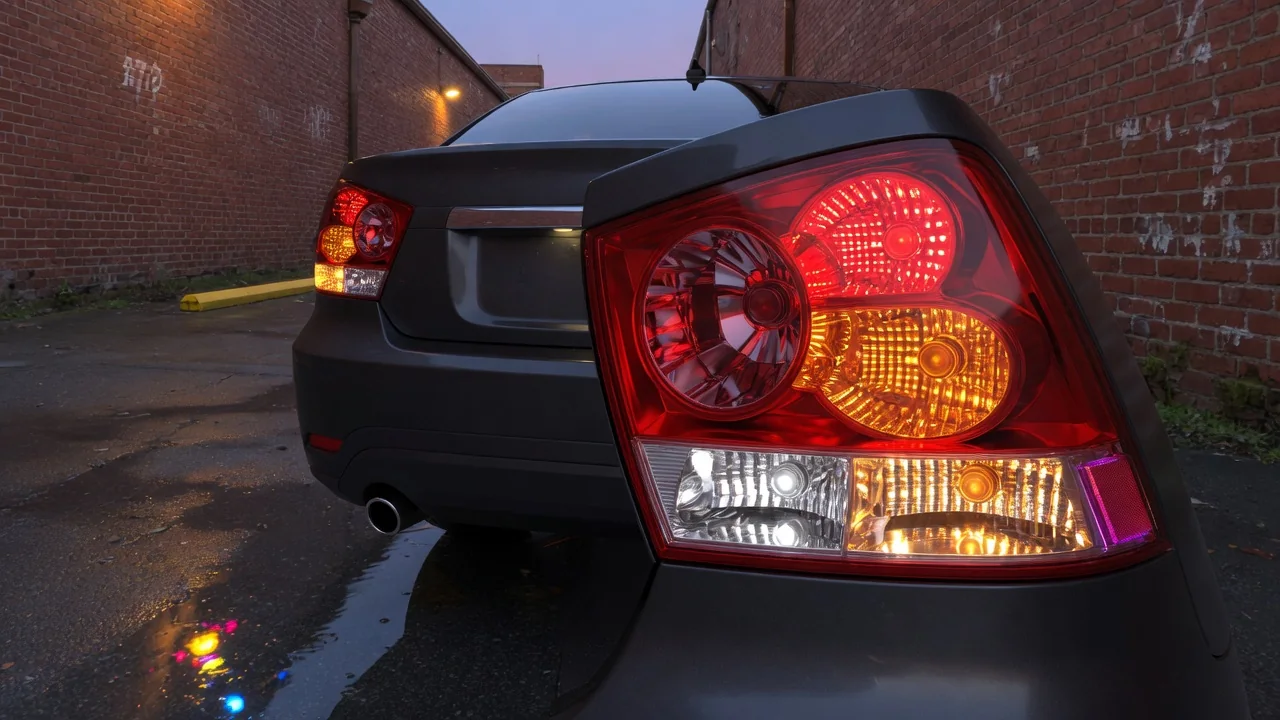
Look closely at almost any car's tail lamp and you will see that the housing is divided into several chambers, each with its own reflector, lens area, or light source. These car tail lamp compartments are not just a styling choice. They exist because one assembly has to deliver several distinct signals, each with its own color, brightness, and beam pattern, and because the lamp must stay serviceable over years of use. Here is why rear lamps use multiple compartments.
Different signals
A typical rear lamp assembly combines several functions that tell following drivers different things. Tail or position lamps mark the vehicle's width and presence at night. Stop lamps announce braking. Turn signals indicate a change of direction. Reverse lamps warn others that the car is backing up and light the ground behind it. Many vehicles also carry a rear fog lamp. Each of these functions has its own required color: red for tail, stop, and fog lamps, white for reverse, and either red or amber for rear turn signals depending on the market.
Separating these functions into compartments keeps their meanings clear. If an amber turn signal bled into a neighboring red section, or a white reverse lamp lit part of a red lens, the signal a following driver sees could become ambiguous or take on the wrong color. Dividing walls and individual reflector cavities keep each light source inside its intended area, so a driver can tell at a glance which function is active. Separation also lets designers space signals so a flashing turn signal is not visually swamped by a bright stop lamp beside it.
Not every function needs its own chamber. Tail and stop lamps share a color, so many designs combine them in one compartment, using a dual-filament bulb or an LED array that runs at low intensity for the tail function and high intensity for braking. The number of compartments on a given vehicle therefore reflects which functions the designer chose to combine and which must be kept apart.
Optics
Each signal also needs a different light distribution, and that is easier to achieve when every compartment has optics tuned to one job. A reflector behind a bulb is shaped to collect light and send it in a controlled pattern, and the lens in front may add textured elements, such as small pillow-shaped facets or prisms, that spread the light horizontally and vertically. Turn signals and stop lamps must be visible across a wide range of angles to drivers behind and slightly to the side, while a reverse lamp is aimed more toward the ground to help the driver see when backing up. Regulations in each market set photometric requirements for these functions, and a single shared reflector would struggle to satisfy them all at once.
Color is handled optically too. Older designs often used a colored lens over a plain bulb. Many current lamps use a clear or lightly tinted outer lens with colored inner lenses, colored bulbs, or colored LEDs behind it. In those layouts, the compartment walls do important work, because the outer lens no longer filters color for every function. An amber turn signal behind a clear outer lens depends on its own chamber to stay amber, and a white reverse lamp depends on separation to stay white rather than picking up a red tint.
LED rear lamps add another layer. Light guides, thick-wall optics, and diffusers can produce uniform glowing shapes, but light can travel sideways through plastic in ways that are hard to control. Optical barriers inside the housing prevent one function's LEDs from illuminating a neighboring element, which would muddy both the signal and the intended appearance. Heat matters as well: incandescent bulbs run hot, and separate chambers help keep that heat away from neighboring parts.
Service
Compartments also make rear lamps easier to maintain. In bulb-based assemblies, each chamber usually has its own socket that can be removed from the back of the housing, often through an access panel in the trunk or cargo area. When one bulb fails, only that socket has to come out, and the rest of the lamp keeps working. Because each compartment is designed around a specific bulb type, using the type listed in the owner's manual or service information matters. A clear bulb installed where an amber bulb belongs, for example, can make a turn signal show the wrong color if the outer lens is clear.
Separate compartments help with diagnosis, too. When a single function stops working, the problem is often limited to that bulb, its socket, or its circuit, which narrows the search. Symptoms such as a lamp that glows faintly when a different function is switched on, or several functions misbehaving together, can point to a shared ground or wiring fault rather than individual bulbs. Moisture can also collect in one chamber while others stay dry, which may indicate a damaged seal, a cracked lens, or a vent problem in that area of the housing.
Many LED rear lamps are built as sealed units without replaceable light sources. In those designs, a failed LED section may require replacing the whole assembly or a specific module, depending on how the manufacturer built it. Some vehicles also split each rear lamp between a fixed body-mounted section and a section on the trunk lid or liftgate, each with its own housing, connector, and service procedure.
Practical implications and limits
For owners, the compartment layout is a useful guide when checking lights. Testing each function separately, with a helper watching the rear or by using a reflective surface, shows which chamber is not doing its job. Because the internal layout varies widely between vehicles, the owner's manual is the reliable reference for which compartment holds which function and what bulb or part it uses. Appearance alone can mislead, since a clear section might house a turn signal, a reverse lamp, or simply a decorative element.
Modifications can undermine what the compartments are designed to do. Tinted covers or smoked lenses reduce light output and can change perceived color. LED replacement bulbs placed in reflectors shaped for filament bulbs may not reproduce the intended beam pattern and can cause rapid flashing or warning messages on some vehicles. Damaged dividing walls or an incorrectly reassembled housing can let light leak between functions. Whether a modified lamp remains legal depends on local regulations.
There are limits to what compartment count tells you. Some designs place the turn signal or reverse lamp in the bumper rather than in the main assembly, and some LED lamps use a single complex optic to handle several functions. More compartments do not automatically mean better visibility or safety; what matters is that each function meets its requirements and stays distinct.