Why Do Race Cars Use Wet Tires? Water, Grip, and Tire Choice
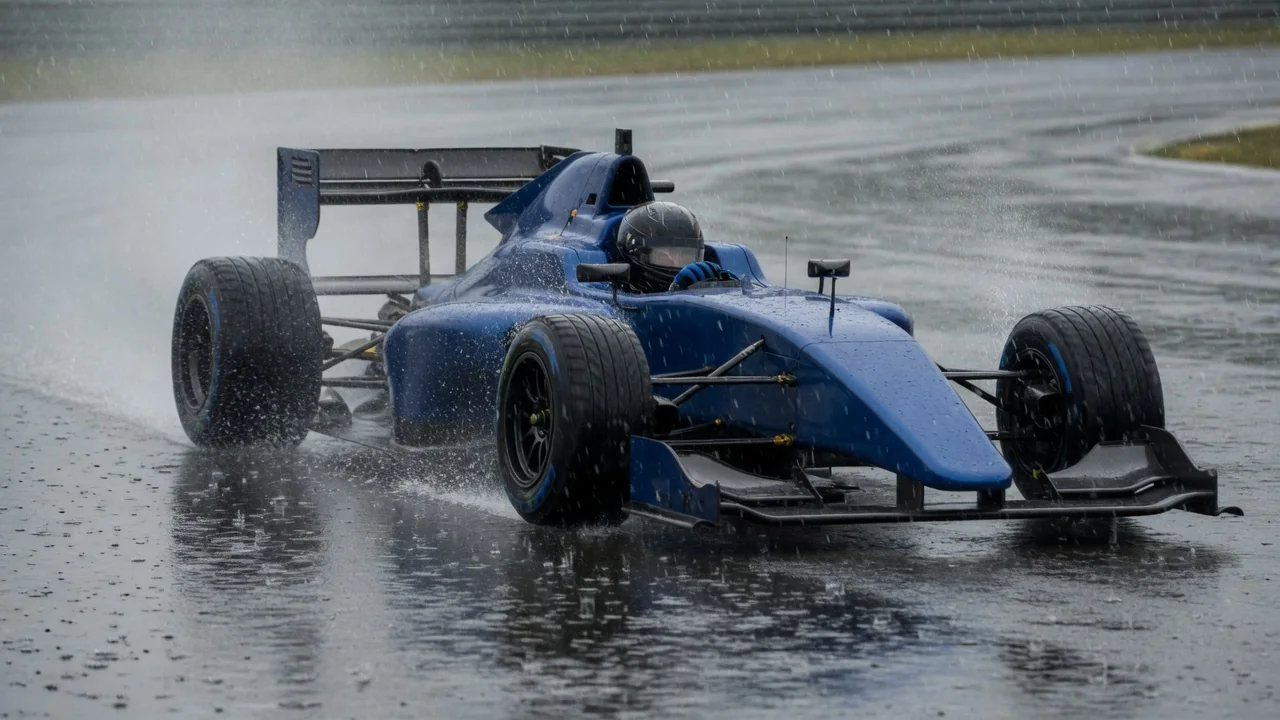
Race cars use wet tires because a smooth slick cannot push water out of its way. On a dry track, a slick's unbroken rubber surface delivers maximum grip. On a wet one, water builds up beneath it until the tire partly floats. Wet tires solve this with a grooved tread and a rubber compound designed for cooler, slippery conditions. This article explains how they move water, when they are used, and how teams choose between tire types.
Water Evacuation: How Grooves Keep Rubber on the Track
Tire grip depends on rubber touching the road surface directly. The rubber deforms around the fine texture of the asphalt and also adheres to it at a microscopic level. Water interrupts both effects. When a tire rolls onto a wet surface, it must displace the water in its path before rubber and asphalt can meet. At low speed there is time for the water to squeeze out of the contact patch. As speed rises, that time shrinks, and water builds up in a wedge at the leading edge of the tire. If the pressure in that wedge becomes high enough, it lifts part or all of the tread off the surface. This is aquaplaning, also called hydroplaning, and it leaves the driver with little steering or braking control.
A slick racing tire has no channels for water to escape, so it is especially vulnerable. A racing wet tire tread adds grooves that give water somewhere to go. Circumferential grooves carry water backward through the contact patch, while angled or lateral grooves direct it toward the sides of the tire. By collecting and expelling water, the tread lets the rubber between the grooves press onto a surface much closer to dry. The volume and layout of the grooves determine how much water the tire can clear at a given speed, which is why tires meant for heavy rain have deeper, more extensive patterns than those meant for a damp track.
Grooves are only part of the answer. Rain and spray cool the tire, and a compound designed for a hot, dry track may never reach the temperature where it grips well. Wet tires therefore use compounds intended to work at lower temperatures and stay pliable on a cold surface. The tread blocks formed by the grooves also flex, which helps generate heat but makes the tire less precise under the high loads of dry running.
Conditions: When Wet Tires Make Sense
Wet tires are not a single answer to every kind of rain. Track conditions run along a spectrum: a light film of moisture after a shower, a damp surface with a drying line forming, steady rain with water collecting in places, and heavy rain with standing water across the circuit. Each stage changes how much water a tire must clear and how warm it can stay, so the right tire at the start of a session may be the wrong one a short time later.
Conditions also vary around a single lap. Low spots and areas with poor drainage can hold puddles while other sections dry quickly. Painted lines, curbs and rubber laid down during dry running tend to become slippery when wet. Camber, surface texture, temperature and wind all affect how fast water drains or evaporates. Drivers often describe conditions corner by corner, because a tire that copes well on one straight may struggle in a flooded braking zone.
Regulations add another layer. Many championships control which tire types are available, how many sets each competitor may use, and sometimes when wet tires must be fitted, such as after officials declare a session wet. These rules differ between series, so the physics of wet tires always operates inside a specific sporting framework.
Tire Choice: Slicks, Intermediates, and Full Wets
Racing series commonly use up to three broad categories of tire. Slicks have no tread and maximize the rubber in contact with a dry track. Intermediates carry a shallower groove pattern and a compound suited to damp conditions or light standing water, bridging dry and fully wet running. Full wets have the deepest grooves and the greatest water-clearing ability, intended for heavy rain. Not every series offers all three, and some run only slicks and a single wet option.
Choosing between them means finding the crossover point, the moment when one tire type becomes faster than another. A wet tire on a drying track runs too hot, its flexible tread blocks squirm and wear quickly, and its grooves no longer offer an advantage. A slick on a wet track cannot clear water or build temperature, so it slides and risks aquaplaning. Teams watch lap and sector times, driver feedback, the emergence of a dry line and weather information to judge when the crossover is approaching.
Timing is often the hardest part. Changing tires costs time in the pit lane, and conditions can shift again soon after a stop. Switching too early can leave a driver struggling on the wrong tire, while switching too late loses time on every lap before the change. That is why mixed weather so often reshuffles race results.
Practical Implications and Limits
Wet tires extend the range of conditions in which racing is possible, but they do not remove every risk. When water depth exceeds what the tread can evacuate, even a full wet can aquaplane. Spray thrown up by cars ahead can cut visibility so severely that safe racing becomes impossible regardless of grip. In those situations officials may slow or stop the field, and tire performance becomes only one factor in the decision.
Driving technique changes as well. Peak grip on a wet tire is lower than on a slick in the dry, so braking points move earlier and inputs must be smoother to avoid a sudden loss of traction. Drivers often leave the usual dry racing line, because rubber deposited there can be slicker in the rain than the surrounding asphalt. Teams may adjust car setup for wet running where rules allow, but those changes are specific to each car and series rather than a universal recipe.
For everyday drivers, the core lesson still applies, even though racing wet tires are built for closed circuits rather than public roads. Road tires are a compromise that must handle dry and wet conditions with one tread, and their ability to clear water depends heavily on remaining tread depth. As grooves wear, there is less room to channel water away and the risk of aquaplaning rises, so checking tread depth and following the tire and vehicle manufacturer's guidance matters for the same reason grooves matter on a race track.