Why Do Race Cars Use Quick-Release Steering Wheels?
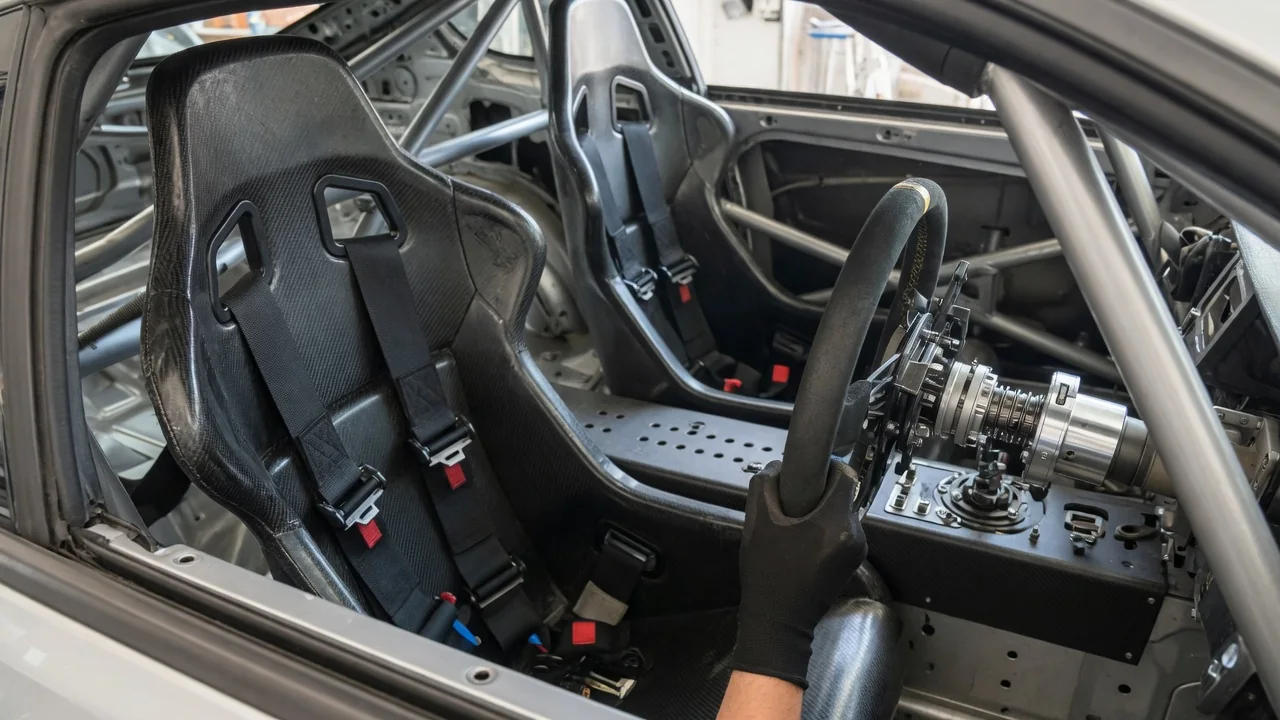
Race cars use quick-release steering wheels mainly so the driver can get in and out of a cramped, caged cockpit quickly, including in an emergency. A motorsport quick release wheel separates from the steering column at a hub. That lets the driver clear the rim, the roll-cage bars, and the harness without contorting their body. The idea is simple, but it only works if the coupling is precise and well maintained. This guide explains the access problem, how the coupling works, and what to inspect.
Driver access: room to get in and out
A typical race car cockpit is far tighter than a road car's. The seat is fixed and often wraps around the driver's ribs and shoulders. A roll cage adds door bars and a dash bar. The driver also wears a helmet, a head-and-neck restraint, and a multi-point harness. With the steering wheel in place, the rim sits close to the driver's thighs and chest. That leaves little room to swing the legs over a side bar or slide out of a deep seat. Taking the wheel off opens that space, so the driver can simply step in and sit down instead of working around a fixed obstacle.
The more important reason is getting out under pressure. After a crash or a fire, a driver may need to release the harness and leave the car as fast as possible, sometimes with poor visibility or an injury. Many sanctioning bodies set rules for how quickly a driver must be able to exit, and the steering wheel is often the largest object in the way. A quick release lets the driver pull the wheel off with one hand and set it aside. It also makes it easier for rescue crews to reach the driver. A removed wheel can make a parked car harder to drive away, but that is a side effect, not the motorsport purpose.
Coupling: how the hub locks and transfers torque
A quick-release system has two halves. One half is fixed to the steering column, usually through an adapter or boss made to fit that column's spline. The other half is bolted to the back of the steering wheel. When the halves are pushed together, a shaped interface carries the steering torque. Designs differ. Some use a splined shaft, some use a hexagonal or other non-round profile, and some use tapered surfaces that pull tight as the lock engages. In every design, the wheel must turn exactly with the column, with no free movement between the parts.
A locking mechanism keeps the halves from sliding apart along the column. A common arrangement uses a spring-loaded collar or sleeve that the driver pulls back to release. When the collar is let go, it pushes balls, pins, or latches into a groove so the wheel cannot slide off. Other designs use a lever or a button. In every case, the lock must hold against the pushing and pulling a driver applies when bracing against the wheel. A well-designed lock also makes a half-engaged state obvious to the driver. Some hubs are indexed so the wheel seats only in the position where it is straight when the front wheels point straight ahead.
Many race wheels carry buttons, paddles, displays, or a horn switch, so the coupling may also have to pass electrical signals. This is usually done with a multi-pin connector built into the hub, or with a separate plug the driver connects after fitting the wheel. Pin alignment and contact condition then become part of the coupling's job. A poor connection can disable shift paddles, the radio, or other functions in the middle of a session.
Inspection: keeping the steering path tight
The coupling is a deliberate break in the steering path, so it needs routine attention. After fitting the wheel, pull firmly on it toward the driver to confirm the lock is fully engaged. Then rock the rim back and forth and push and pull it along the column. Any click, knock, or movement you can feel between the halves points to wear, dirt, or an incomplete lock. Fix it before the car moves.
Periodic inspection goes further. Check the splines or drive faces for burrs, rounded edges, or shiny wear marks. Check the locking balls, pins, and groove for flattening or pitting. Make sure the release collar springs back crisply and that no grit or debris is packed into the mechanism. Confirm that the bolts holding the wheel and the column adapter are tight and use whatever retention method the manufacturer specifies. Look for cracks around welds or mounting holes on the adapter. If the hub carries wiring, check the pins and sockets for bent, burned, or corroded contacts.
When parts are worn, replacing them is generally better than an improvised repair, because play in a quick release tends to grow over time. Follow the hub maker's instructions for cleaning, lubrication, and service intervals. Avoid pairing halves from different manufacturers unless they are explicitly designed to work together. Some racing series also require quick-release hubs to meet a specific certification standard, which makes the label and documentation part of the inspection.
Practical implications and limits
Fitting a quick release changes the car's ergonomics. The hub adds length between the column and the wheel, which moves the rim closer to the driver. That can change arm angle, the view of the gauges, and clearance to the dash. Builders often make up for it with a wheel of a different dish depth or by moving the seat. It is best to treat the hub as part of the whole driving position, not as a simple bolt-on accessory.
On a road car, the trade-offs are more serious. Most factory steering wheels contain an airbag, and fitting an aftermarket hub usually means removing it. That disables a key safety system and typically turns on a warning light. The adapter may also affect a collapsible steering column or other crash features. Whether a quick release is allowed on a street-registered vehicle depends on local regulations and inspection rules, and insurers may treat it as a modification.
Finally, a quick release only helps if it is used correctly. It does not replace other ways of getting out quickly, such as a harness that releases easily, a cage with a clear exit path, and practiced exit drills. One key risk is human error: a wheel that looks seated but is not fully latched. A pull check every time the wheel goes on matters more than any single design feature, along with the rulebook and manufacturer guidance that apply to the car.