Why Do Race Cars Use Adjustable Anti-Roll Bars?
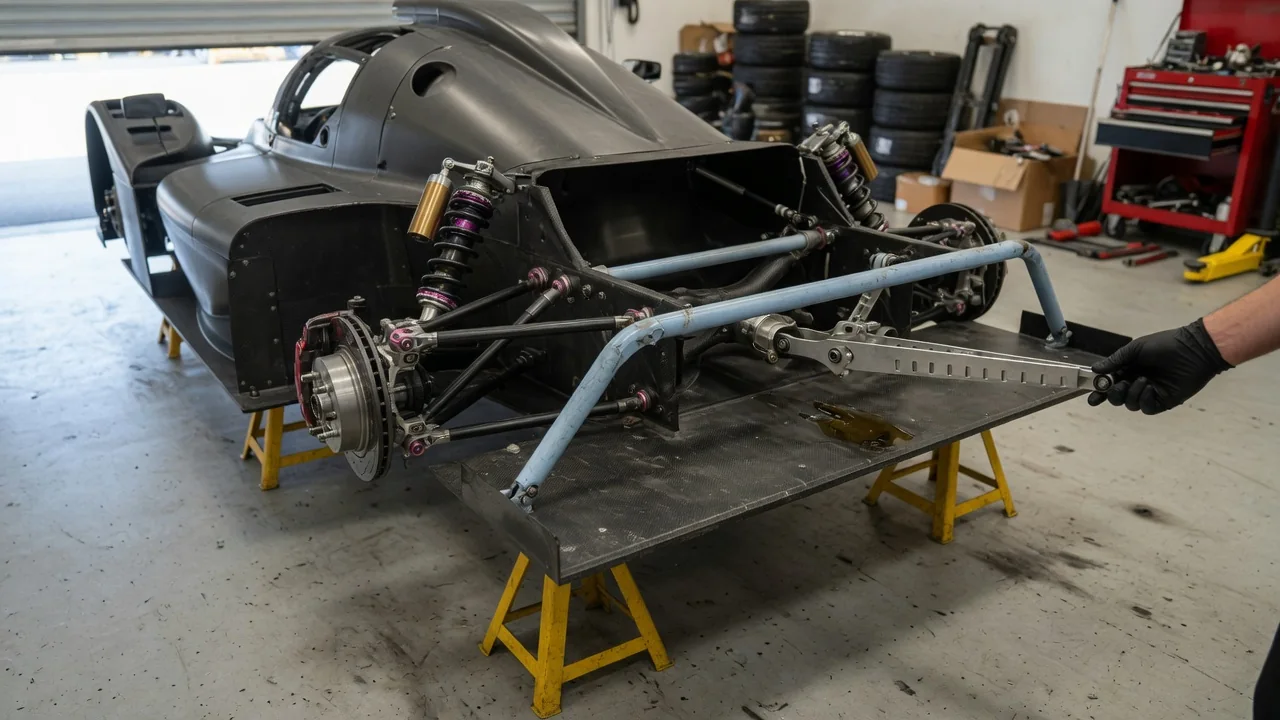
An anti-roll bar, also called a sway bar or stabilizer bar, is a torsion spring that links the left and right wheels of one axle and resists body roll in corners. On a road car it is usually a fixed part chosen by the manufacturer. In motorsport, anti-roll bar adjustability gives engineers and drivers a fast, precise way to change how a car handles. Here is why race cars use adjustable anti-roll bars and where that adjustment fits in a setup.
Roll balance: shifting grip between the front and rear
When a car corners, lateral acceleration transfers load from the inside tires to the outside tires. The total amount of that transfer depends mainly on the car's mass, center of gravity height, track width, and how hard it is cornering. What the suspension controls is how that load transfer is shared between the front axle and the rear axle. Each axle's share is strongly influenced by its roll stiffness, and the anti-roll bar is one of the main contributors to roll stiffness at that end of the car.
This distribution matters because tires are load sensitive. As vertical load on a tire rises, its grip grows, but not in proportion, so a pair of tires with an uneven load split produces less total lateral grip than the same pair loaded more evenly. The axle that carries a larger share of the load transfer therefore tends to lose grip first. Stiffening the front bar generally pushes the balance toward understeer, while stiffening the rear bar generally pushes it toward oversteer. Softening either bar has the opposite tendency.
An adjustable bar lets the team move this front-to-rear balance in small, repeatable steps. Common designs change the effective lever arm by moving the end link between holes on the bar arm, or rotate a flat blade so it is stiffer or softer in bending. Some series and cars also allow the driver to adjust a bar from the cockpit, though whether that is permitted and how it is implemented depends on the regulations and the specific car.
Track conditions: adapting the balance to the surface and the session
A balance that suits one circuit or one moment rarely suits every situation. Grip levels change as rubber builds up on the racing line, as track temperature rises or falls, and when rain arrives. In lower-grip conditions such as a wet track, teams often soften the bars to let the car roll more and keep the tires working more evenly, while a high-grip surface may tolerate or benefit from stiffer settings. These are general tendencies rather than fixed rules, and the right direction depends on the car and its tires.
Circuit layout also matters. Because an anti-roll bar couples the two wheels on an axle, a bump or curb that lifts one wheel also twists the bar and loads the opposite side. A very stiff bar can make the car nervous over curbs and uneven surfaces, so bumpy tracks or circuits where drivers use the curbs aggressively may call for softer settings. Smooth tracks with long, fast corners may favor stiffer roll control to keep the chassis settled and, on cars with significant aerodynamics, to hold a more consistent platform.
Conditions also change within a single run. Fuel burn shifts weight, and tires lose grip as they wear and heat cycle. A setting that feels ideal on fresh tires and a full tank can drift out of balance late in a stint. Where cockpit adjustment is allowed, a driver can trim the bar to compensate; otherwise the team may change it during a pit stop or between sessions.
Setup context: why the bar is the preferred balance tool
Anti-roll bars are not the only way to change roll stiffness. Springs, dampers, ride height, alignment, and on some cars aerodynamic settings all affect handling. The bar is valuable because it acts mainly in roll. Springs resist roll, but they also resist heave, the whole car moving up and down, and pitch under braking and acceleration. Changing a spring therefore alters ride height behavior, aero platform, and bump response at the same time. An anti-roll bar has relatively little effect when both wheels on an axle move together, so it can retune roll balance with fewer side effects on the rest of the setup.
Speed of change is the other reason. Swapping springs usually means lifting the car, disassembly, and often resetting ride heights and corner weights. Moving a bar link or rotating a blade is typically much quicker, which matters when practice time is limited. Engineers often use springs to establish the car's basic platform and ride quality, then use the bars for finer balance tuning within that framework. The bar setting also interacts with alignment, since roll affects camber, and with damper settings, which shape how quickly the car reaches its roll angle.
Practical implications and limits
An adjustable bar is a balance tool, not a source of extra grip. It redistributes load transfer between the axles, but it cannot raise the car's total available grip if the tires, aerodynamics, or basic geometry are the limiting factor. A car that is slow everywhere because it lacks grip will not be cured by bar changes alone, and chasing balance with large bar swings can mask a different underlying problem.
Stiffer is not automatically better. Excessive roll stiffness at one end can unload the inside tire so much that it loses traction or lifts, which can hurt corner exits on a driven axle and make the car abrupt at the limit. Bar end links should also be adjusted so the bar carries no preload at rest with the driver aboard; unintended preload can shift corner weights and make the car behave differently in left and right turns. Methodical changes, one adjustment at a time with clear driver feedback, make it easier to understand what each step actually did.
For street-based cars used on track days, adjustable aftermarket bars offer a similar way to tune balance, but road use adds compromises. Stiff settings can reduce ride comfort and single-wheel bump compliance, and any change in handling balance should suit the car's stability systems and the driver's experience. Installation should follow the vehicle's service information and the bar maker's instructions, and class regulations decide what is allowed in a given form of competition.