Why Do Race Cars Have Tow Hooks? Recovery, Mounting and Inspection
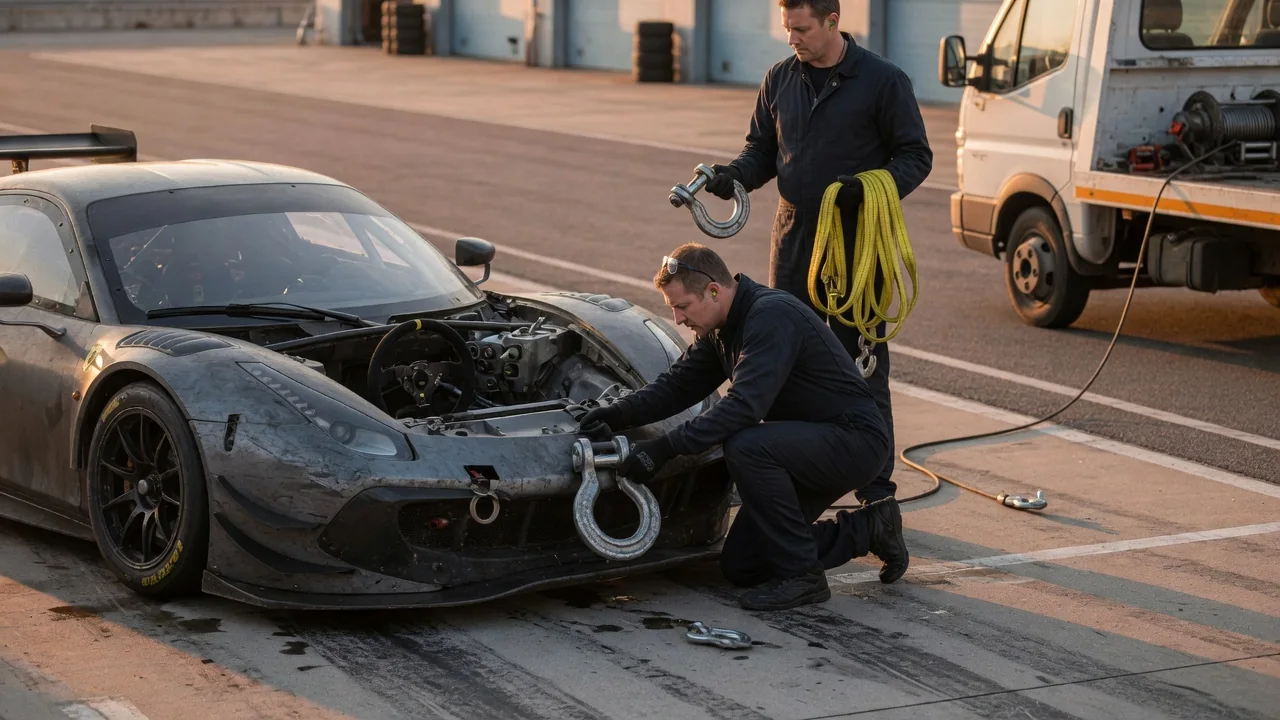
Race cars carry tow hooks or tow straps for one main reason: when a car stops on track, someone has to move it quickly and safely without causing more damage. The hook or strap on a race car is safety equipment, not decoration. This guide explains the motorsport tow hook purpose in recovery, how tow points are typically mounted, and what a sensible inspection routine looks like.
Recovery: Why Race Cars Need a Quick Attachment Point
In racing, a stranded car is a hazard. It may be stuck in a gravel trap, resting against a barrier, or stalled with a mechanical failure where other cars arrive at high speed. Track marshals and recovery crews need to attach a tow line or recovery vehicle quickly, often while wearing gloves and working under time pressure. A clearly marked, easily reachable tow point lets them do that without searching under the car or reaching beneath a low front splitter. The faster the car is moved, the sooner the session can return to normal running. That is why the answer to the question of why race cars have tow hooks is tied to both safety and event flow.
A dedicated tow point also protects the car itself. Race cars commonly sit low and use lightweight body panels, splitters, diffusers and aerodynamic parts that are not built to carry pulling loads. If a crew has nowhere suitable to attach a strap, they may be forced to use a suspension arm, a bumper cover or an exhaust hanger, which can bend components or tear bodywork. For this reason, many sanctioning bodies and track-day organizers require front and rear towing points and expect them to be marked in a contrasting color so they are visible at a glance. Exact requirements differ between series and events, so the relevant rulebook is the authority for any particular car.
The two common forms are rigid hooks or eyes and fabric tow straps. Rigid eyes are simple and strong. Fabric straps fold flat against the bodywork, are less likely to snag on another car during contact, and can be routed out from behind a bumper without large openings. Both serve the same job: giving recovery crews a predictable place to connect.
Mounting: Attaching Tow Points to the Car's Structure
A tow point is only as strong as what it is bolted to. The general principle is to attach it to a load-bearing part of the vehicle, such as the chassis, a subframe, a bumper reinforcement beam, or a dedicated mounting point provided by the manufacturer. If a strap is attached only to a plastic bumper cover, a thin sheet-metal panel or an aerodynamic component, the mount may pull out when the car is dragged from gravel or pulled up a slope. The forces during recovery can be high and are not always applied in a straight line, so the mounting must also tolerate some sideways pull.
Location matters for access. Front and rear points should be reachable without removing panels or using tools. They should sit where a strap or hook can be connected while the car is resting on its belly in gravel or against a barrier. Many road cars already have threaded receivers behind small covers in the bumpers, designed to accept a screw-in towing eye supplied with the vehicle. On track, drivers often fit that eye or an aftermarket hook or strap that uses the same receiver or nearby structural bolts. Whether an aftermarket part is appropriate depends on the specific vehicle and the part's design. The owner's manual or service information is the place to confirm the factory towing provision.
Routing also deserves attention. A fabric strap should exit the bodywork cleanly, without rubbing against sharp edges, radiator cores, intercoolers or hot exhaust parts. A rigid hook should not protrude so far that it becomes a snag point, nor sit so deep that a crew cannot reach it.
Inspection: Checking Tow Hooks and Straps
A tow point may go unused for months and then face a hard pull, so check it regularly rather than assuming it will work. For fabric straps, look for frayed or cut webbing, damaged stitching, and stiffness or discoloration that may indicate heat or sun exposure. Also look for contamination from oil, fuel or coolant. Check that the strap's mounting bolt or bracket is tight and that the webbing has not been chafed where it passes through the bodywork.
For rigid hooks and screw-in eyes, look for bending, cracks, corrosion and damaged threads, both on the eye and in the receiver. Check welds or brackets for cracking, and make sure fasteners are secured according to the vehicle or part maker's guidance. A screw-in eye should thread in fully by hand before final tightening; resistance can indicate cross-threading or debris. Any tow point used in a heavy recovery, such as pulling a car out of deep gravel or away from a barrier, deserves a closer look afterward, since it may have been loaded at an angle. When in doubt, replacing a strap or hook is usually simpler than trusting a damaged one.
Technical inspection at many events includes confirming that tow points are present, visible and accessible. Passing that check confirms presence, not condition, so inspecting the hardware remains the owner's responsibility.
Practical Implications and Limits
For an enthusiast taking a road car to a track day, the practical takeaway is to plan the tow point before arriving rather than at the gate. Find the factory towing eye, confirm where it threads in, and decide whether to leave it installed for the day or fit a dedicated strap. A tow point that is fitted and marked makes the recovery crew's work easier and can reduce the chance of extra damage after an off-track excursion.
Tow points also have clear limits. They are generally intended for pulling or towing a car at low speed, not for lifting it by crane, unless the vehicle or series specifically provides lifting points for that purpose. They are not designed for jerking or snatch-style recovery, and a strap's rating does not describe the strength of the structure behind it. A tow point on one car tells you little about how another car's mount will behave, because mounting structures differ widely. Finally, a tow hook does not replace sound decisions on track: after an off, following marshal and event instructions matters more than any hardware.