Why Do Modern Cars Have Ground Straps?
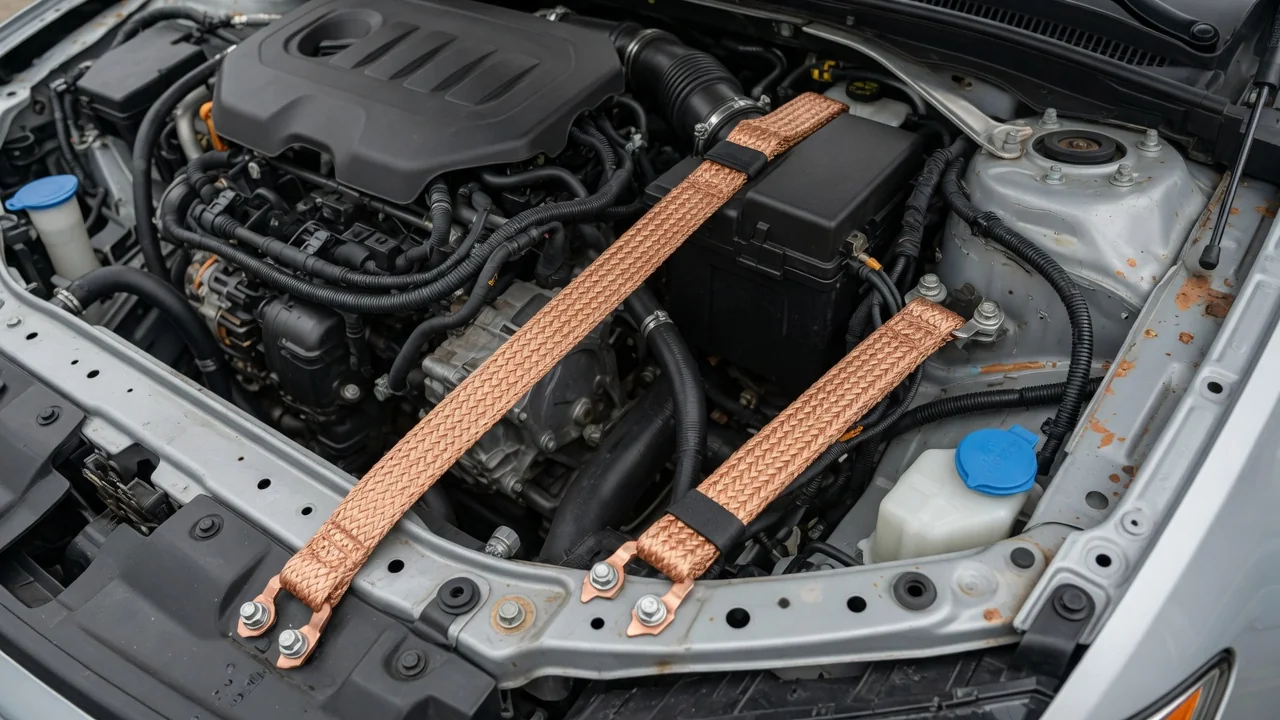
Open the hood of almost any modern car and you will find at least one short cable or braided strap bolted between the engine, the body and the battery negative terminal. These straps look minor, but they complete the electrical circuit for nearly everything on the vehicle. So why do modern cars have ground straps? This article explains the vehicle ground strap function in three parts: how current returns to the battery, why engine movement requires a dedicated flexible link, and how corrosion gradually weakens that link.
The return path: completing the circuit
Every electrical circuit needs a complete loop. In most cars, the battery positive feeds components through dedicated wires, fuses and relays. The return side uses the metal structure of the vehicle itself. This arrangement, often called a chassis or body ground, saves a great deal of copper wiring, weight and complexity, because the body acts as one large shared conductor back to the battery negative terminal. Ground straps and cables are the bridges that connect the battery, the engine and the body into that common return network.
The engine needs its own solid link because some of the heaviest currents in the car flow through it. The starter motor is bolted to the engine, and the alternator is usually mounted there as well. When the starter cranks, its current has to travel back to the battery, and the alternator's charging output depends on the same connection to complete its circuit. Without a low-resistance ground between the engine and the body or battery, these loads cannot get the current they need. Modern vehicles add another layer. Engine and transmission sensors, ignition components and control modules often rely on stable ground reference points. Even a small extra resistance in the return path shifts the voltage a module sees, and that can distort sensor signals that are interpreted in fractions of a volt.
Ground straps can also help control electrical noise. Ignition systems, alternators and electric motors generate interference, and a short, wide connection between large metal assemblies helps keep them at the same electrical potential. This is one reason some straps are flat braids rather than round cables. A broad, flat conductor generally handles high-frequency noise better than a thin wire of similar length. Whether a particular strap exists mainly for current return or mainly for interference control depends on the vehicle's design.
Engine movement and rubber mounts
The engine is not rigidly bolted to the body. It sits on rubber or fluid-filled mounts that absorb vibration and keep engine shake out of the cabin. Those same mounts are poor electrical conductors, so they effectively insulate the engine from the body. The mounting system that makes the car comfortable also breaks the most obvious electrical path, and the ground strap exists to restore it.
The engine also moves. It rocks under acceleration and braking, twists under torque at startup, and vibrates continuously while running. A rigid conductor would fatigue and crack under that constant motion. For that reason, ground straps are made flexible, either as finely stranded cable or as woven braid, and they are routed with enough slack to follow the engine without pulling tight. Over many years, flexing, vibration and heat from nearby exhaust components can still break individual strands. This gradually reduces the strap's capacity, even when it looks intact at a glance.
When the dedicated ground is weak or missing, current does not simply stop. It looks for any other conductive route between the engine and the body. That route can include mechanical control cables on vehicles that have them, metal-braided hoses, wiring harness shields, or small ground wires never intended to carry starter current. Those parts can overheat, become damaged or fail early. This is why a ground fault sometimes shows up as damage to a component that seems unrelated.
Corrosion at the connection points
A ground connection is only as good as the metal-to-metal contact at each end. Engine bays are exposed to moisture, road salt, heat cycles and automotive fluids, and all of these attack bolted joints. Oxide layers form on the terminal, the bolt and the mounting surface, and even a thin film adds resistance. Because ground straps carry large currents, a small rise in resistance at a contact can cause a noticeable voltage loss and local heating at the joint. That heating can then speed up further deterioration.
Modern construction can add to the challenge. Engines, transmissions and body structures may combine steel, aluminum and other alloys, and the strap itself is often copper or tinned copper. When dissimilar metals touch in the presence of moisture, galvanic corrosion can develop, and one metal corrodes faster than the other. Manufacturers manage this with plated terminals, specific fasteners, sealants and carefully chosen mounting locations. Age, physical damage, or repair work that leaves paint, sealer or undercoating between the terminal and the surface can undo those protections.
Corrosion can also be hidden. A strap may look sound on the outside while the strands under the insulation or inside a crimped terminal have turned green or white and lost much of their conductivity. Uncovered braided straps are easy to inspect but more directly exposed to the environment. In both cases the problem tends to develop slowly, so ground-related symptoms usually appear gradually rather than all at once.
Practical implications and limits
Because many circuits share the same grounds, a poor connection can produce a confusing mix of symptoms. These include slow or intermittent cranking, dim or flickering lights, charging irregularities, erratic gauge readings, and warning lights that come and go. None of these symptoms is unique to grounds. Weak batteries, failing alternators, bad connections on the positive side and faulty modules can produce similar effects, so a ground strap should be treated as one candidate in a diagnosis, not an automatic answer.
Technicians commonly check grounds with a voltage drop test, which measures across the ground connection while the circuit is under load, for example during cranking. A resistance reading on an unloaded strap can look acceptable even when the connection fails under real current, so testing under load is generally more informative. The acceptable drop, the number of straps and their exact locations vary by vehicle. The service information for the specific model is the right reference, not a generic figure.
When a strap or its contacts need attention, the usual approach is to clean the mating surfaces to bare metal, replace damaged straps with parts of equivalent size and construction, and tighten the fasteners properly. Adding extra ground wires is not a substitute for repairing the original connection, and improvised changes can create unintended current paths. Hybrid and electric vehicles also have high-voltage systems that are designed differently and are typically isolated from the chassis. Those systems require specific procedures and training, so the guidance here applies only to the conventional low-voltage electrical system.