Why Do Gas Engines Need Spark Timing Control?
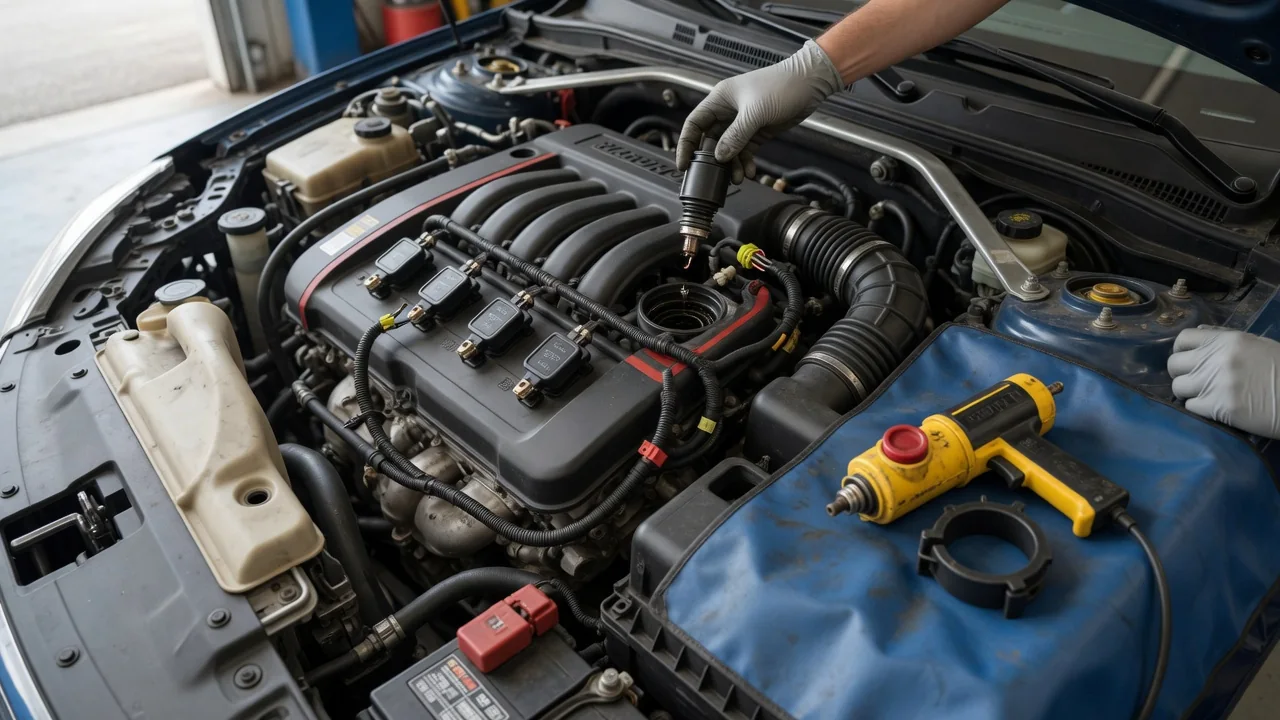
A gasoline engine does not burn its fuel instantly. After the spark plug fires, a flame front needs time to spread across the combustion chamber, and the piston keeps moving the whole time. Spark timing control decides exactly when that spark happens relative to piston position. If the timing is right, pressure pushes efficiently on the piston. If it is wrong, pressure arrives too early, too late, or uncontrollably. This article explains why ignition timing control matters and what it actually manages.
Pressure timing
Spark timing is really about pressure, not the spark itself. The goal is to place the resulting pressure rise at the most useful point in the piston's travel. Combustion pressure does the most useful work when it peaks shortly after the piston passes top dead center and starts moving down. If peak pressure arrives while the piston is still rising, the expanding gases push against the piston's motion, which wastes energy and adds mechanical stress. If it arrives too late, the piston has already moved far down the cylinder. The gases then expand into a growing volume, and much of their energy leaves as heat in the exhaust instead of turning the crankshaft.
Under a given set of conditions, the burn takes a certain amount of time, so the spark usually has to occur before top dead center. This is called spark advance, and it is measured in degrees of crankshaft rotation. As engine speed rises, the crankshaft turns through more degrees in the same amount of time. The spark therefore generally has to fire earlier to keep peak pressure in the right place. Burn speed also changes with load, mixture strength, charge temperature, and how much exhaust gas is mixed into the intake charge. During light-load cruising, a thin, diluted charge burns more slowly and typically needs more advance. A dense charge at full load burns faster. Engineers often describe the target as the minimum advance for best torque, meaning the smallest amount of advance that delivers maximum torque at a given operating point.
No single fixed setting can satisfy all of these changing conditions. That is the basic reason gas engines need timing that adjusts continuously rather than staying at one value.
Knock avoidance
Advancing the spark raises cylinder pressure and temperature earlier in the cycle, and there is a limit to how far that can go. As the flame front travels outward from the spark plug, it compresses and heats the unburned mixture still waiting at the edges of the chamber, often called the end gas. If the end gas gets hot and pressurized enough, it can ignite on its own before the flame reaches it. The result is a sudden, uncontrolled pressure spike known as knock or detonation. Drivers often hear it as pinging or a metallic rattle under load.
Mild, occasional knock may cause little immediate harm. Sustained or heavy knock, however, can overheat and damage pistons, ring lands, head gaskets, and spark plugs. Knock is most likely under these conditions: • high load at relatively low engine speed; • hot intake air or coolant; • high compression, or boost from a turbocharger or supercharger; • carbon deposits that raise effective compression; • fuel with lower octane than the engine was designed for
Timing control lets the engine run close to its most efficient advance while staying on the safe side of the knock limit. Many modern engines use one or more knock sensors that detect vibration frequencies characteristic of knock. When knock is detected, the engine control unit retards the timing, in some systems for individual cylinders, and then gradually restores advance once the condition clears. Retarding the spark lowers peak pressure and end-gas temperature, at the cost of some torque and efficiency. How aggressively a given engine responds, and how it adapts after repeated knock events, depends on its specific calibration.
Engine response
Spark timing affects torque almost immediately, so the control unit uses it as a fast adjustment tool, not just an efficiency setting. Changing airflow through the throttle takes time, because the intake manifold has to fill or empty. A change in spark timing takes effect on the very next combustion event. This makes timing useful wherever quick torque changes matter.
Timing adjustments serve several purposes: • At idle, small changes help hold a steady speed when loads such as the air conditioning compressor, power steering, or electrical systems switch on and off. • During a cold start, many engines deliberately retard timing so more combustion heat goes into the exhaust, which helps the catalytic converter reach operating temperature sooner. • Some powertrains briefly pull timing to soften torque during automatic transmission shifts, or to cut power quickly when traction or stability control intervenes. • Timing also affects how the engine feels when the driver presses the accelerator. Well-placed advance supports strong, smooth torque, while excessive retard leaves the engine feeling flat and sluggish.
Timing also affects emissions. Higher peak combustion temperatures tend to increase the formation of nitrogen oxides. Calibrations therefore balance advance against emission targets, working alongside other systems such as exhaust gas recirculation. The manufacturer's calibration determines which of these strategies a particular vehicle uses and to what extent.
Practical implications and limits
For owners, the most practical consequence concerns fuel. Using the octane grade recommended in the owner's manual lets the engine run the timing its calibration expects. Many engines with knock sensors will still run on a lower grade without obvious noise, because the control unit retards timing to protect the engine. The trade-off can be reduced power and fuel economy, especially under load or in hot weather. Whether an engine gains anything from higher octane than recommended depends on its design. An engine calibrated for regular fuel may show little or no difference.
Many current engines have no user-adjustable base timing at all. The control unit sets spark timing electronically, using signals from the crankshaft and camshaft position sensors. Older engines with distributors may need base timing set with a timing light, following the service manual's procedure, and the correct value and method differ by engine. Persistent pinging, unusual loss of power, poor fuel economy, or a stored knock sensor or position sensor code are all reasons to diagnose the cause rather than assume a timing fault. Similar symptoms can come from lean mixtures, overheating, carbon buildup, vacuum leaks, or incorrect fuel. Timing control can compensate for some unfavorable conditions, but it cannot fix underlying mechanical or fuel-system problems, and every bit of retard it applies for protection costs some efficiency.