Why Do Factories Scan Vehicle Barcodes During Assembly?
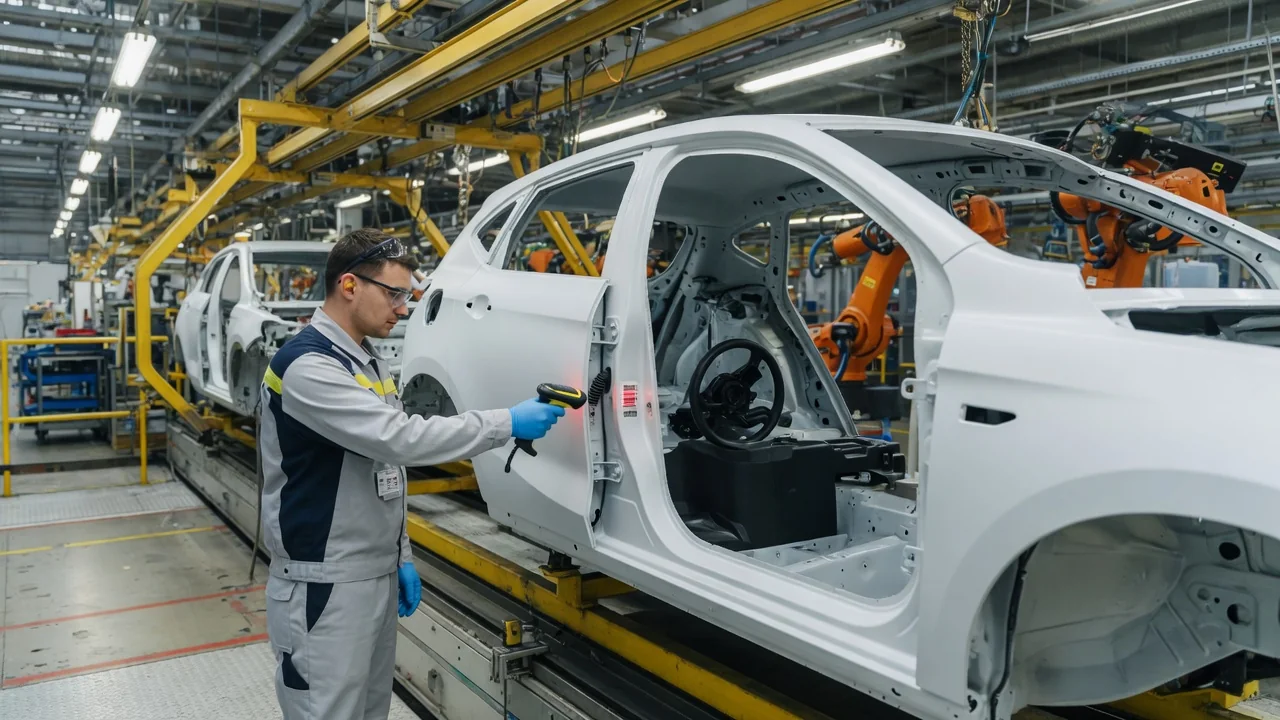
On a modern assembly line, workers and automated stations scan barcodes on vehicle bodies, parts, and work orders many times before a car rolls off the line. The short answer to why factories scan vehicle barcodes during assembly is that each scan links a physical object to a digital record. That link helps confirm the right part is installed, keeps each vehicle's build in the correct order, and leaves a history that can be traced later if a quality question arises.
Part identity: confirming the right component goes on
Many vehicle components look nearly identical from the outside but differ in ways that matter. A wiring harness for one trim level, a brake caliper for a different wheel size, or a control module with a different software configuration may share the same shape and mounting points. A barcode label, often a one-dimensional code or a two-dimensional matrix code, carries a part number and frequently additional data such as a supplier code, a batch or lot reference, or a serial number. Scanning it lets the plant's system check the part against what that specific vehicle is supposed to receive, rather than relying on a person to tell similar components apart by eye.
This check is a form of error-proofing. When the scanned part number does not match the vehicle's build specification, the station can flag the mismatch, display a warning, or in some setups prevent the next step until the issue is resolved. The barcode on the vehicle itself, commonly tied to the vehicle identification number or an internal production number, provides the other half of the comparison. Without both identities, the system would know what part was picked up but not which car it was meant for. Components with safety or regulatory significance, such as airbag modules, seat belt assemblies, and electronic control units, are typical candidates for individual identification, although exactly which parts are scanned varies by manufacturer and plant.
Build sequence: keeping each vehicle's order straight
Assembly lines commonly build vehicles in mixed sequences, meaning a car with one engine, color, and option package may be followed directly by a different configuration. Each body carries its own build instructions, sometimes called a build sheet or broadcast, that tell each station what to install. Scanning the vehicle's barcode as it reaches a station retrieves those instructions, so the operator or robot works from the correct specification for that exact unit rather than from an assumption about what usually comes next.
Scans also confirm where a vehicle is in the process. When a body is scanned at a checkpoint, the production system records that it has arrived and which operations are complete. This matters for parts delivered in sequence, where suppliers or in-plant areas prepare components such as seats or instrument panels in the same order as the vehicles on the line. If a vehicle is pulled for repair, held for inspection, or otherwise moves out of order, the scanning record helps the plant adjust so the matching parts still meet the right vehicle. Scans at key stations can also confirm that required steps were not skipped before the vehicle moved on.
Some stations go further by tying tool results to the scanned vehicle. A connected tightening tool, for instance, may record whether a fastener reached its specified torque and associate that result with the vehicle's identity. Software loading for electronic modules can work in a similar way, with the scan determining which configuration is written to a given unit.
Traceability: building a record that outlasts the line
This is the core of car assembly barcode tracking: every scan that pairs a part identifier with a vehicle identifier adds an entry to that vehicle's production history. Over the course of assembly, this can build a detailed record of which serialized or lot-coded components went into which car, when key operations happened, and what results inspection or test stations reported. Plants generally keep these records in manufacturing execution or quality systems, though the depth and retention of the data differ between companies and between part types.
The value of this record shows up when something goes wrong after production. If a supplier discovers that a batch of components may be defective, traceability data can identify which vehicles received parts from that batch. Instead of reviewing every vehicle built over a broad date range, a manufacturer can narrow its focus to the specific units affected, which can make investigations and recalls more targeted. The same data supports root-cause analysis inside the plant: if a recurring defect appears, engineers can look for common factors such as a particular station, shift, tool, or part lot.
Practical implications and limits
For car owners, the effect of this tracking is usually indirect. A recall notice tied to a specific VIN, or a dealer looking up which version of a part was originally fitted, may draw on production records created in part by assembly-line scanning. It also helps explain why replacement parts are often ordered by VIN rather than by model name alone: two vehicles of the same model and year can leave the factory with different components.
Scanning has limits. A barcode confirms identity, not condition; a correctly identified part can still have a hidden defect, and a scan does not prove a connector was fully seated or a bolt was tightened unless the station records that separately. Labels can be damaged, misread, or scanned from the wrong item if procedures are not followed, which is why plants typically combine scanning with visual checks, functional tests, and end-of-line inspection. Some factories use RFID tags or other identification methods alongside or instead of printed barcodes for certain tasks. Finally, the scope of tracking differs: not every fastener or minor part is individually recorded, and details of what a given manufacturer scans are rarely published, so general explanations describe common practice rather than how any particular vehicle was built.