Why Do Exhaust Hangers Reduce Cabin Noise?
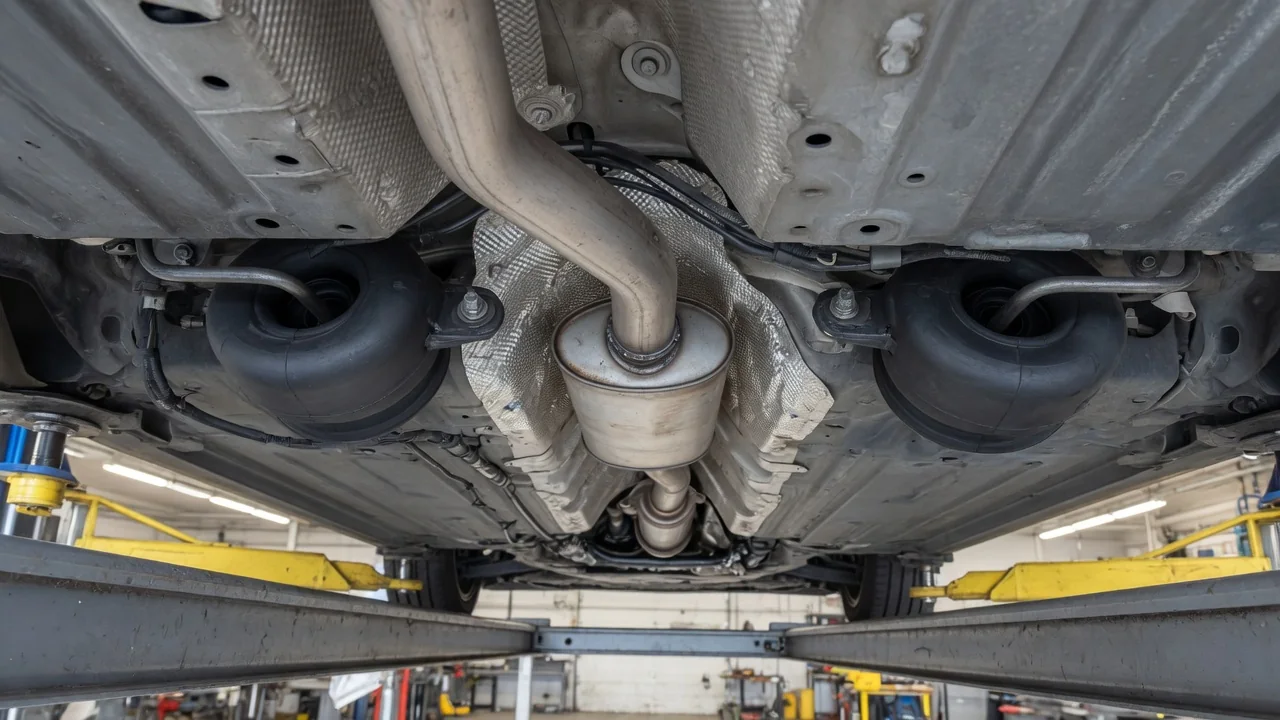
Exhaust hangers look like simple rubber loops, yet they play a central role in keeping exhaust vibration out of the passenger compartment. The exhaust system shakes constantly from engine pulses and powertrain movement, and anything rigidly bolted to the body would pass that energy straight into the floor. This article explains why exhaust hangers reduce cabin noise, how vibration travels from the pipes into the body, and how aging rubber gradually erodes that isolation.
Rubber mounts
An exhaust system is a long assembly of pipes, catalytic converters, resonators and mufflers. It bolts to the engine at one end and hangs beneath the body for the rest of its length. Rubber hangers carry much of its weight and hold it in position, but they also allow controlled movement. The engine sits on its own flexible mounts and rocks under acceleration, braking and load changes, and the exhaust moves with it. Hangers let the system swing with that motion and grow with thermal expansion. Rigid points would instead resist that movement and put stress on welds and flanges.
The noise benefit comes from vibration isolation. Engine firing pulses and exhaust gas flow make the pipes vibrate across a wide range of frequencies. A soft elastic element between a vibrating part and the structure it attaches to transmits less force than a rigid bracket. This effect is strongest at frequencies well above the natural frequency of the supported mass bouncing on that element. Rubber also has internal damping, which turns part of the vibration energy into a small amount of heat and limits how strongly the system can resonate. The vehicle manufacturer tunes the stiffness and shape of each hanger, so the balance between support and isolation differs from one design to another.
Location matters as well. Engineers generally try to place hangers near points where the exhaust moves least in its main vibration patterns, so less motion enters the mount in the first place. Many systems also include a flexible joint near the engine, such as a braided flex section or a spring-loaded ball joint. That joint decouples engine rocking from the rest of the pipework. Hangers and these joints work together, and neither does the whole job alone.
Body path
Noise reaches the cabin by two broad routes. Airborne noise travels as sound waves from the tailpipe outlet and from the shells of mufflers and pipes. Structure-borne noise travels as vibration through solid connections and is turned into sound somewhere else. Exhaust hangers mainly address the second route. Each hanger links a rod welded to the exhaust with a bracket fastened to the underbody, a crossmember or a subframe. The rubber therefore sits exactly where vibration would otherwise pass into the vehicle structure.
Once vibration enters the body, large thin panels such as the floor pan, the trunk floor and the rear bulkhead can behave like loudspeaker diaphragms. A small force at a bracket can set a panel vibrating, and that panel radiates sound directly into the passenger space. The cabin is an enclosed volume with its own acoustic resonances, so certain low frequencies can build into a noticeable boom or drone, often at particular engine speeds. Reducing the force that passes through each hanger reduces how strongly these panels are excited. This is why exhaust hanger vibration isolation has an effect that occupants can hear and feel.
The isolation only works if the hangers remain the only contact points. If a pipe, muffler or heat shield touches the floor, the subframe or another component, it creates a short circuit that bypasses the rubber entirely. Designers leave clearance around the exhaust for this reason. Sagging hangers, a misaligned repair or a bent shield can close that gap and produce rattles, buzzing or a harsh vibration in the floor.
Wear
Hanger rubber lives in a demanding environment. It sits close to hot pipes, faces road water, salt and ozone, can be contaminated by oil or other fluids, and flexes continuously while the engine runs and the vehicle moves. Over time the material tends to harden, develop surface cracks, stretch permanently or tear. Hardened rubber is stiffer and passes more vibration into the body. Stretched rubber lets the system hang lower and swing farther than intended.
Common signs of worn hangers include: • more vibration felt through the floor or seats at idle; • a new drone at cruising speeds; • a clunk when the engine starts or shuts off; • knocking over bumps; • a tailpipe that sits visibly lower or off center in its cutout; None of these symptoms proves a hanger problem on its own. Worn engine or transmission mounts, loose heat shields, failing flex joints and exhaust leaks can produce similar complaints. A visual check under the vehicle is more reliable than guessing from sound alone.
A failed hanger also changes how loads are shared. When one support tears, its share of the weight and movement shifts to neighboring hangers, joints and the connection at the engine. That added strain can speed up wear on the remaining rubber and stress flanges, flex sections and pipe joints. Catching a cracked or stretched hanger early is usually simpler than dealing with the damage a sagging, swinging exhaust can cause.
Practical implications and limits
When hangers are replaced, the stiffness of the new part matters as much as its fit. Hangers made from firmer materials such as polyurethane, or solid mounts, are sometimes chosen to limit exhaust movement. A stiffer part generally transmits more vibration, though, so cabin noise can increase. Wire, clamps or straps used as a roadside fix create a rigid path and should not stay in place long term. During installation, align the system so each hanger rests in a relaxed, neutral position with proper clearance. Hangers should not be pre-stretched or twisted to make parts line up.
Hangers also have clear limits. They reduce structure-borne transmission, but they cannot quiet a leaking joint, a deteriorating muffler, or the airborne drone that some aftermarket exhaust systems produce by design. New rubber will not cure vibration that comes from worn engine mounts or driveline components. The number, shape and placement of hangers differ widely between vehicles, so the service information for the specific vehicle is the right reference for correct parts and procedures. Exhaust components get very hot, so inspect or replace hangers only with the system cool and the vehicle safely supported.