Why Do EV Motors Need Cooling? Losses, Heat Paths and Power Limits
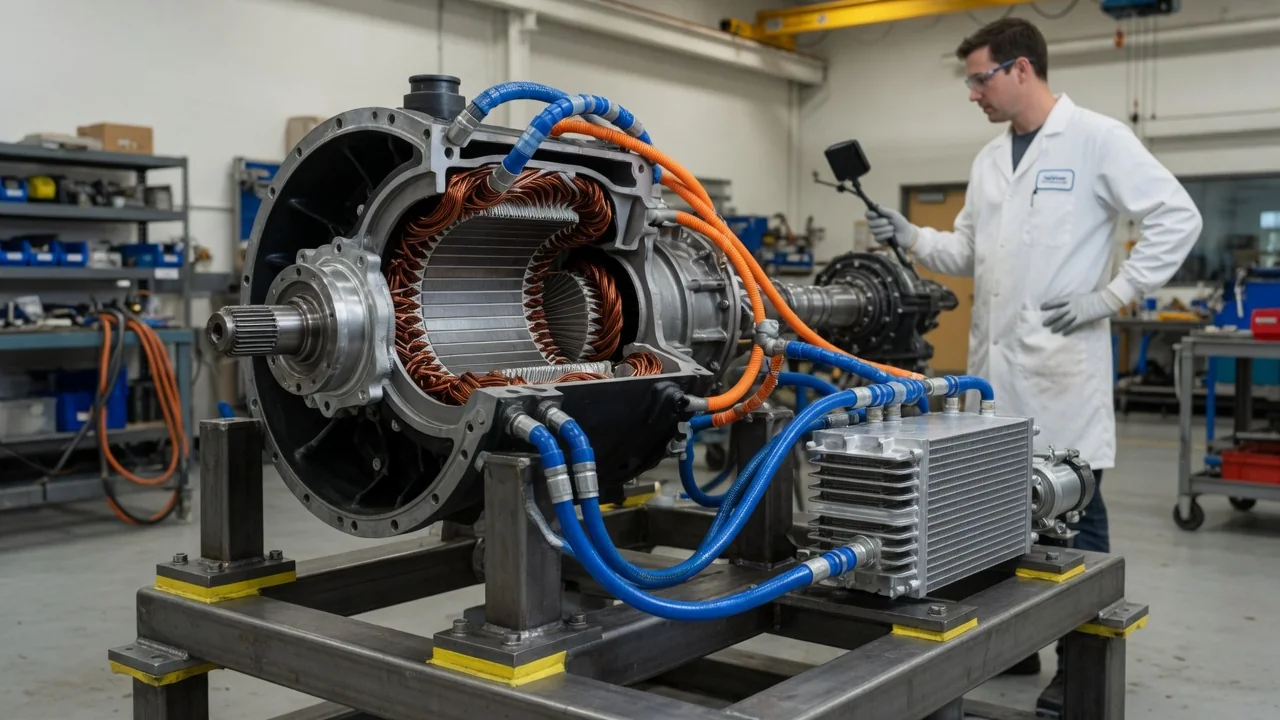
Electric motors are far more efficient than combustion engines, so it can seem odd that they need a dedicated cooling system. The reason is scale. Even a small fraction of the power flowing through a traction motor and its inverter turns into heat, and that heat builds up in parts with firm temperature limits. To understand EV motor thermal control, it helps to look at three things: where the losses come from, how heat leaves the drive unit, and why temperature caps output.
Electrical losses: where the heat comes from
The largest and most familiar source of heat is resistance in the stator windings. Current flowing through copper produces heat in proportion to the square of the current, so doubling the current roughly quadruples this loss. Motor torque depends closely on current, which means hard acceleration, steep climbs and heavy loads all drive winding heat up quickly. At high electrical frequencies, current also crowds toward the surfaces of the conductors, which adds further loss. Copper resistance rises with temperature as well, so a hot winding generates somewhat more heat for the same current. Cooling helps keep that feedback effect in check.
The stator and rotor cores are built from thin, insulated steel laminations that carry a constantly changing magnetic field. Each reversal of magnetization costs energy through hysteresis, and the changing field also induces small eddy currents in the steel. These core losses grow with frequency, so they become more significant at high motor speed, such as during sustained highway driving. In permanent-magnet motors, harmonics in the magnetic field can cause eddy-current heating in the magnets themselves. Smaller contributions come from bearing friction and from air drag on the spinning rotor.
The inverter converts battery DC into the AC the motor needs, and it is a heat source in its own right. Its power semiconductors lose energy while they conduct current and again each time they switch on and off, which happens thousands of times per second. The switched waveform they produce is also not perfectly smooth, and that adds harmonic losses inside the motor. For this reason, motor and inverter cooling are usually treated as one connected problem.
The cooling path from winding to outside air
Heat produced inside a motor has to travel a route before it can leave the vehicle. In the stator, it moves from the copper through the winding insulation and slot liners into the steel laminations, and then into the housing. Each layer resists heat flow to some degree. Insulation is a particularly poor conductor of heat, so the hottest point is usually deep inside the windings, often at the end turns that extend beyond the stator core.
Many traction motors use a liquid jacket in the housing through which a water-glycol coolant circulates. Others spray or circulate oil, which can reach the end windings and sometimes the rotor directly because it does not conduct electricity. That oil is then cooled through a heat exchanger. The rotor is the harder part to cool because it spins and is separated from the stator by an air gap, so its heat often leaves through the shaft, the bearings or the oil flow. The inverter typically sits on a cold plate in the same coolant loop or a connected one.
From there, coolant carries heat to a radiator at the front of the vehicle, where airflow and an electric fan release it to the outside air. Pumps, valves and sometimes a chiller linked to the air-conditioning system let one integrated thermal system serve the motor, inverter, battery and cabin. In cold weather, some designs route drive-unit waste heat toward the battery or cabin instead of simply discarding it. How these loops are arranged varies widely between vehicles.
Why temperature sets power limits
Every part along that path has a temperature it should not exceed. Winding insulation ages faster the hotter it runs, and sustained overheating can lead to insulation breakdown and short circuits. Permanent magnets lose strength as they warm, which reduces torque for a given current. Past a certain point, they can be partially demagnetized for good, especially if high temperature coincides with strong opposing magnetic fields. Inverter semiconductors have junction temperature limits, and repeated large temperature swings stress their internal bonds and solder layers. Bearing lubricant also degrades when it overheats.
This is why motors are commonly given two kinds of power rating: a short-duration peak rating and a lower continuous rating. Peak output is possible because the mass of the motor and inverter absorbs heat for a while before critical parts reach their limits. Continuous output is the level at which the cooling system can remove heat as fast as it is produced. Cooling capacity therefore largely determines how long peak power can be held and how high sustained power can be.
To protect the hardware, control software monitors temperatures with sensors such as thermistors embedded in the windings and inside the inverter. It often also estimates temperatures that are hard to measure directly, such as rotor magnet temperature. When readings approach a threshold, the controller reduces the allowed current, a process known as derating. Output usually falls gradually rather than cutting out, and it normally recovers as the components cool.
Practical implications and limits
For drivers, the most visible effect is that repeated or prolonged high demand can bring reduced power. Several hard launches in a row, track sessions, long uphill drives while towing, or sustained high speed in hot weather are the situations most likely to trigger it. Reduced output in these conditions is usually the protection system working as intended, not a sign of failure. Some vehicles show a message or indicator, while others simply limit acceleration. How quickly and how much a given car derates depends on its specific hardware and software, which general principles cannot predict.
Maintenance matters because the system only works when coolant flows freely and the radiator can shed heat. Following the manufacturer's coolant specification and service schedule, not mixing coolant types, and keeping the front air intakes clear of debris all protect the cooling path. Drive units that use oil may have their own fluid service requirements. Reduced power during ordinary driving, a coolant warning, visible leaks, or unusual pump or fan noise are reasons to have the system inspected instead of continuing to drive hard.
Owners also have limited ability to diagnose or adjust the system themselves. Coolant temperature readings, where a vehicle displays them, do not directly show winding or magnet temperature, and derating thresholds are set by the manufacturer. The owner's manual and service information for the specific vehicle are the reliable reference for fluid types, service intervals and the meaning of warnings.