Why Do Engines Need an Oil Pump?
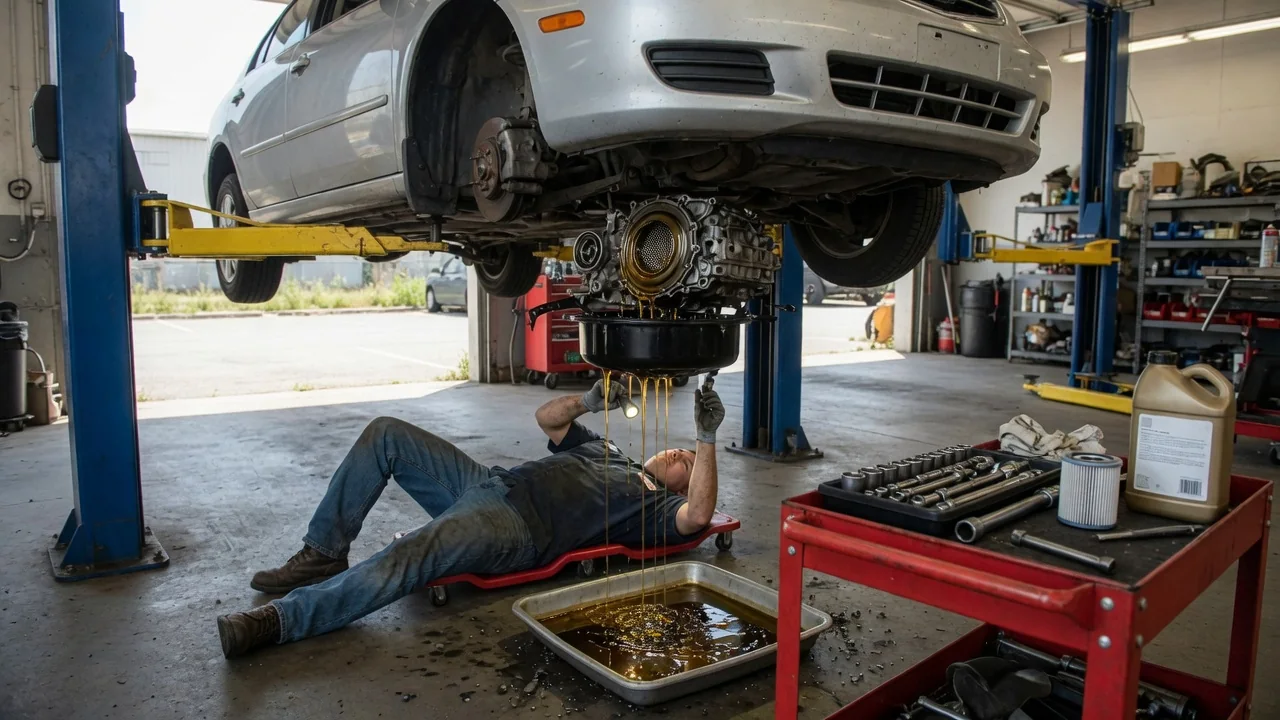
Why do engines need an oil pump? Because oil sitting in the pan protects nothing. Bearings, camshafts and other fast-moving parts depend on a steady, pressurized supply of lubricant, and gravity alone cannot deliver it upward through a running engine. The pump turns a pool of oil into a circulating system that reaches every loaded surface.
Pickup and pump
Circulation begins at the pickup, a tube that reaches down into the oil pan and ends in a screened inlet sitting below the oil level. The screen stops larger debris, such as gasket fragments or hardened sludge, from entering the pump. Because the pump can only move what the pickup can draw in, the oil level matters: if it drops far enough, hard cornering, braking or a steep grade can slosh oil away from the inlet and let the pump pull air instead.
The pump itself is a positive-displacement device, commonly using meshing gears or an inner and outer rotor to trap oil and push it toward the engine. It is driven mechanically by the engine, so output rises with speed. A relief valve bleeds off excess pressure when the oil is cold and thick or revs are high. Where the pump sits and how it is driven differ between designs; some mount around the crankshaft nose, others sit in the pan driven by a chain or shaft.
Oil passages
From the pump, oil usually passes through the filter and then into drilled or cast channels in the block, often called galleries. These feed the main bearings that support the crankshaft, and passages drilled through the crankshaft carry oil onward to the connecting rod bearings. In these bearings the pressurized supply maintains a thin film that keeps the spinning journal from touching the bearing shell. Without that film, metal contacts metal, and heat and wear build up within moments.
Other branches carry oil up to the cylinder head to lubricate the camshaft and valve train. Depending on the engine, pressurized oil may also operate hydraulic lifters or lash adjusters, timing chain tensioners, variable valve timing actuators, piston cooling jets and turbocharger bearings. This is why pressure matters beyond lubrication alone: several components use oil as a working fluid. After doing its job, the oil drains back to the pan by gravity, carrying heat and fine contaminants away with it.
Warning signs
The most direct warning is the red oil pressure light or a low-pressure message on the instrument cluster. It indicates that the sensor is reading pressure below its threshold, and it should be treated as a reason to shut the engine off as soon as it is safe. Some vehicles have a gauge instead of, or alongside, the light, and a reading that falls well below its usual position at warm idle deserves the same attention as a flickering lamp.
Sound can offer another clue. Ticking or clattering from the top of the engine may suggest the valve train is short of oil, while a deeper knock from low in the block can point to bearing distress. None of these signs proves the pump has failed. Low oil level, the wrong viscosity, diluted or degraded oil, a blocked pickup screen, worn bearings, a faulty sensor or a wiring problem can produce similar symptoms, so the cause needs to be confirmed before parts are replaced.
Everyday Use and Observations
In normal driving, the lubrication system gives little to observe, which is how it should be. The oil light comes on with the ignition as a bulb check and goes out within a moment of the engine starting, as the pump fills the galleries and pressure builds. On vehicles with a gauge, pressure is typically higher on a cold start, when the oil is thick, and settles lower once the engine is warm, rising and falling with engine speed.
Cold starts are the most demanding moment for the system, because thick oil takes longer to reach the far end of the passages. That is one reason manufacturers specify a particular viscosity grade, and why using the grade listed in the owner's manual matters. Checking the dipstick regularly, where one is fitted, keeps the pickup covered; some newer vehicles rely on an electronic level display instead. Changing the oil and filter on the manufacturer's schedule limits the sludge that can restrict the screen.
Limits and Next Steps
A warning light and a dipstick only tell part of the story. The light shows that pressure at the sensor is below a set point, not why, and the dipstick shows quantity, not pressure or oil condition. If the level is low, topping up with the correct oil may resolve the warning, but the reason for the loss, whether a leak or oil consumption, still needs to be found. If the level is correct and the light stays on, the engine should not be run.
Proper diagnosis usually means a workshop measuring actual pressure with a mechanical gauge and comparing it against the manufacturer's specification for that engine. Any stored fault codes are evidence to interpret alongside that test, since they often reflect the sensor circuit as much as the oil system, and their meaning can vary by manufacturer. Reaching the pump or pickup may involve removing the oil pan or timing components, so the work is generally best left to a qualified technician, with the vehicle towed instead of driven.