Why Do Engines Have Hot Spots? Heat, Coolant Flow and Design
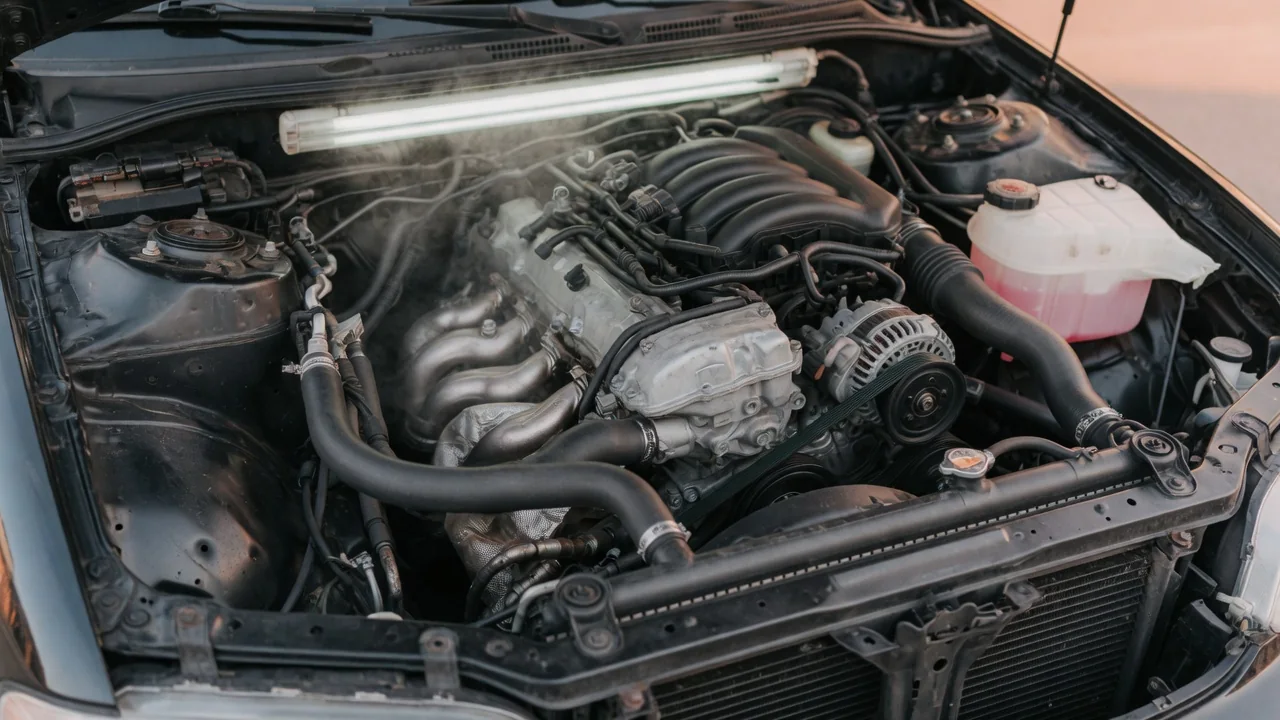
Every running engine has hot spots, which are areas that get noticeably hotter than the surrounding metal even when the cooling system is working correctly. By themselves they are not a sign of failure. They come from where combustion releases heat, how well coolant reaches each surface, and the compromises engineers make when packaging an engine. Understanding engine cooling hot spots explains why certain parts tend to suffer first and why cooling system maintenance matters.
Heat concentration: where an engine runs hottest
Combustion releases a large amount of heat in a small space for a very short time. The surfaces that face the burning mixture directly absorb the most heat: the roof of the combustion chamber, the piston crown, the valve faces and the upper part of the cylinder wall. That exposure is uneven. The top of the cylinder bore meets the highest pressures and temperatures as the piston nears top dead center. Lower in the bore, the walls are partly shielded by the piston and see gases that have already expanded and cooled somewhat.
The exhaust side of the cylinder head is usually hotter than the intake side. Hot exhaust gas rushes past the exhaust valve and through the exhaust port on every cycle, while the intake side is washed by a comparatively cool incoming charge. An exhaust valve has limited ways to shed heat. Much of it leaves through contact with the valve seat, which happens only while the valve is closed, and the rest travels up the stem into the guide. As a result, the exhaust valve and the metal around the exhaust port are typically among the hottest parts of the engine. The spark plug tip is another highly loaded point because it protrudes into the chamber.
Thin sections that receive heat from more than one direction form a third category. The narrow metal bridges between valve seats in the head and the wall between neighboring cylinders are heated from both sides, yet there is little room around them for coolant. Heat builds up there faster than it can be carried away.
Coolant passages and uneven flow
The coolant jacket is not a uniform bath surrounding the engine. The water pump pushes coolant into a network of cast passages, commonly through the block and up into the cylinder head before it returns toward the thermostat and radiator, although routing varies between designs. Coolant picks up heat as it travels, so areas farther downstream receive warmer coolant. Areas where flow slows down or stagnates carry heat away less effectively, even when the overall coolant temperature looks normal.
Very hot surfaces can make coolant boil locally. A limited amount of small-bubble boiling at the metal surface can actually help heat transfer, because the bubbles form, detach and collapse quickly. Trouble starts when vapor collects into a pocket. Steam conducts heat far worse than liquid coolant, so the metal under it heats up rapidly. Air trapped in the system after service behaves in a similar way. Pressurizing the cooling system raises the boiling point, which gives hot areas more margin before vapor forms.
Passage size is limited by casting and packaging. Between closely spaced cylinders or around spark plug bosses there may be room for only a narrow channel, or none at all. The holes in the head gasket are sized and positioned to meter coolant between the block and head, deliberately sending more flow to some areas than others. Over time, scale, corrosion products and degraded coolant can narrow these passages and coat the walls, adding insulation exactly where heat transfer is already difficult.
Design choices that create and manage hot spots
Many hot spots are a direct result of engineering trade-offs. Compact engines save weight and space, larger bores within a given block length help power, larger valves improve airflow, and higher compression improves efficiency. Each of these goals tends to either concentrate more heat in a small area or reduce the metal and space available for cooling. Some engines cast neighboring cylinders together with little or no coolant between them. Engineers accept such compromises and then work to manage the consequences rather than remove them.
Several design tools target the hottest zones. Cross-flow cooling routes coolant across the head, often directing it toward the exhaust side first. Drilled or cast jets can aim flow at valve bridges and spark plug areas. Some engines use separate circuits or control strategies that cool the head and block differently. Material choice also matters: aluminum conducts heat well and spreads it away from local peaks, while cast iron offers strength and durability. Certain engines spray oil onto the underside of the pistons, and some use sodium-filled exhaust valves that help move heat from the valve head toward the stem. None of these features is universal, and their use depends on the specific engine.
Some designs integrate the exhaust manifold into the cylinder head so coolant absorbs exhaust heat. That can speed up warm-up, but it also places more heat load on the head's cooling passages. The overall design goal is not identical temperatures everywhere, which is not achievable, but keeping every area within limits the materials, oil and fuel can tolerate.
Practical implications and limits
For owners, the key point is that cooling problems show up first where the margin is smallest. Low coolant level, an incorrect coolant mix, old coolant, scale buildup, a weakening water pump or air left in the system after service reduce cooling capacity in the hottest zones before the rest of the engine is affected. Using the coolant type specified by the manufacturer and following the bleeding procedure in the service manual helps protect those areas.
The dashboard temperature gauge relies on a sensor at one location, so it reports conditions at that point rather than at every surface. A local hot spot can run too hot while the gauge reads normally or reacts late. Problems linked to hot spots can include knock or pinging, since overheated surfaces make the mixture more prone to igniting abnormally, as well as head gasket failure between cylinders, cracks near valve seats, burned exhaust valves and a warped head after severe overheating. These symptoms can also have other causes, so they call for proper diagnosis rather than assumptions.
There are limits to what a general explanation can tell you. The exact location and severity of hot spots depend on the individual engine's layout, load, operating conditions and condition of the cooling system, so the behavior of a particular engine cannot be predicted from general principles alone. Modifications that raise power output also add heat to the same critical areas. Hot spots can be managed, but never fully eliminated.