Why Do Engineers Test Cars in Crosswinds?
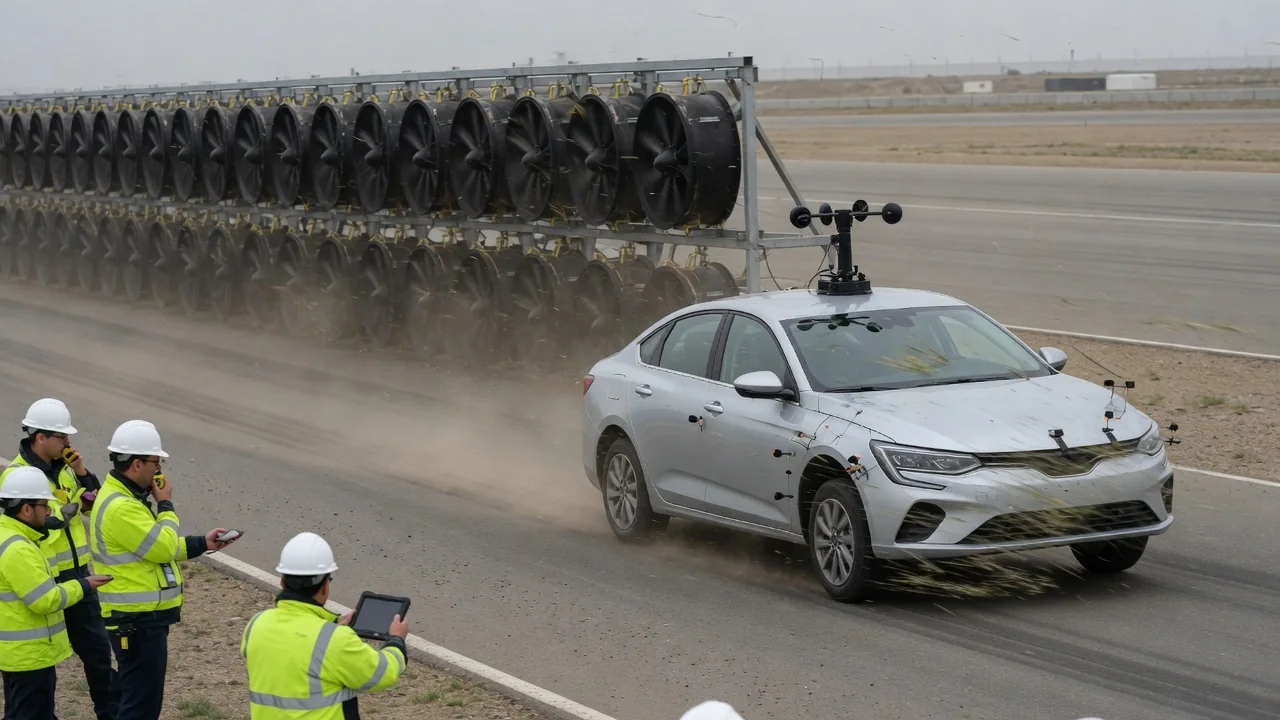
A strong gust on an open highway can nudge a car sideways or make it wander in its lane. Crosswind testing exists to study that moment. Engineers measure how wind from the side pushes and twists a vehicle, how that motion feels from the driver's seat, and which body shapes make the response calmer. Vehicle crosswind testing ties together aerodynamics, steering, suspension, and the human driver, because stability in wind depends on all of them.
Side forces: how wind pushes and turns a car
When a car drives through still air, the airflow it meets comes straight from the front. A wind blowing across the road changes that. The air the car actually experiences now arrives at an angle, which comes from combining the car's own speed with the wind's speed and direction. Engineers call this angle yaw. At lower driving speeds, even a modest crosswind creates a noticeable yaw angle. At highway speed, the same wind produces a smaller angle, but the airflow carries much more energy, because aerodynamic forces rise roughly with the square of airspeed.
At a yaw angle, pressure around the body becomes uneven. The windward side sees higher pressure and the leeward side sees lower pressure. The result is a side force that tries to push the car across its lane. That force rarely acts through the vehicle's center of gravity. The point where it effectively acts is often called the center of pressure. On typical car shapes it usually sits ahead of the center of gravity, so the wind also creates a yawing moment that tries to turn the nose away from the wind. Crosswinds can also change lift and add a rolling moment that loads the suspension more on one side.
Steady wind is only part of the picture. Gusts, gaps between buildings, bridge exits, and the wake of a passing truck all create sudden changes, which the car experiences as transient events. Wind tunnels with turntables let engineers rotate a vehicle and measure forces across a range of yaw angles, which is useful for comparing designs. Transient behavior can differ from these steady measurements, though. Development may therefore also use track facilities with fans that blow across the road, along with simulation, to see how forces build and fade as a vehicle passes through a gust.
Driver feel: why the numbers are only half the answer
A driver does not sense side force directly. What drivers notice is the car drifting sideways, the nose turning, the body leaning, and changes in steering wheel effort. These responses depend on aerodynamics, but also on tires, suspension geometry, steering ratio, weight distribution, and the stiffness of the steering system. Two vehicles with similar aerodynamic loads can feel quite different. That is a central reason engineers test cars in crosswinds as complete vehicles rather than relying on aerodynamic figures alone.
The driver is also part of the control loop. When a gust hits, the car begins to move before the driver reacts, and the correction that follows may be well timed or slightly late. A vehicle whose response is quick, small, and predictable is generally easier to manage than one that reacts slowly and then overshoots. With a slow, overshooting car, late corrections can turn a single disturbance into several back-and-forth motions. For this reason, engineers look at more than how far the car moves. They also consider how easy the motion is to recognize and correct.
Comfort and confidence are partly subjective, so crosswind evaluation often combines measured data with human judgment. Measurements such as yaw rate and lateral displacement sit alongside ratings from trained test drivers and results from driving simulators. A car that needs constant small steering inputs on a windy highway can be tiring over a long trip even if it never becomes unsafe. Reducing that workload is a legitimate development goal.
Shape choices: designing a body that stays calm
Body shape strongly influences both how large the side force is and where it acts. Tall, flat sides give the wind a large area to push on, so taller vehicles generally collect more side force than low ones of similar length. The rear of the body matters a great deal for the yawing moment. Features near the back that generate side force help move the center of pressure rearward, closer to the center of gravity. That tends to reduce how strongly the nose is pushed off course. The principle is similar to the way tail feathers keep an arrow pointed straight.
Edge details count as well. When wind arrives at an angle, the radius of the rear pillars, the shape of the tailgate or trunk edges, and the way the roof ends all affect where airflow separates from the body. Sharper rear edges can encourage cleaner separation. Very rounded rear shapes can let flow wrap around the back and change how side force is distributed along the car. Front corners, the underbody, mirrors, and spoilers also contribute. These effects interact, so a change that helps in a straight-ahead wind tunnel run may behave differently at yaw.
Shape choices involve trade-offs. Lower drag, styling goals, interior space, and cooling needs do not always line up with the best crosswind behavior. Engineers often pair aerodynamic changes with chassis tuning, such as suspension and steering settings, to reach acceptable overall stability. Crosswind testing lets them check whether a design decision made for efficiency or appearance has made the car unusually sensitive to side wind.
Practical implications and limits
For owners, the main takeaway is that a vehicle's crosswind behavior is tuned for the configuration it was developed in. Roof boxes, bike carriers, cargo racks, tall loads, and trailers change the shape and area the wind acts on and can shift the center of pressure. As a result, a loaded car can be more sensitive to gusts than it feels when empty. Tire condition and pressure also affect how well the car resists sideways disturbance. For roof load limits and related guidance on a specific model, check the owner's manual.
Testing also has limits. Real wind is turbulent, varies with height above the ground, and is shaped by terrain, roadside structures, and traffic, so no test program can reproduce every situation a driver will meet. Results describe how a particular vehicle behaves under the conditions studied. They are not a universal rating that transfers between models. On the road, practical habits still matter: keep both hands on the wheel, ease off speed when strong gusts are reported, and anticipate exposed spots such as bridges, open plains, and gaps between buildings or large vehicles. Engineering can make a car calmer in wind, but it cannot remove the effect of wind entirely.