Why Do Electrical Faults Appear Only When It Rains?
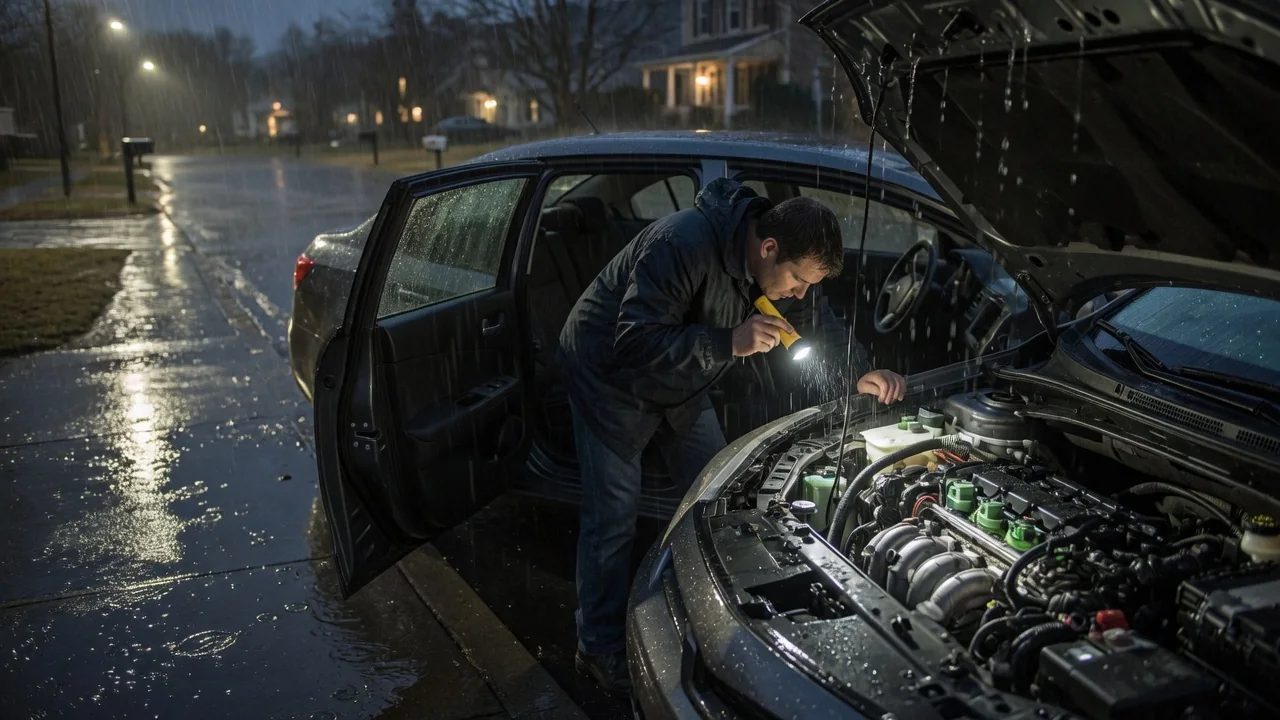
A car that runs perfectly on dry days but throws warning lights, flickers its gauges, or stalls in wet weather is not haunted. Rain changes a vehicle's electrical environment in specific, predictable ways. It pushes water into places designed to stay dry, it turns minor corrosion into real resistance, and it switches on extra loads at the same moment. Understanding why electrical faults appear only when it rains makes these intermittent problems much easier to track down.
Connector Intrusion: How Water Gets Inside the Circuit
Many underhood and underbody connectors are sealed with rubber wire seals, cavity plugs, and a gasket where the two halves meet. These seals work well when new, but heat cycles, age, and chemical exposure harden them over time. Water can get in through a seal that has shrunk slightly, a cavity plug lost during an earlier repair, or a connector that was never fully latched. Tire spray, water running off the cowl, and puddle splash all reach connectors that rarely see moisture in dry weather.
Water does not have to enter through the connector face. Capillary action can draw it along the copper strands inside a wire's insulation from a damaged spot elsewhere in the harness. It then arrives at a terminal that looks perfectly sealed from the outside. Inside the cabin, water can come from a clogged cowl or sunroof drain, a worn door membrane, or a leaking windshield seal. It soaks carpet and padding and puts moisture around modules and connectors mounted near the floor.
Once inside, rainwater rarely stays pure. It dissolves road salt, dirt, and residue, which makes it conductive enough to create small leakage paths between adjacent pins. On a high-current circuit this may not matter. Sensor signals, reference voltages, and data network lines are different: they carry small currents, so even a modest leak can distort them. A control module then sees a reading that makes no sense, sets a fault code, or disables a feature. When the connector dries, the leakage path disappears and the system looks normal again. That is why these faults seem to come and go with the weather.
Ground Paths: Why Weak Returns Fail in Wet Weather
Every circuit needs a return path to the battery. In most vehicles that path runs through ground straps, ring terminals bolted to the body or engine, and the metal structure itself. These bolted joints are exposed to the same water and road salt as everything else. When moisture sits between dissimilar metals, it acts as an electrolyte and speeds up corrosion. The result is an oxide layer that adds resistance to a connection that should be close to zero.
Rain also tends to switch on many loads at once. Wipers, headlights, the blower motor, the rear defroster, and on some vehicles heated mirrors all draw current in wet weather. A ground connection with slightly high resistance may handle a light load without trouble. When several of these circuits share it, the same connection can produce a significant voltage drop. Components on that ground then receive less voltage than intended, and sensors referenced to it may report values that are shifted up or down.
Several circuits often share one ground point, so a single poor connection can cause symptoms that look unrelated. A flickering instrument cluster, a dim lamp, an erratic gauge, and a communication fault may all appear together. Current that cannot return cleanly may also find an unintended path through another component, making lights glow faintly or accessories behave oddly. Scattered symptoms like these strongly suggest checking the shared return path rather than each component.
Diagnosis: Reproducing a Fault That Only Shows Up Wet
Diagnosis starts with careful observation. Note when the problem begins: while driving in rain, after a car wash, after parking overnight in damp conditions, or only when certain loads such as wipers or headlights are on. Stored trouble codes and any freeze frame data can show which circuit or module was affected and under what conditions. A visual inspection then looks for water stains, white or green corrosion, displaced seals, damp carpet, and drains blocked with debris.
The most useful test separates moisture from electrical load. On a dry day, turn on every load that normally runs in the rain and watch whether the fault appears. If it does, a ground or supply connection struggling under load is the likely cause. If it does not, try controlled wetting. Apply a spray bottle or gentle mist to one area at a time while watching live data or a meter to find the connector or harness section that reacts. Avoid high-pressure water, which can force water past seals that would normally hold.
For a suspected ground, a voltage drop test tells you more than a simple resistance check. With the circuit operating, connect a meter between the component's ground and the battery negative terminal. The reading shows how much voltage is lost along the return path under real current. The acceptable figure depends on the circuit and the manufacturer's service information. Wiggling the harness and connectors while watching the same reading can pinpoint an intermittent joint. Avoid piercing wire insulation with probes, because every puncture becomes a future entry point for water.
Practical Implications and Limits
Weather-dependent faults often dry out before anyone can see them, so a vehicle inspected on a sunny afternoon may show nothing wrong at all. Detailed notes, photos of warning messages, and a record of the exact conditions help bridge that gap. A part is also often replaced because it set the code, only for the fault to return with the next storm. In those cases the real cause was the water route or the connection, not the component.
Moisture-related problems also tend to get worse over time. Corrosion that starts as an occasional rain-only glitch can eventually become a permanent open circuit or a terminal that no longer grips its mating pin. Cleaning and drying a connector may restore operation for a while. Corroded terminals, damaged seals, or a compromised pigtail usually need proper repair, and the water source should be stopped so the problem does not come back.
Connector locations, ground points, seal designs, and drain routing differ between vehicles. The wiring diagrams and component locators in the service manual for the specific vehicle are the reliable reference. Some systems call for extra caution: airbag circuits and the high-voltage components of hybrid and electric vehicles should be handled only according to the manufacturer's procedures. A car electrical fault caused by moisture can usually be traced, but a systematic approach works far better than guesswork.