Why Do Differential Gears Let Wheels Turn at Different Speeds?
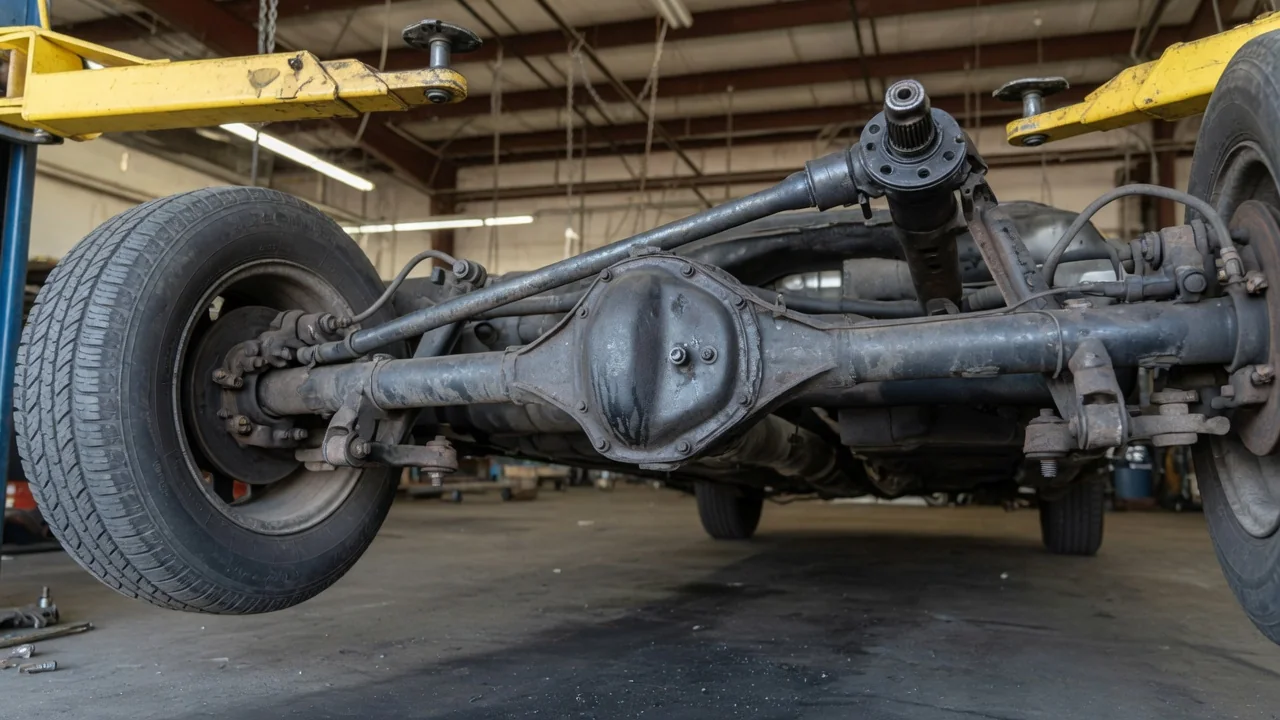
When a car turns, its wheels do not travel the same distance, yet the engine drives them through a single input. The differential is the gear set that resolves this conflict. It splits engine torque between two axle shafts while letting them rotate at different speeds. This explanation of differential cornering covers why wheel speeds must differ, how the gears inside an open differential handle that difference, and where the same design runs into trouble when traction is limited.
Different paths
Picture a car making a right turn. Each wheel follows its own arc around a common center point, and the left-side wheels trace a larger arc than the right-side wheels. In the same amount of time, the outside wheel must cover more ground than the inside wheel, so it has to spin faster. The front and rear wheels also follow slightly different arcs. That is why vehicles that drive both axles need a way to handle speed differences between front and rear as well as from side to side.
If both drive wheels were locked to one solid shaft, they would be forced to turn at the same speed. In a corner, one or both tires would have to scrub or slip against the road to make up the distance mismatch. That scrubbing wears tires, loads the axle shafts and other driveline parts, and makes the vehicle resist turning, an effect most noticeable on high-grip pavement during tight, slow maneuvers such as parking. Non-driven wheels avoid the problem because each spins freely on its own bearing. Driven wheels need a connection that still delivers power while allowing each side to find its own speed, and that is the job of the differential.
Gear motion
In a conventional open differential, the driveshaft or transaxle output turns a pinion gear that meshes with a larger ring gear. The ring gear is bolted to a housing called the carrier, or case, so the carrier rotates with it. Inside the carrier, small bevel gears, often called spider gears or differential pinions, ride on a cross shaft fixed to the carrier. These spider gears mesh with two side gears, and each side gear is splined to an axle shaft or half shaft leading to one wheel.
When the car drives straight and both wheels meet equal resistance, the spider gears do not spin on their shaft. They act as a rigid link, carrying both side gears around at the same speed as the carrier, so both wheels turn together. When the car begins to turn, the outside wheel needs to rotate faster and the inside wheel slower. The spider gears now rotate on their cross shaft while still being carried around by the carrier. That rotation lets one side gear advance relative to the carrier while the other falls behind by the same amount.
The result is a simple relationship: the average of the two side-gear speeds always equals the carrier speed. If the outside wheel speeds up by a certain amount, the inside wheel slows by that same amount. Because the spider gears pivot freely, an open differential delivers roughly equal torque to both sides regardless of their speeds, apart from small internal friction losses. This is why the design handles cornering so smoothly: it lets speeds differ without fighting the turn. It is also the source of its main weakness.
Traction limits
Because an open differential splits torque essentially equally, the wheel with the least grip sets the limit for both. If one drive tire sits on ice, loose gravel, or mud, or lifts off the ground on uneven terrain, it can resist only a small amount of torque before it spins. The other wheel receives about the same small amount of torque, even if it rests on dry pavement with plenty of grip. The differential then does exactly what it was designed to do: it lets the wheels turn at different speeds, so the low-traction wheel spins quickly while the other barely moves or stays still.
The same gear behavior explains a familiar shop observation. With the drive wheels raised and the carrier held from turning, rotating one wheel by hand makes the opposite wheel rotate the other way. With the carrier fixed, any speed one side gains must be lost by the other, so the two wheels move in opposite directions.
Several designs address this limit. Limited-slip differentials add clutch packs, viscous couplings, or torque-sensing helical gears that resist speed differences and can send more torque to the wheel with grip. Locking differentials can join the two axle shafts so both turn together, typically only when the driver or a control system engages them, since a locked axle brings back the cornering scrub described earlier. Many modern vehicles also use antilock brake hardware to brake a spinning wheel, creating resistance that the open differential can pass to the opposite side. Which approach a given vehicle uses depends on its design and should be confirmed in its owner's manual or service information.
Practical implications and limits
Differential action is continuous, not something that happens only in sharp turns. Gentle curves, lane changes, and slight differences in tire diameter all produce small speed differences that the gears absorb. That is one reason manufacturers often call for matching tires on driven axles, and on many all-wheel-drive systems for matching tires on all four corners. A noticeably smaller tire, such as a worn tire paired with a new one or a compact spare, makes the differential or coupling work constantly, which can add heat and wear. Follow the vehicle maker's guidance on tire matching and temporary spare use, since tolerances vary between drivetrains.
The gears and bearings rely on gear oil, and clutch-type limited-slip units may require a specific fluid or friction additive. Using the wrong lubricant can cause chatter during tight turns or accelerate wear. Service intervals and fluid specifications are vehicle-specific, so the maintenance schedule is the correct reference rather than a general rule.
Driving technique also matters. When one wheel spins on a slippery surface, adding throttle usually just makes it spin faster, because the open differential keeps feeding equal torque to both sides. Easing off, letting traction aids work, or improving grip under the spinning tire is generally more effective. New noises that appear only while turning, such as clunking, grinding, or whining, can point to differential, axle, or joint wear, but similar sounds have other causes, so a proper inspection is the way to identify the source.