Why Do Cars Use Both Adhesive and Spot Welds?
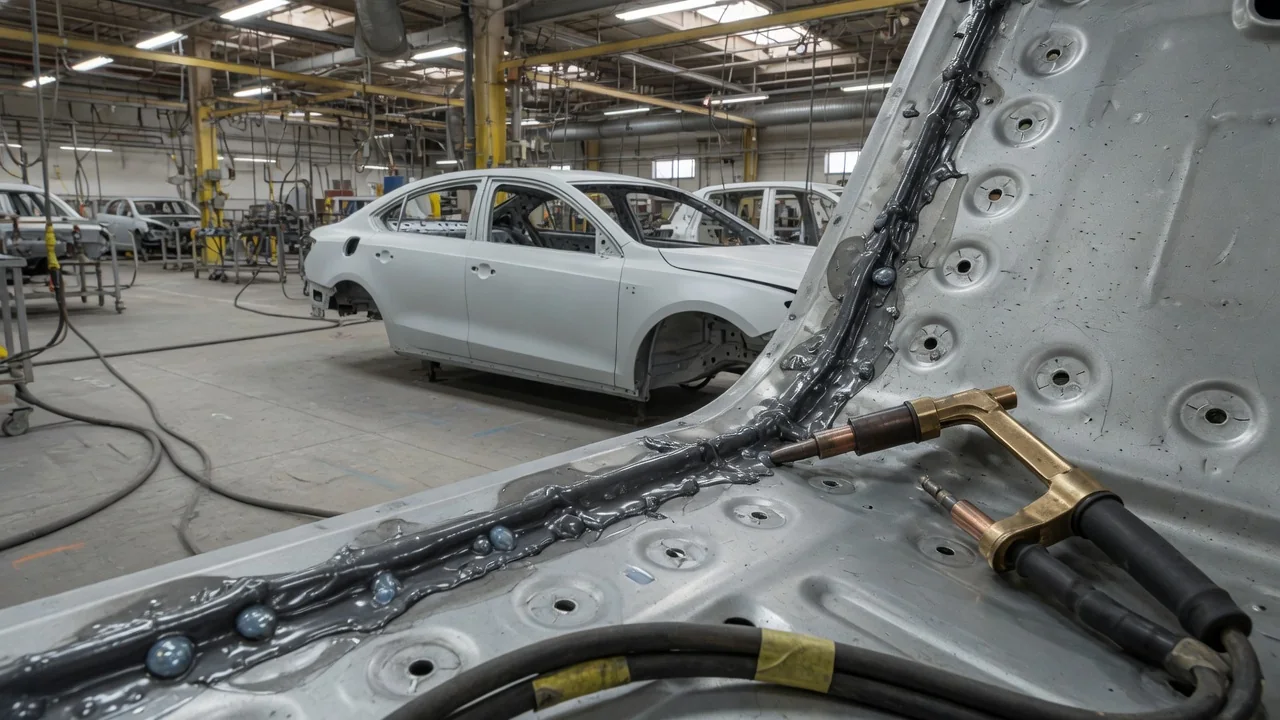
Look closely at a modern car body and you will often find several thousand spot welds, yet many of the flanges they join also carry a thin layer of structural adhesive. This car body adhesive and spot weld combination, often called weld-bonding, is not redundancy for its own sake. Each method covers a weakness of the other. Together they affect how strong the joint is, how well it keeps out water, and how the body is built on the assembly line.
Joint Strength: How Welds and Adhesive Share the Load
A resistance spot weld fuses overlapping sheets at a small, roughly circular nugget. Between those nuggets the panels only touch and are not attached. When the body is loaded, force has to funnel through each weld, which concentrates stress at the edge of the nugget. Under the constant vibration of driving, those points are typical places for fatigue cracks to begin. The unattached metal between welds can also flex slightly relative to the sheet beside it.
Structural adhesive, usually an epoxy-based product in body construction, connects the entire overlap instead of a series of points. Load spreads across a much larger area, peak stress around each weld drops, and the flange behaves more like one continuous piece. Repeated over many seams, this tends to make the body structure stiffer and more resistant to fatigue. Engineers value those qualities for handling, ride comfort and long-term durability. Crash-toughened formulations are also designed to stay attached and absorb energy during an impact rather than breaking in a brittle way.
Adhesives have a weakness of their own. They are strong in shear, when two bonded sheets try to slide past each other, but much weaker in peel and cleavage, when one sheet is pried away starting from an edge. Spot welds resist peeling well. In a weld-bonded joint the welds act as anchors that stop a peel from unzipping the bond, while the adhesive carries distributed shear loads. How much the combination improves on either method alone depends on the materials, flange design and adhesive chosen, so there is no single universal figure.
Sealing: Closing the Gaps Between Welds
Even a tightly welded flange leaves a narrow gap between the sheets wherever there is no weld. Water, road salt and fine dirt can be drawn into that gap by capillary action, and corrosion-protection coatings applied later may not fully penetrate such a tight space. Rust that starts there can spread outward unseen for a long time. Adhesive that fills the flange displaces the gap and blocks the path moisture would take, helping protect the metal inside the joint.
The same continuous layer helps with noise and cabin integrity. Unbonded surfaces can rub, buzz or transmit vibration, and open seams can let air, dust and water reach the interior. A bonded seam damps vibration and closes those paths. Hem flanges, where the outer skin of a door, hood or trunk lid is folded over an inner panel, commonly use a hem adhesive that both bonds and seals the folded edge. Not every bead on a car body is structural, though; separate seam sealers and anti-flutter materials handle sealing and damping without carrying significant load.
Where a design joins dissimilar metals such as aluminum and steel, an adhesive layer can also help keep them apart and reduce galvanic corrosion. Those mixed-material joints, however, are often made with rivets or other mechanical fasteners combined with adhesive rather than conventional spot welds, because welding aluminum directly to steel is difficult.
Production: Why the Two Methods Fit the Assembly Line
In the body shop, robots typically dispense adhesive onto stamped panels before they are joined. Body adhesives are generally formulated to tolerate the light oil left on steel from stamping, so panels do not need to be perfectly clean. The parts are then clamped and spot welded straight through the uncured adhesive. Electrode pressure squeezes the adhesive aside so metal-to-metal contact forms, and the welding current creates the nugget. Products intended for this use are described as weldable or weld-through adhesives.
At this stage the adhesive provides little strength, which is exactly why the welds matter in production. They lock the panels in position, hold the body geometry and allow the structure to be lifted, moved and processed long before the adhesive hardens. Many body adhesives are heat-cured and reach full strength during the oven bake that follows electrocoat or paint application, a step the body goes through anyway, so no separate curing line is needed. Some areas, such as hem flanges, may receive an induction pre-cure so the parts cannot shift and the adhesive is not washed out during pretreatment.
Because the adhesive shares the load, the combination also gives engineers more design freedom. Depending on the structure, they may adjust weld count or spacing, or make better use of thinner high-strength steels, while still meeting stiffness and durability targets. Those trade-offs are decided joint by joint during development rather than by a fixed rule.
Practical Implications and Limits
For owners, weld-bonding is mostly invisible. Its effects show up indirectly, as a body that stays tight and quiet with age and flanges that are less prone to hidden rust. How extensively adhesive is used varies widely between vehicles, model generations and even different areas of the same body, so it is not safe to assume that a particular seam on a particular car is bonded without checking the manufacturer's information.
Collision repair is where the combination matters most. The factory oven cure cannot be reproduced on a finished car without risking damage to paint, trim and electronics, so repairs rely on two-part repair adhesives that cure at room temperature or with modest heat. These are combined with resistance spot welds, rivets or other joining methods as the manufacturer's repair procedure specifies. Leaving out the adhesive or substituting a different method can produce a joint that is weaker, less stiff or more vulnerable to corrosion than the original.
The approach also has inherent limits. Bond quality is difficult to confirm by eye because it depends on surface condition, correct bead placement and complete curing; a contaminated or under-cured bond adds little. Welding heat degrades adhesive close to the weld, and bonded panels are harder to separate when a section must be replaced. Weld-bonding is robust under controlled factory conditions, but in repair its benefits depend on following the documented process.