Why Do Car Wax Products Bead Water? The Chemistry Explained
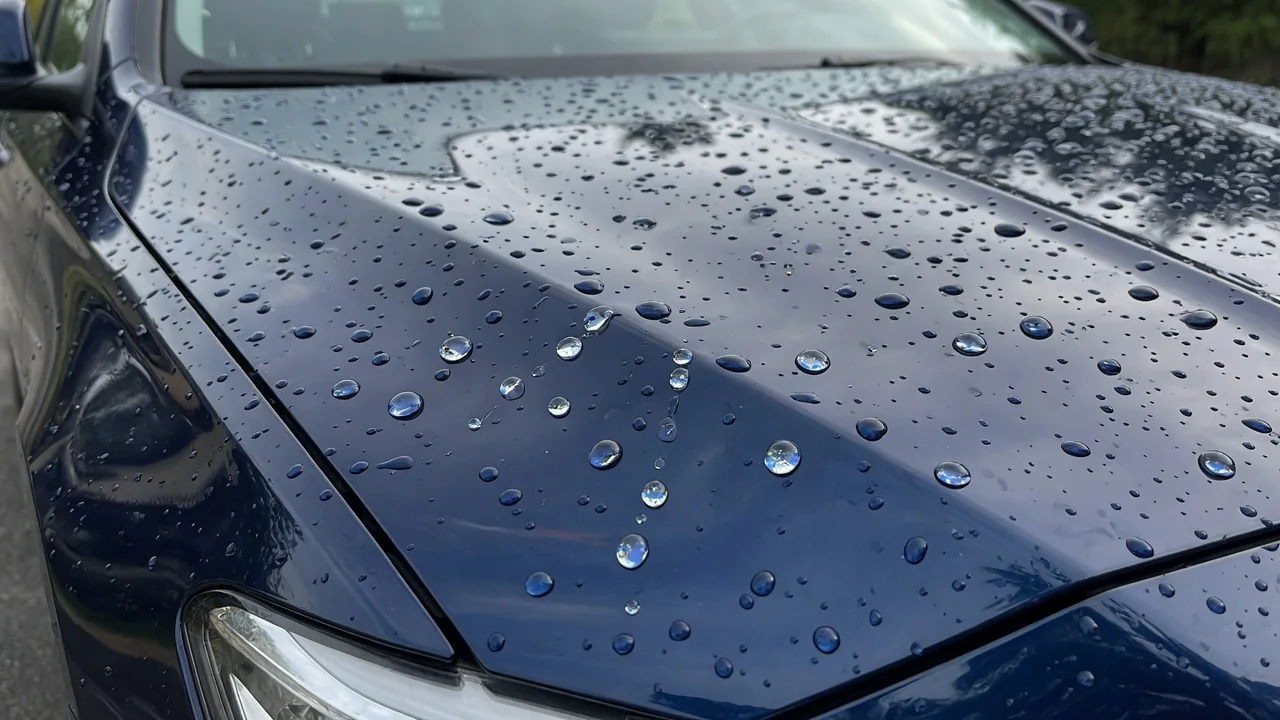
Few things look more satisfying after a fresh coat of wax than rain gathering into tight, round drops that roll off the hood. That behavior is not decoration added to the product. It is a direct result of how water interacts with a low-energy surface. Understanding why car wax products bead water explains what the wax is actually doing to the finish, what protection it provides, and why beading is a useful but imperfect sign of that protection.
Surface energy: why water pulls itself into beads
Water molecules are strongly attracted to one another through hydrogen bonding. At the edge of a drop, that attraction shows up as surface tension, a force that pulls the liquid inward and tries to minimize the area exposed to air. Whether water spreads out or stays round depends on a competition between two forces: the attraction of water to itself and its attraction to whatever surface it sits on. Surfaces are often described by their surface energy. A high-energy surface, such as clean glass or bare metal, attracts water strongly, so a drop flattens and spreads. This is called wetting. A low-energy surface attracts water only weakly, so the water's own cohesion wins and the drop pulls up into a bead.
Car waxes are built from low-energy materials. Natural waxes such as carnauba consist largely of long-chain esters, fatty acids and alcohols. Many products blend them with hydrocarbon waxes, oils, silicone fluids or synthetic polymers. These molecules are mostly nonpolar, which means they carry little of the uneven electrical charge that water molecules use to grip a surface. When a thin film of such material covers the clear coat, water meets a surface it cannot bond with effectively, so it rests on top as rounded drops.
Chemists describe this with the contact angle, the angle formed where the edge of a drop meets the surface. Low angles indicate spreading, and angles above 90 degrees are conventionally called hydrophobic. Waxes and sealants raise the contact angle compared with an unprotected, slightly contaminated finish. Microscopic texture in the protective layer can amplify the effect, because tiny pockets of air beneath a drop reduce how much of it actually touches solid material. Some products are formulated to favor tall, round beads. Others emphasize sheeting, where water slides off in larger sheets. Both outcomes come from low surface energy combined with different film chemistry and texture.
Protection: what the water-repelling layer actually does
The beading film is a thin, sacrificial layer between the environment and the clear coat. Because it is low in surface energy, it does more than repel water. Many contaminants that rely on wetting or adhesion have a harder time bonding to a waxed panel, including road grime, pollen and some traffic film. Dirt that does land tends to release more easily during washing. That reduces the amount of rubbing needed, and with it the opportunity to introduce wash marring.
Water that beads and runs off also spends less time in contact with the paint. Rain and rinse water can carry dissolved minerals, acidic pollutants and residues. When that water drains away instead of lingering as a film, less of it is left to dry on the surface. Bird droppings, tree sap and insect remains can still cause damage, but a waxed layer can buy a little time and make removal gentler. The protective function comes from the barrier itself. The beading is simply the visible evidence that a low-energy barrier is present on the outermost surface.
This protection has clear boundaries. A wax film is far thinner and softer than the clear coat, so it offers little resistance to scratches, stone chips or abrasion. Some products include ingredients intended to reduce ultraviolet exposure, but beading alone says nothing about how well a given product does that.
Limits: what beading can and cannot tell you
Beading reports on the condition of the very top layer of the surface, not on everything underneath. If a waxed panel becomes covered by a thin film of road grime, oily traffic residue or dust, water meets that contamination instead of the wax. Grime usually has higher surface energy, so beading weakens or disappears even though some wax may remain beneath. The opposite can also happen. Certain wash soaps, quick detailers and rinse aids leave their own hydrophobic residue, which produces strong beading for a short time without indicating a durable protective layer.
Wax films also wear away. Heat, sunlight, repeated washing, strong alkaline or solvent-based cleaners, and simple friction from washing and drying gradually thin and break up the layer. As it erodes, contact angles drop and beads become flatter, less uniform and slower to roll off. How quickly this happens depends on the product chemistry, the climate, how the vehicle is stored and how it is washed. No single lifespan applies to every car.
Beads themselves are not entirely harmless. A drop that sits on a horizontal panel and evaporates leaves behind whatever minerals it carried, and hard water can produce water spots even on a well-protected finish. Beading helps water leave the surface when the vehicle moves or the panel is sloped. On a flat, stationary roof or hood in the sun, however, drops can remain long enough to dry in place.
Practical implications and limits
The most reliable way to judge car wax water beading is on a clean surface. After a thorough wash with a pH-balanced car shampoo and a rinse, consistent tight beads or quick sheeting on most panels suggest the protective layer is still present. If water clings in flat patches after the car has been driven in dirty conditions, wash it first to find out whether the wax has failed or was merely hidden. Comparing horizontal panels with vertical ones also helps. Roofs, hoods and trunk lids receive more sun and contamination, so they typically lose protection sooner than doors.
Because beads can leave mineral spots as they dry, drying the vehicle after washing still matters even when water seems to roll off on its own. A clean, soft microfiber towel or filtered air works well. Washing in shade and on cool panels reduces the chance that drops dry before you can remove them. When reapplying, follow the product label on surface preparation, application temperature, curing time and compatible surfaces, because formulations differ.
Vehicle-specific factors also matter. Matte and satin finishes, vinyl wraps, paint protection film and unpainted textured plastic may react differently to waxes, and some can stain or develop uneven sheen. For those surfaces, the owner's manual and the finish or film manufacturer's care guidance should take priority over general advice. Water beading is a convenient quick check that the outermost layer is hydrophobic. It is not a full measure of paint health, which still depends on regular washing, decontamination when needed, and inspection for chips, etching and other damage.