Why Do Car Speakers Need Door Enclosures? Air, Sealing and Rattles Explained
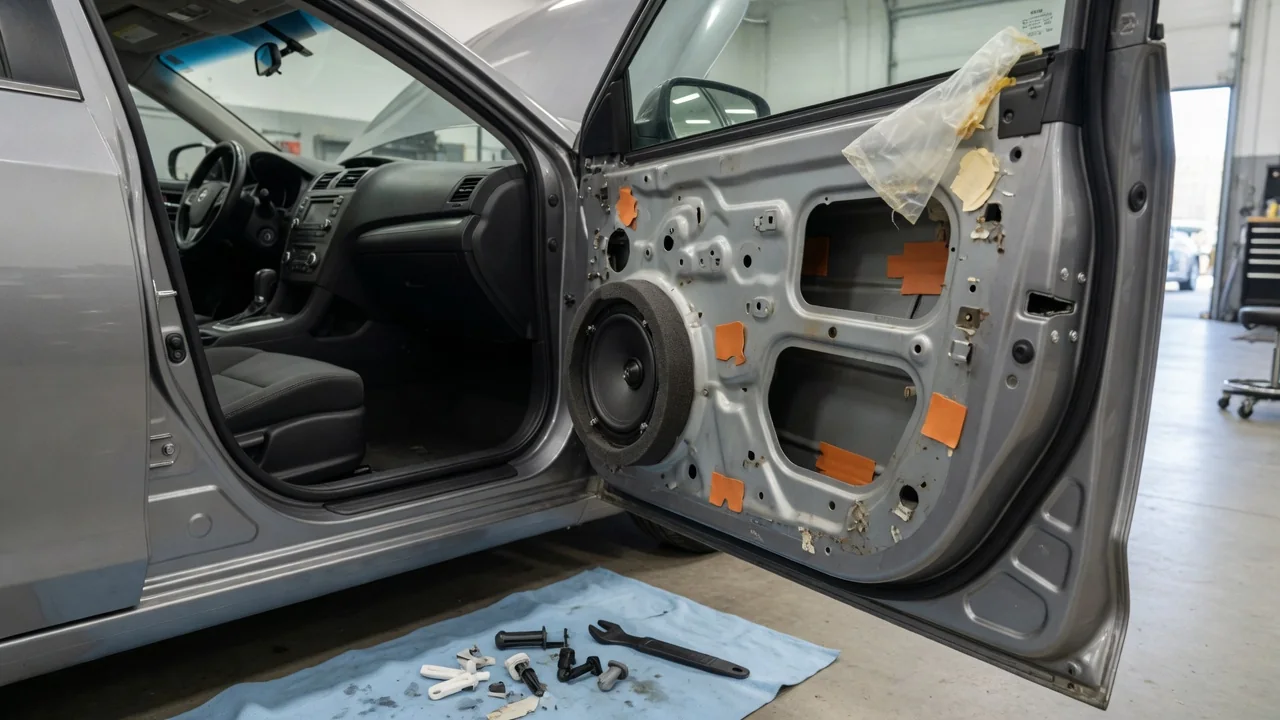
Most factory and aftermarket car speakers are mounted in the doors, but the door is doing far more than holding the speaker in place. The door structure works as the speaker's enclosure: it separates the sound coming off the front and back of the cone, provides a volume of air behind it, and either supports or undermines clean output depending on how well it is sealed and damped. Understanding these three factors explains why door enclosures matter and what limits them.
Air movement
A speaker produces sound by moving its cone forward and backward. Every forward push creates a pressure wave in front of the cone, and at the same instant it creates an opposite wave behind it. These two waves are out of phase. If nothing separates them, the rear wave wraps around the edge of the speaker and meets the front wave, and the two partially cancel each other. This effect is often called an acoustic short circuit, and it is the main reason a bare speaker held in open air sounds thin and lacks bass.
Cancellation is strongest at low frequencies. Bass notes have long wavelengths, so they bend easily around small obstacles and reach the opposite side of the cone with little loss. Higher frequencies have short wavelengths and are more directional, which is why midrange and treble suffer less from a missing enclosure. Any structure that blocks the rear wave from reaching the listener therefore matters most for the bottom end of the speaker's range.
The car door solves this by acting as a large baffle with a sizable car speaker door cavity behind it. The inner door skin separates the front of the speaker, which faces the cabin, from the back of the speaker, which fires into the space between the inner and outer sheet metal. Because that space is relatively large compared with a small speaker, it behaves somewhat like the free-air or infinite-baffle mounting that many car coaxial and component woofers are designed for. The air trapped behind the cone also influences how the cone moves, so the enclosure affects both how much bass reaches the cabin and how controlled that bass is.
Sealing
A door only works as an enclosure if the rear wave actually stays inside it. In practice, doors are full of openings. The inner skin usually has large service holes that allow assembly and repair of the window regulator, lock mechanism and wiring. There are gaps around the window slot, passages for cables and rods, and drain holes at the bottom. Factory doors often cover the service holes with a thin plastic sheet that keeps water away from the trim panel but does little to stop sound.
Every leak between the back of the speaker and the cabin gives the rear wave a path to escape and cancel the front wave, which brings back the same loss of bass described above. Leaks close to the speaker are especially harmful, because the rear wave has only a short distance to travel. Leaks can also let sound fill the space between the door trim panel and the metal door, where it bounces around and comes out through gaps in the trim instead of through the speaker grille, smearing the sound.
Sealing therefore happens at several levels. The speaker itself should seal tightly against its mount, typically with a foam gasket or a rigid mounting adapter that leaves no air gaps around the frame. Large openings in the inner door skin near the speaker can be covered with rigid, airtight panels rather than flexible sheets. Foam rings between the front of the speaker and the back of the trim panel can help channel output through the grille instead of letting it spread behind the panel. A rigid, well-fastened mounting surface also keeps the speaker frame from flexing, so the cone's motion goes into moving air rather than moving the mount.
Rattles
Doors are built from relatively thin sheet metal and plastic trim, which makes them light but prone to vibration. When the speaker plays, the rear wave pushes directly against the outer door skin, and the speaker's mechanical vibration travels into the inner skin and trim. Large flat panels tend to resonate at particular frequencies, so certain notes can make the door itself act like an unwanted second speaker, adding boominess or a hollow, tinny character.
Beyond panel resonance, doors contain many small parts that can buzz or tap: trim clips, wiring harnesses, lock and handle rods, the window glass in its channels, and plastic covers. These rattles add noise that has nothing to do with the music. They are most noticeable with bass-heavy content and at higher volume, and they can mask detail even when the speaker itself is performing well.
Controlling rattles usually involves adding damping material to the large metal panels to reduce how freely they vibrate, securing loose wiring and rods so they cannot strike the metal, and placing foam or felt at points where the trim panel touches the door. The goal is not to make the door completely dead, but to stop it from contributing its own sound so that what reaches the cabin comes from the speaker cone.
Practical implications and limits
How much a door enclosure helps depends heavily on the specific vehicle. Door size, the number and placement of openings, panel stiffness, trim design and speaker location all vary, so the same speaker and the same treatment can give noticeably different results in different cars. General principles predict the direction of change, but not the exact improvement in any particular door. Speaker choice also matters: some woofers are designed for free-air mounting in a large volume, while others expect a smaller sealed box, and the manufacturer's mounting recommendation is a better guide than assuming every speaker suits a door.
A door is still a wet, working part of the car. Rain runs down inside the outer skin, so drain holes at the bottom must stay open and any panels added to the inner skin must keep water away from the trim and wiring. Window regulators, lock linkages and glass need clear space to move, and some vehicles place sensors or other safety-related components inside the door, so any work should follow the vehicle's service information and avoid blocking or disturbing these parts. Removing a door panel can also break clips or affect weather seals if done carelessly.
Finally, a well-sealed and damped door improves the efficiency and clarity of a door speaker, but it does not change the physical size of the cone. Small door woofers can only move a limited amount of air, so very deep bass at high volume is usually the job of a dedicated subwoofer. Treating the door enclosure is best understood as letting the existing speaker perform closer to its potential, not as a way to turn it into something it was never designed to be.