Why Do Car Panels Need Reinforcement Ribs? Stiffness, Noise and Space
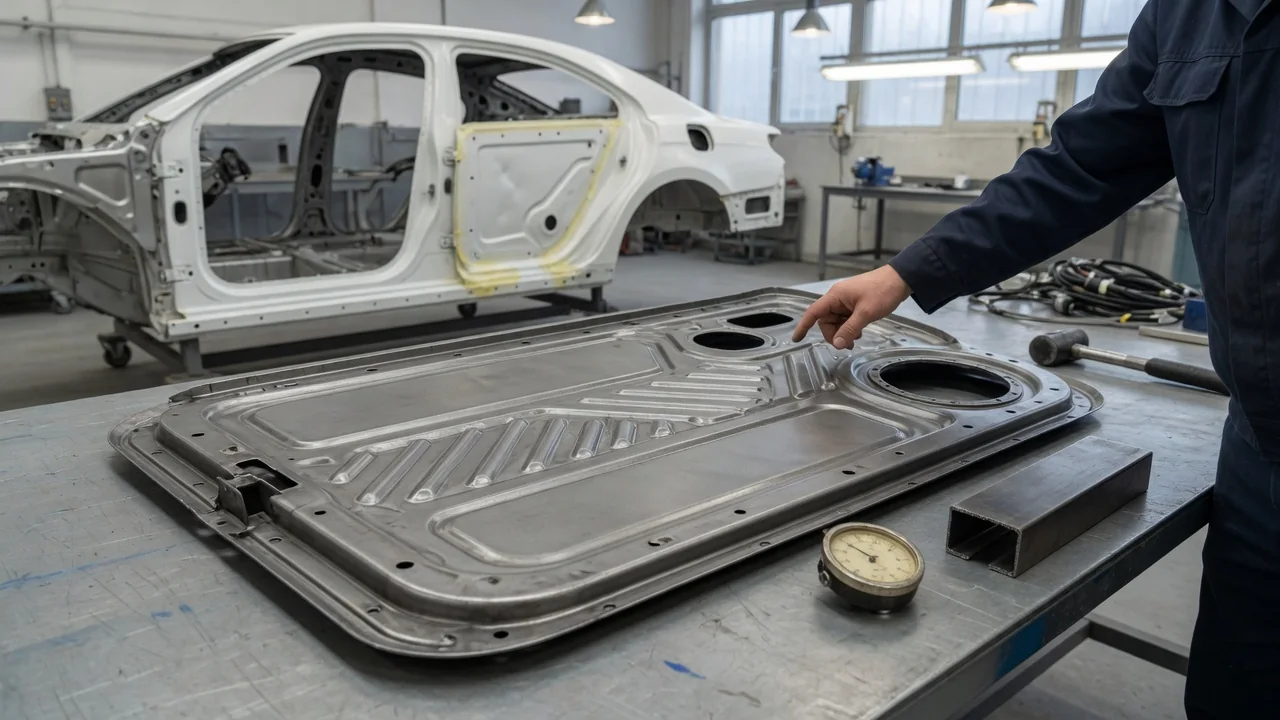
Look under a hood, inside a door, or at a bare floor pan and you will see raised lines, grooves, and embossed patterns pressed into the steel or aluminum. These sheet metal reinforcement ribs, also called beads or swages, are not decoration. They let a thin, light panel act as if it were much stiffer. They also help control vibration and noise, and they take up very little space. Here is how each of those jobs works.
Panel stiffness
A flat sheet of thin metal is easy to bend because almost all of its material sits close to its own center plane. Bending stiffness depends heavily on how far material is placed from that plane. Engineers describe this property with the area moment of inertia. For a simple rectangular section, that value grows with the cube of its depth, so even a modest increase in section depth has an outsized effect. Pressing a rib into the sheet does exactly this. It pushes some metal out of plane and turns a flat strip into a shallow channel. The panel weighs nearly the same, but across the rib it resists bending much better than the flat sheet it came from.
This matters because body and inner panels are made as thin as practical to save weight and material. A large, nearly flat area of thin sheet can flex under hand pressure or sag where a component is mounted to it. It can also pop in and out between two stable shapes, an effect body shops call oil canning. Ribs divide that large area into smaller, better supported fields and give it a stiffer backbone. Forming a rib also stretches the metal locally. In many steels and aluminum alloys, the resulting work hardening raises strength in the formed zone. Still, the change in cross-section is the primary reason ribs are used.
Ribs are directional. A straight bead stiffens the panel against bending that would flatten or fold the bead along its length. The panel can still hinge relatively easily along a line parallel to the bead. For this reason, designers use crossing patterns, diagonal beads, X shapes, or ribs that follow the expected load path. It is also why a rib that stops abruptly can leave a flexible zone or a point where strain concentrates.
Noise
Every panel has natural frequencies at which it tends to vibrate. Engine pulsations, road input, tire noise, or exhaust energy can excite a panel near one of those frequencies. When that happens, a large thin area can move like a loudspeaker cone and radiate sound into the cabin. Owners often describe the result as drumming, boom, or a buzzy resonance at a particular speed or engine rpm. Natural frequency rises as stiffness increases relative to mass. As a result, a ribbed panel tends to vibrate at higher frequencies and with smaller motion than the same panel left flat.
Ribs also break a big vibrating surface into smaller sections. This changes the panel's mode shapes and can move resonances away from the frequencies that the drivetrain or the road excites most strongly. For this reason, floor pans, roof inner panels, spare tire wells, and firewalls commonly carry bead patterns. Ribs are not a complete noise solution, though. They add stiffness but very little damping, so manufacturers typically combine them with damping pads, sprayed or bonded deadeners, and insulation. How much a rib pattern helps in a particular vehicle depends on its noise sources and the rest of its sound treatment.
Packaging
Packaging is the engineering term for fitting every part of a car into the space available. A panel could be made stiffer with thicker metal, welded-on brackets, or a deeper hat-section member. Each of those options adds weight, cost, extra parts, or depth. A rib adds useful stiffness while using very little depth. It is usually formed while the panel itself is stamped, so it adds no separate parts or joints that could squeak, corrode, or need assembly time.
That small depth matters in tight areas. Inner door panels must leave room for window glass, regulators, and wiring. Floor pans sit close to exhaust components and fuel and brake lines. Firewalls and wheel wells have to clear hoses, harnesses, and suspension travel. Rib patterns can be arranged around mounting points and can leave flat landing areas for brackets. In some designs they form channels that help guide lines or harnesses or direct water toward drain holes. Outer skins need a smooth appearance surface, so designers there often rely on gentle curvature, called crown, plus ribbed inner panels behind the skin instead of visible beads.
Practical implications and limits
For owners and repairers, the key point is that ribs are part of how a panel was designed to work. When straightening a dented inner panel, floor, or trunk pan, restoring the original bead shape helps recover the stiffness the flattened area lost. Cutting through a rib to route a cable, mount an accessory, or install a speaker can weaken the area around the cut. The panel may then flex or vibrate more than before. Doing such work in flatter, already supported zones, or adding a reinforcement, is generally the safer choice. Reproduction or aftermarket panels may not copy the original bead pattern exactly, so compare them with the original before installation.
In custom fabrication, a bead roller or press tooling is commonly used to add ribs to fabricated floors, firewall block-off plates, or interior panels. This keeps thin sheet flat and quiet. Bead placement still needs planning. Beads pull material inward as they form, which can distort the edges of a sheet. A pattern that ends close to an edge or a hole can also leave weak spots. Laying out the beads before cutting the blank to final size helps manage that shrinkage.
Ribs also have clear limits. They cannot restore strength lost to corrosion. They do not replace the structural rails or pillars that carry crash and chassis loads. On some structural members, beads serve a different purpose, such as controlling how a part folds in a collision. Those parts should not be modified without manufacturer repair information. Ribs also will not cure a rattle caused by loose fasteners, missing clips, or worn mounts. Treat them as one of several tools for making thin panels stiff, quiet, and compact.