Why Do Car Hoses Need Reinforcement Layers?
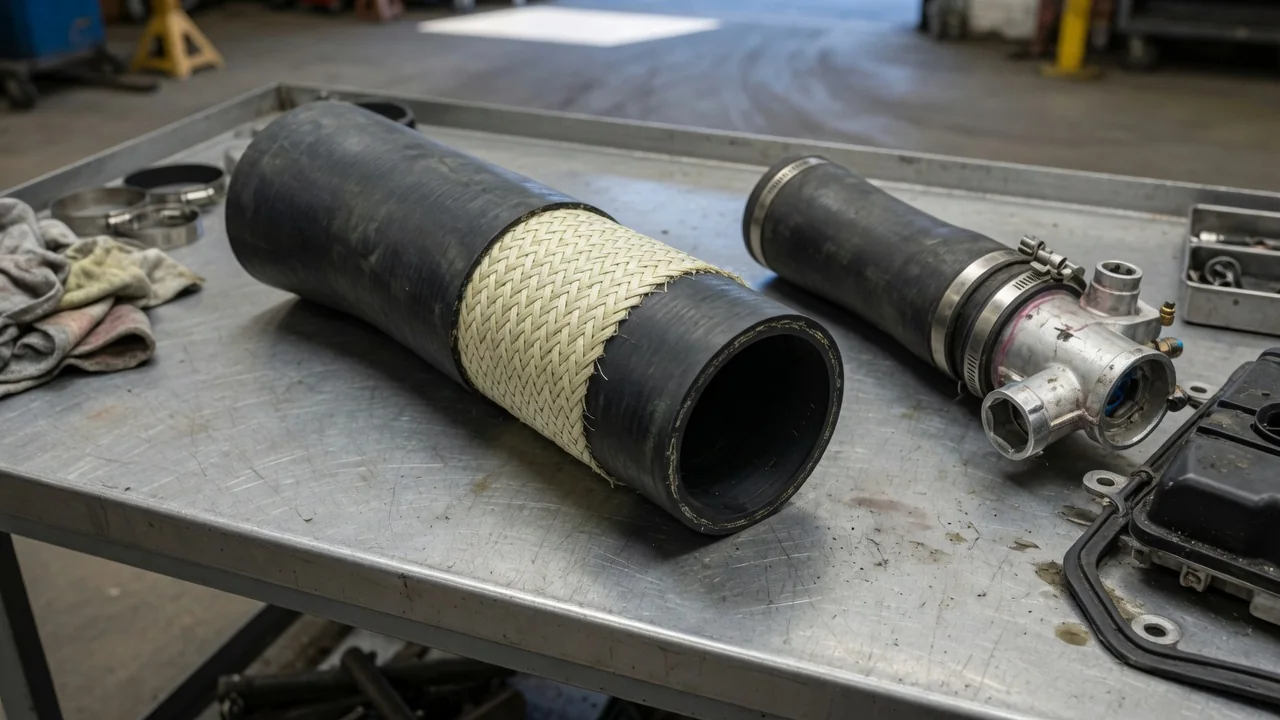
A car hose looks like a simple rubber tube, but most hoses under the hood are layered composites. An inner tube holds the fluid, an outer cover shields against heat, oil and ozone, and between them sits one or more reinforcement layers made of textile cord, fabric plies or wire. That middle layer lets a reinforced automotive hose carry pressure, flex with engine movement and keep its shape for years. Here is why car hoses need reinforcement layers and what that means for inspection.
Pressure resistance
Rubber is excellent at sealing and flexing, but on its own it stretches easily. When the fluid or air inside a hose is pressurized, it pushes outward in every direction. This creates tension around the circumference of the hose wall, often called hoop stress, as well as tension along its length. An unreinforced rubber tube would respond by ballooning, growing longer and eventually splitting. The reinforcement layer carries most of that load instead. Textile yarns such as polyester, rayon or aramid, or steel wire in more demanding applications, are far stiffer than rubber, so they hold the hose close to its designed diameter while the rubber layers handle sealing and protection.
The amount and type of reinforcement depend on the job. A coolant hose sees the moderate pressure of a sealed cooling system combined with heat, so knitted or spiral textile reinforcement is common. Brake hoses must transmit hydraulic pressure with very little expansion, because any swelling absorbs fluid volume and can make the pedal feel softer, so they use tightly braided reinforcement. Power steering pressure hoses face higher, fluctuating pressure and may use multiple braids or wire. Charge-air hoses on turbocharged engines often use several fabric plies to cope with boost pressure and heat. Exact construction varies by vehicle and supplier, so the service information for a specific car is the reference for what is fitted.
Pressure can also act in the opposite direction. Hoses on the suction side of a system, such as some intake, crankcase ventilation or vacuum lines, can be pulled inward. Reinforcement, sometimes an embedded wire helix or a stiffer wall, keeps them from collapsing and restricting flow. Many lower radiator hoses sit on the suction side of the water pump and contain an internal coil spring for this reason.
Flexibility
If stiffness were the only goal, metal tubing would do the job everywhere. Hoses exist because parts of the car move relative to each other. The engine rocks on its mounts under load, steering and suspension components travel through their range, and parts expand and contract as they heat up and cool down. Vibration is constant. A hose has to absorb all of this without cracking at the fittings, and it often has to route around tight corners in a crowded engine bay. Reinforcement makes it possible to combine that flexibility with pressure strength instead of choosing one over the other.
The geometry of the reinforcement is what makes this work. Braided or spiral yarns are laid at an angle to the hose axis rather than straight along it or directly around it. This lets the fibers shift and scissor slightly as the hose bends, much like a woven finger trap. Designers choose the lay angle so that, under pressure, the hose changes very little in length or diameter; the theoretical neutral angle for a braid is about 54.7 degrees, and practical designs work around it. The same layer helps the hose keep a round cross-section through its designed bend radius instead of kinking. Molded hoses with preformed bends hold the reinforcement in the correct shape for their route, which is why many coolant hoses are made for one specific application.
Inspection
Because the reinforcement is buried inside the hose, it usually cannot be seen directly. Inspection therefore relies on signs that the surrounding layers, or the bond between them, are failing. With the engine off and cool, look along the full length of each accessible hose, paying special attention to the ends near clamps and fittings, bends, and spots close to exhaust components or moving parts. Warning signs include cracks or crazing in the outer cover, swelling or bulges, oil-soaked or gummy rubber, abrasion where a hose rubs against something, and seepage or crusty residue at the connections.
Feel matters as much as appearance. On coolant and similar hoses, a gentle squeeze when the system is cold can reveal problems. A hose that feels spongy or noticeably softer than its neighbors may have a degraded inner tube or weakened reinforcement, while one that is hard and brittle has aged and lost elasticity. A bulge that appears under pressure is a serious warning, because it usually means the reinforcement in that area is no longer restraining the inner tube. Cords or wire visible through the cover mean the protective layer is gone and the hose is due for replacement.
Brake hoses deserve particular care. Check them for cracks, chafing and bulging, including with the steering turned so the full length is visible. Some failures are internal and invisible: a deteriorated inner liner can restrict fluid flow, which may show up as a dragging brake or a pull to one side rather than as an obvious external defect. A suspected brake hose problem should be diagnosed properly rather than judged by appearance alone.
Practical implications and limits
Reinforcement explains why a replacement hose must match the original application, not just the diameter. Two hoses of the same size can differ greatly in construction, pressure capability, temperature tolerance and compatibility with coolant, oil or fuel. A generic heater hose used to carry fuel, or an unrated tube used for brake or power steering pressure, may fit and seem fine at first but fail with little warning. In the US, brake hoses are covered by a federal safety standard and carry identifying markings. Using the part specified for the vehicle, or a replacement listed for that application, is the safe approach, along with correct clamps, clean fittings and routing without twists or contact with sharp edges.
It is equally important to understand what reinforcement does not do. It does not protect the rubber from heat aging, ozone, oil contamination or chemical attack from the fluid inside. Those processes still break down the inner tube and cover over time, and once the rubber weakens, the reinforcement itself can be exposed to moisture and abrasion. A well-built hose may even hold its shape while its liner is already degrading, so appearance alone is not a guarantee of condition. Age, operating conditions and the manufacturer's maintenance schedule matter alongside visual checks, and because replacement intervals and inspection points differ between vehicles, the owner's manual and service manual remain the reference for any specific car.